
State development
Gov Dauda Lawal Flags Off 2026 Wet-Season Farming, Distributes 72,000 Bags of Free Fertiliser to Zamfara Farmers

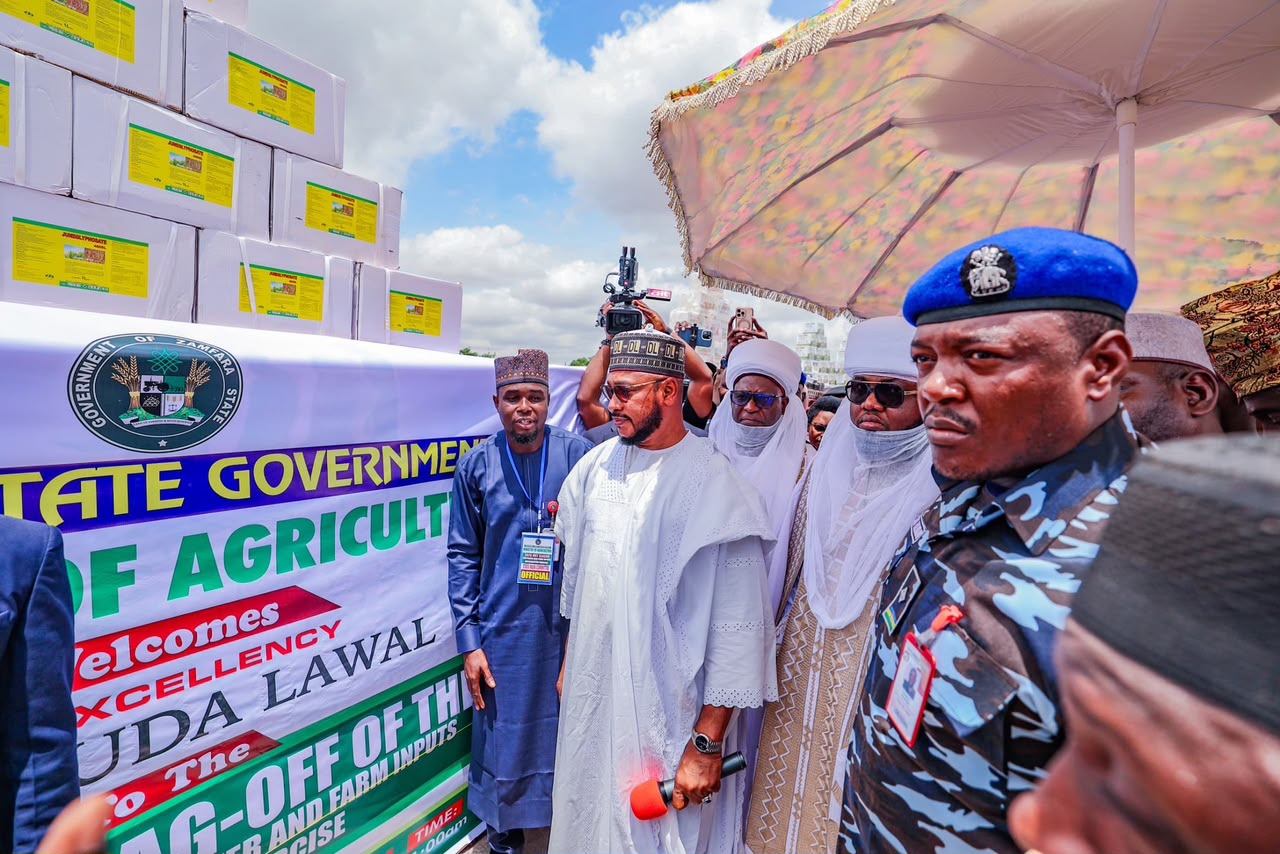
The Executive Governor of Zamfara State, Dr Dauda Lawal P.hD has launched a landmark agricultural intervention programme in Zamfara State with the distribution of over 120 truckloads of fertilisers and essential farm inputs to smallholder farmers across the state as part of preparations for the 2026 wet-season farming cycle.

The official flag-off ceremony was held yesterday Friday 11th of July at the Trade Fair Complex in Gusau, the state capital, drawing a large turnout of farmers, traditional rulers, agricultural extension workers and government officials who gathered to witness what the governor described as a turning point in the state’s quest for food security and self-sufficiency.
The comprehensive package distributed to farmers includes 72,000 bags of high-quality fertiliser, 200,000 litres of herbicides to combat weeds and pests, 100 crop residue crushers to help farmers prepare their land more efficiently, 100 grass choppers for livestock feed production, 100 feed milling machines to support animal nutrition, improved pasture seeds aimed at boosting livestock farming, 20 motorcycles to enhance the mobility of agricultural extension agents and 20 mobile phones designated for those same agents to facilitate real-time communication and data collection in the field. The distribution is structured to ensure equitable access across the state, covering all 147 political wards spread across Zamfara’s 14 Local Government Areas. Each ward is receiving 340 bags of fertiliser, while each Local Government Area is allocated 8,000 litres of herbicides, ensuring that no community is left behind in the intervention.
In his address to the gathering, Governor Lawal delivered a passionate speech about the central role of agriculture in Zamfara’s history, culture and economy. He reminded the audience that Zamfara State has long been recognised as one of Nigeria’s agricultural strongholds, blessed with vast, fertile land and a population of hardworking farmers whose livelihoods have for generations depended on the soil. He stressed that farming is not merely an economic activity but a fundamental part of the people’s identity, heritage and resilience and that it holds the key to inclusive growth, sustainable development and the fight against poverty, banditry and crime that have plagued the state in recent years. The governor articulated a clear vision of shifting Zamfara’s agricultural sector from subsistence-based practices to a productive, technology-driven and market-oriented system that can compete on a national scale. He outlined plans to unlock farmers’ potential through improved access to inputs, widespread mechanisation, expansion of irrigation schemes, robust extension services, adoption of climate-smart farming methods and the creation of strong market linkages that would guarantee fair prices for produce.
Governor Lawal also took the opportunity to highlight the improving security situation across the state, noting that as peace gradually returns to more communities, farmlands are being reopened, displaced families are returning to their homes and agricultural activities are resuming at an encouraging pace. He emphasised that his administration’s responsibility is to sustain and accelerate this progress by providing the necessary support, infrastructure and enabling environment for farmers to thrive. He pointed to the state government’s strengthened collaboration with the Federal Government, development partners and international organisations, citing the timely payment of counterpart funds as evidence of the administration’s commitment to ensuring that Zamfara fully benefits from critical agricultural interventions. He further reeled off a list of ongoing programmes that have already made a tangible difference, including FADAMA III, NG-CARES, SPIN, ZACADEP, SAPZ and various IFAD-supported initiatives, through which thousands of farmers have received improved seeds, fertilisers, agrochemicals, irrigation facilities, farming equipment and modern agricultural knowledge.
The governor further underscored the state’s push for mechanisation and private-sector investment by referencing the newly established Zamfara State Agriculture Hub in Kwatarkwashi, Bungudu Local Government Area, which he described as a concrete demonstration of the administration’s long-term vision. He called on farmers to make the best use of the inputs provided, assuring them that the government would continue to monitor the distribution process to prevent diversion or mismanagement. He concluded by reaffirming that his administration’s commitment to agricultural revival is backed not by empty promises but by deliberate, measurable action and that the ultimate goal is to reposition Zamfara State as a major contributor to Nigeria’s agricultural economy and a model for other states grappling with similar challenges. The event ended with farmers expressing gratitude and optimism, with many describing the intervention as the most comprehensive they had received in years, giving them renewed hope for a bountiful harvest in the coming season.


By Karen Ibrahim
When Governor Dauda Lawal spoke about infrastructure at the flag-off of one of his many road projects, he was extremely careful not to present road construction as an end in itself. His administration, he said, considers the development of urban and rural infrastructure a “development imperative”, with the broader objective of creating “a robust foundation for sustainable development and economic growth across all sectors.”For Governor Lawal cannot and should not be viewed through the prism of physical structures.
That emphasis is very significant in a state such as Zamfara State, where the infrastructure deficit has for years been a major constraint that has hampered development. Poor and inadequate road networks have left many communities poorly connected, limited access to markets, schools, healthcare facilities and other essential services. The deficit extends beyond roads to electricity, potable water, housing, healthcare and other basic public infrastructure. Indeed, the Zamfara State Government has acknowledged that the deterioration of infrastructure, and inadequate water supply were among the problems inherited by the administration.
For a largely agrarian state, terrible road networks means that farmers will struggle to move their produce to market; for a rural population, greater difficulty getting to a hospital or school; and for businesses, it can translate into higher costs of doing business, and fewer opportunities for investment. This explains why the Dauda Lawal’s administration is frontally addressing the infrastructure deficit.
It is against this background that Governor Lawal’s infrastructure agenda deserves commendation. From the construction and rehabilitation of roads linking towns and rural communities to investments in healthcare, education, water supply, housing and urban development, the administration has approached infrastructure as part of a broader strategy to reconnect communities, stimulate economic activity and create the foundation for sustainable growth. The task is substantial, but so too is the logic behind it: before Zamfara State can fully realise its agricultural, commercial and human-capital potential, it must first close the infrastructure gap that has constrained that potential for years.
The financial commitments provide an indication of the seriousness attached to the agenda by Governor Lawal.
In 2024, about N109 billion was allocated to Infrastructure and Urban Development out of a capital budget of N308.2 billion. In 2025, the Ministry of Works and Infrastructure received N108.81 billion, including N106.24 billion for capital expenditure. By 2026, the Citizens’ Budget put the allocation to infrastructure at about N195.58 billion. While the numbers matter, what matters more is what the spending is intended to achieve.
Road construction has naturally occupied the centre of the infrastructure agenda because roads remain the most immediate link between communities, markets and economic opportunities in the predominantly agrarian state.
Several of the projects are therefore significant not simply because of their length, but because of the various communities they connect. The 94-kilometre Yandoton Daji–Doka–Yan Waren Daji–Hayin Alhaji–Bedi–Yankuzo/Tsafe Road, for instance, is intended to improve connectivity across communities whose economic activities depend heavily on agriculture and local commerce.
Similarly, the 53-kilometre Jauri–Dogon Kade–Nassarawa Mai Layi–Nassarawa Godal Road opens another important corridor between the various communities. Other projects include the Birnin Zauma–Gummi/Bukkuyyum Road, Maradun–Makera Road, Zurmi–Rukudawa Road and the Lambar Asako–Asako Road, including the Asako Bridge.
The administration has also committed N5 billion in emergency road construction in each of the three senatorial zones.Taken together, these projects shows that it is not confined to the state capital. There is a deliberate attempt to address the connectivity gap between urban centres and rural communities.
A farmer experiences the benefits of good roads in the cost of taking his produce to the market, the reduction in time spent travelling, and the ease with which farm inputs can reach his community. That is why rural roads have economic significance.
The state capital, Gusau, has been the focus of township road construction, drainage and traffic infrastructure, alongside the development of a central motor park and beautification projects. The objective goes beyond making the city look better.
As the administrative and commercial centre of the state, Gusau accommodates a growing population and increasing commercial activity that entails the movement of people and goods from across the state. An urban infrastructure system that cannot keep pace with that volume of growth will eventually become a constraint on the economy itself.
Governor Lawal is not just constructing roads. He understands that roads without drainage will deteriorate faster, and that traffic congestion reduces productivity. This is why the Gusau urban renewal programme has been comprehensive.
The infrastructure agenda extends beyond roads.
The newly constructed international airport is perhaps the most ambitious expression of the administration’s desire to improve connectivity to the state. For a highly religious state such as Zamfara, however, the significance of the airport goes beyond economics and infrastructure. The sight and sound of pilgrims taking off from, and returning through, an airport within their own state carries a psychological and emotional significance that is difficult to quantify. For many residents, the airport represents the possibility of embarking on one of Islam’s most sacred journeys from their own doorstep rather than travelling to another state before beginning the journey. Beyond that symbolism, the airport is expected to improve access for investors and businesses, facilitate faster movement of people, strengthen Zamfara’s connection to national and international markets, and create better logistics for agriculture, livestock and other economic activities.
The same logic applies to water infrastructure. With more than N25 billion earmarked for the sector in the 2026 budget, the administration recognises that the development of towns and communities cannot be separated from access to reliable water supplies. Water infrastructure may not be as visible as a major road, but its importance to households, public health, agriculture and urban development is difficult to overstate. As Zamfara’s towns expand and population pressures increase, investment in the sector is therefore not merely about meeting today’s needs but about preparing the state for the demands of tomorrow.
Most often, discussions about infrastructure are treated as though it were separate from agriculture, commerce, security, or social development. In reality, the sectors are interconnected. Infrastructure does not and will not solve every problem by itself. But without it, solving them becomes considerably harder.
This is the philosophy behind Lawal’s approach. His administration has described the infrastructure programme not merely as construction activity but as part of an effort to create a conducive environment for businesses to thrive, improve security and establish the conditions for sustainable development.
Governor Dauda Lawal’s infrastructure agenda is therefore best understood not just as the construction of roads, bridges, drainage projects, water schemes and an airport, but as an attempt to lay the foundation upon which a more productive Zamfara State will stand. That is the significance of the governor’s description of infrastructure as a “development imperative”. It captures the central idea behind the programme: that economic growth cannot be sustained where communities remain disconnected, cities lack basic infrastructure, and the movement of people, goods and services is constrained.
Taken together, these projects suggest that the administration’s infrastructure agenda is not simply about building physical structures. It is about changing the conditions that have constrained Zamfara’s development for decades. A good road network will connect farmers to markets, reliable water will improve the quality of life in communities, modern public facilities can strengthen essential services, while the international airport has opened the state to greater movement of people, investment, and opportunity.
The scale of the infrastructure deficit means that the Lawal administration still has a considerable distance to cover, and that is not a problem considering his commitment to the project. But the significance of the current intervention lies in its direction and breadth. By committing substantial resources to infrastructure while linking those investments to agriculture, commerce, human capital and social development, the government is building not just projects, but the foundation upon which a more productive and connected Zamfara will emerge.
For a state that has spent years confronting the combined burdens of insecurity, poverty and underdevelopment, infrastructural development has changed the story. Roads that connect communities, water that reaches households, facilities that serve the people, and an airport that connects Zamfara to the wider world are more than symbols of government activity. They are investments in the possibility of a different future. That is the foundation of Dauda Lawal’s infrastructure agenda for Zamfara State.
Zamfara State Government under the leadership of Governor Dauda Lawal has earmarked N7.2 billion for development projects across 375 communities in the state, under the Nigeria Community Action for Resilience and Economic Stimulus (NG-CARES), a World Bank-funded initiative. Deputy Governor Mani Mummuni disclosed this in Gusau on Tuesday while flagging off a free project implementation training programme for participants drawn from 158 communities across the state.
He explained that Governor Dauda Lawal had approved the N7.2 billion for various community development projects through the State Community and Social Development Agency (CSDA), adding that the funds would finance projects spanning health, education, water supply, agriculture and drainage, among others, across the state’s 14 Local Government Areas. The deputy governor noted that the projects would be implemented by Community Project Monitoring Committees (CPMCs) under the supervision of the CSDA, and reiterated the state government’s commitment to providing social amenities to vulnerable communities.
Mummuni urged participants to ensure transparency and accountability in managing resources for project execution in their communities, describing the initiative as part of Governor Lawal’s administration’s effort to extend the dividends of democracy to the people, especially at the grassroots level. He expressed confidence that the training under CSDA would encourage community participation in project implementation, while also promoting transparency, accountability, and commitment to the development of their communities.
In his remarks, the General Manager of CSDA, Umar Nakwada, revealed that the participants were drawn from CPMCs responsible for monitoring projects in their communities, and that the training was designed to sensitise them on effective project implementation. He stated that the training covered Batch A projects worth N3.2 billion, spanning 158 communities, and assured that the agency would ensure effective monitoring of all projects to be implemented by CPMC members in benefiting communities. Nakwada also commended Governor Lawal for his unwavering support in improving the livelihoods of grassroots communities.
Also speaking, the State NG-CARES Coordinator, Mukhtar Ibrahim, praised the Zamfara Government for its commitment to supporting the livelihoods of vulnerable households. He explained that NG-CARES aims to expand access to livelihood support, food security services, and grants for poor and vulnerable households and firms, focusing on three result areas: livelihood and social support, food security and agricultural value chain, as well as micro and small enterprises recovery. small enterprises recovery,” Ibrahim said.
State development
Governor Dauda Lawal Reshuffles Cabinet, Harps on Strengthening Governance Efficiency
His Excellency, Dr. Dauda Lawal, Executive Governor of Zamfara State, has approved a minor cabinet reshuffle involving three Honourable Commissioners as part of ongoing efforts to strengthen governance and enhance service delivery across the State.
Announcing the development, the Secretary to the Zamfara State Government, Malam Abubakar Mohammad Nakwada, stated that the redeployment is aimed at strategically repositioning key Ministries for greater efficiency and effective implementation of the Administration’s Rescue Agenda.
The affected Commissioners are:
I. Hon. Abdulrahaman Tumbido, redeployed from the Ministry of Commerce and Industry to the Ministry of Environment and Natural Resources;
II. Hon. Kasimu Yahya Kaura, redeployed from the Ministry of Environment and Natural Resources to the Ministry of Youth and Sports Development; and
III. Hon. Tasiu Musa Shinkafi, redeployed from the Ministry of Youth and Sports Development to the Ministry of Commerce and Industry.
The redeployment takes immediate effect.
Governor Lawal has directed the affected Commissioners to ensure a smooth transition and complete all necessary handing-over processes within one week.
The Governor further charged them to bring renewed vigour, dedication, and innovation to their new assignments, while remaining focused on delivering tangible benefits to the people of Zamfara State in line with the objectives of the Rescue Agenda.
-
Politics3 years ago
13 Ondo Assembly Members Disown Endorsement of Aiyedatiwa
-
Politics2 years ago
APC Group, Ondo Govt, Quarrel Over Money for Endorsement
-

 Trending News5 years ago
Stop unsavoury, inciting statements – DSS warns
-

 Others5 years ago
Adron Homes Celebrates 10 Years Of Housing Excellence
-

 Humanity5 years ago
President Buhari Commiserates With Ambassador Maureen Tamuno Over The Loss Of Her Father
-

 Others7 years ago
EX- CUSTOMS BOSS, IBRAHIM MERA’S DWINDLING FAME
-

 Business2 years ago
Bigi Carbonated Soft Drinks Treats 40 Consumers to an Epic Easter Movie Hangout
-

 Business2 years ago
Wema Bank Shines at Global SME Finance Forum Conference Awards 2024 …Awarded: • SME Financier of the Year (Africa) • Platinum Award for Best Financier for Women Entrepreneurs (Africa)