
News
NYC Inaugurates Lagos Executives, Targets Fake Products

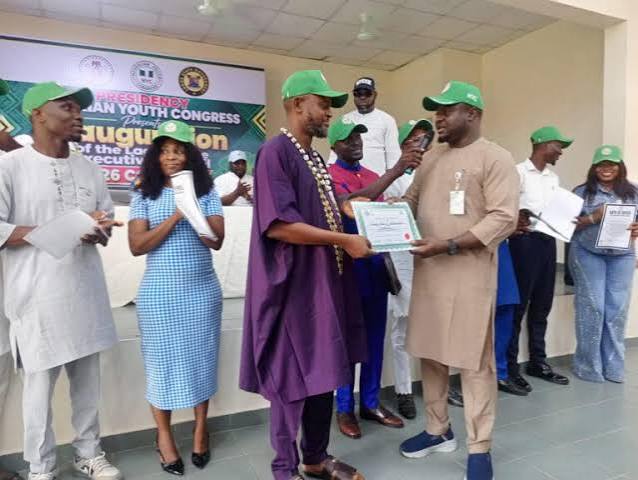
NYC Lagos executives pledge action against fake food, drugs and drinks, cultism and unemployment following the inauguration of the association’s new leaders
The Nigerian Youth Congress (NYC) has inaugurated its newly elected Lagos State executives in Festac Town, Amuwo-Odofin, Lagos, on Wednesday, November 11, 2026, announcing plans for a statewide sensitisation campaign against fake food products, counterfeit drugs and alcoholic drinks, alongside renewed efforts to tackle cultism, drug abuse, unemployment and insecurity among young people.
Also read:Court Forfeits 2 Mercedes-Benz Cars Linked to Fraudster

The inauguration took place during the organisation’s leadership and training summit, which brought together youth advocates, political representatives and stakeholders in security and community development.
The newly inaugurated Lagos chairman, Adebowale Alimi, said his administration would work with relevant regulatory agencies, particularly the National Agency for Food and Drug Administration and Control (NAFDAC) and the Standards Organisation of Nigeria (SON), to raise awareness about the dangers of counterfeit and substandard consumer products.
Alimi described the circulation of fake food, medicines and alcoholic drinks as a serious public health concern, warning that young Nigerians were particularly vulnerable to the consequences.
He said the proposed campaign would involve a statewide sensitisation walk designed to educate residents about identifying unsafe products and making informed purchasing decisions.
“We are going to stage this walk across Lagos State because young people are dying at ages when they should still be contributing to society,” Alimi said.
He added: “If you say the youths are the leaders of tomorrow, they must actually stay alive to become the leaders of tomorrow.”
The chairman identified the campaign as one of his administration’s immediate priorities, promising to organise the exercise within its first three to six months.
Alimi also acknowledged the challenges posed by cultism, describing education, vocational training and responsible parenting as important tools for preventing young people from becoming involved in criminal activities.
He urged parents to take an active role in guiding their children while encouraging young people to pursue education and acquire practical skills that could improve their employment prospects.
“Get educated because an educated environment is a safe environment. Violence does not add any value to anybody. It does not add any paycheque to your pocket,” he said.
He further called on young people to embrace vocational skills and entrepreneurship, arguing that practical abilities could create opportunities beyond conventional salaried employment.
According to him, the Lagos chapter would convene a meeting of its executive committee to develop practical strategies for addressing cultism and other social problems affecting communities across the state.
Alimi said youth organisations could encourage positive behaviour and discourage criminal activities, but government institutions and security agencies must take the leading responsibility in tackling organised crime.
The National President of NYC, Jethro Annum, also called for greater discipline, unity and responsible citizenship, stressing that the upbringing of young people should begin within the family.
Annum said the organisation was established to provide a unified platform for youth mobilisation, leadership development and engagement with government, particularly amid divisions and leadership disagreements within existing youth organisations.
He described the Lagos inauguration as more than a leadership ceremony, explaining that the accompanying training programme was designed to prepare young people for greater involvement in decision-making and public affairs.
“We are tired of being onlookers. We are participants now,” he declared.
Annum maintained that families, schools and society shared responsibility for raising responsible young Nigerians, adding that the Congress would complement these efforts through leadership training and public sensitisation.
He also disclosed that NYC had facilitated opportunities for more than 10,000 young Nigerians to participate in the Federal Government’s 3 Million Technical Talent (3MTT) programme.
The 3MTT initiative, launched in 2023 by the Federal Ministry of Communications, Innovation and Digital Economy, aims to develop a pool of three million technical professionals through training in areas such as software development, cybersecurity, artificial intelligence, data analysis and cloud computing.
The programme has continued to expand through partnerships with training organisations, development agencies and private-sector institutions.
Official figures published by the Federal Ministry in November 2026 indicated that more than 179,000 fellows had been trained across four cohorts and the DeepTech programme, while over 1.8 million Nigerians had registered on the platform.
Annum said the Congress intended to sustain its involvement in programmes that equip young people with relevant skills and improve their prospects in the changing labour market.
He also addressed concerns about public confidence in the organisation, insisting that credibility must come through consistent service, transparency and measurable achievements.
“Trust is not what you sell in the market. Trust is what you earn from the people,” he said.
He urged young Nigerians to examine the manifestoes of political aspirants ahead of the 2027 general elections and assess their commitment to youth development before offering support.
The national president also maintained that the Congress was not interested in competing with other youth organisations, arguing that its relevance should be determined by its performance and contributions to society.
At the gathering, Folorunsho Olusegun, an All Progressives Congress (APC) candidate for the Lagos State House of Assembly representing Amuwo-Odofin Constituency I, highlighted the economic difficulties facing young Nigerians and defended the Federal Government’s reform programme.
Olusegun expressed optimism that the reforms introduced by President Bola Tinubu would eventually produce economic benefits, although he acknowledged the temporary hardships associated with their implementation.
He also pointed to government allocations to states and local councils as providing opportunities for palliative interventions to cushion the effects of economic pressures.
On youth empowerment in Amuwo-Odofin, Olusegun said he had supported students financially, facilitated employment opportunities and assisted young people through various empowerment initiatives.
He also defended the performance of the Amuwo-Odofin Local Government administration, claiming that the council chairman had facilitated the construction of more than 13 roads within approximately 15 months in office.
According to Olusegun, the Lagos State Government had also taken over the construction of three additional roads in the area.
However, he acknowledged residents’ concerns about deteriorating infrastructure, including complaints by community groups such as Bring Back Festac.
He explained that he was still awaiting election into the state legislature and therefore did not yet hold an elective position through which he could directly implement constituency projects.
Olusegun nevertheless promised to pursue effective representation through lawmaking, oversight and constituency development if elected.
He also cautioned young Nigerians against drug abuse, cultism, cybercrime, online blackmail and the circulation of manipulated information, particularly as political activities gather momentum ahead of the 2027 elections.
The event ended with renewed commitments from the newly inaugurated executives to work with community leaders, government institutions and relevant agencies to address issues affecting young people.
For the Lagos chapter, the proposed campaign against fake food, drugs and alcoholic drinks is expected to be an early test of its ability to turn its promises into practical public engagement.
The success of the initiative will depend not only on the proposed awareness walk but also on sustained collaboration with regulatory authorities, effective public education and stronger efforts to ensure that unsafe products are identified and removed from circulation.
Also read:Court Forfeits 2 Mercedes-Benz Cars Linked to Fraudster
As the organisation begins its new leadership tenure, its wider challenge will be demonstrating that youth advocacy can translate into tangible improvements in public health, employment opportunities, security and participation in governance.


Balogun traders protest the disputed BBA election timetable, demanding a caretaker committee and a constitutionally approved process

Abia Town Unions awards recognise Sun MD Onuoha Ukeh and other prominent indigenes as the association launches a ₦500m Abia House project in Lagos

Kebbi government supports an IDP mother of triplets with relief materials as her newborn babies receive treatment for neonatal jaundice
-
Politics3 years ago
13 Ondo Assembly Members Disown Endorsement of Aiyedatiwa
-
Politics3 years ago
APC Group, Ondo Govt, Quarrel Over Money for Endorsement
-

 Trending News6 years ago
Stop unsavoury, inciting statements – DSS warns
-

 Others5 years ago
Adron Homes Celebrates 10 Years Of Housing Excellence
-

 Humanity5 years ago
President Buhari Commiserates With Ambassador Maureen Tamuno Over The Loss Of Her Father
-

 Others7 years ago
EX- CUSTOMS BOSS, IBRAHIM MERA’S DWINDLING FAME
-

 Business3 years ago
Bigi Carbonated Soft Drinks Treats 40 Consumers to an Epic Easter Movie Hangout
-

 Business2 years ago
Wema Bank Shines at Global SME Finance Forum Conference Awards 2024 …Awarded: • SME Financier of the Year (Africa) • Platinum Award for Best Financier for Women Entrepreneurs (Africa)