
World
Trump, Xi and Putin Sign Declaration Toward Peace

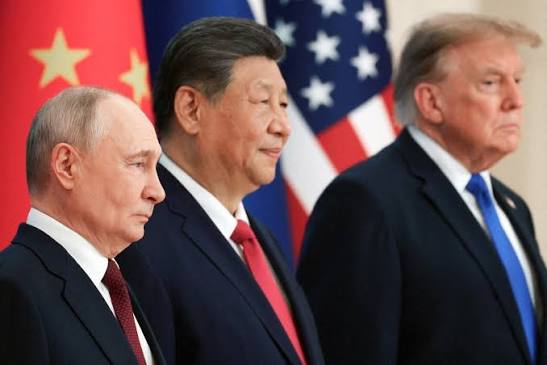
Trump, Xi and Putin issued a Declaration Toward Peace after their first trilateral summit, outlining plans on UN reform, nuclear risks and energy security.

United States President Donald Trump, Chinese President Xi Jinping and Russian President Vladimir Putin have issued a joint “Declaration Toward Peace” following an unprecedented trilateral summit in Shenzhen, China, outlining plans to pursue United Nations reforms, address nuclear risks and strengthen global energy security.
The declaration was released on Thursday, November 19, 2026, after the three leaders met at Kylin Villa on the sidelines of the Asia-Pacific Economic Cooperation (APEC) Summit.
Also read: ‘You Can’t Cut Our Light’: Residents Confront Electricity Workers
According to a statement attributed to the White House, the leaders exchanged views on international developments and committed themselves to maintaining strategic stability and international security.
“The three heads of state had an in-depth exchange of views on the current international situation and committed to maintaining strategic stability and international security,” the statement said.
The meeting, which lasted approximately one hour and 20 minutes, brought together the leaders of three major global powers against the backdrop of Russia’s ongoing war in Ukraine, tensions in the Middle East and growing competition over international influence.
Trump described the meeting as an opportunity to make history, while Putin said it had opened a new chapter in diplomatic relations.
Xi also said the three countries shared a common perspective on safeguarding global peace.
A major component of the declaration focused on reforming the United Nations to improve its ability to respond to international challenges and fulfil its responsibility for maintaining peace and security.
The leaders also addressed the International Criminal Court (ICC), stressing the importance of state consent and immunity for government officials.
They said international judicial institutions must not abuse their jurisdiction, a position that could attract further attention given the ICC arrest warrant against Putin and the Trump administration’s opposition to the court.
On energy cooperation, the three countries expressed support for strengthening the supply and production of refined petroleum products, while reaffirming the importance of stable energy flows.
The declaration also outlined plans for dialogue on reducing nuclear risks and preventing the spread of nuclear weapons.
The issue has gained renewed attention following the expiration of a major US-Russia nuclear arms control treaty in February 2026.
The summit also drew international attention because of its possible implications for the war in Ukraine.
European leaders expressed concern that discussions among Washington, Moscow and Beijing could influence the future of the conflict without sufficient involvement from Ukraine and its European partners.
German Chancellor Friedrich Merz reportedly dismissed the summit as a “photo op”, while French President Emmanuel Macron questioned whether it would lead to a major restructuring of international relations.
Trump, however, maintained that any agreement on Ukraine would involve Europe.
According to US special envoy Jared Kushner, the president wanted to pursue a deal with European countries alongside the United States.
The trilateral meeting followed separate engagements between the leaders.
Trump and Putin held talks for the first time since August 2025, while Trump and Xi also met privately.
Putin and Xi had held discussions a day earlier, marking what the Chinese president described as their 50th meeting.
The gathering has nevertheless raised questions about the balance of global power and whether closer cooperation among the three countries could influence decisions traditionally involving other nations.
Some critics warned that the summit could strengthen the positions of Moscow and Beijing while giving Trump limited diplomatic gains.
Senate Democratic leader Chuck Schumer criticised the engagement, saying: “Xi Jinping and Vladimir Putin are playing Donald Trump like a cheap violin.”
Also read: ‘You Can’t Cut Our Light’: Residents Confront Electricity Workers
Despite the concerns, the declaration signals an effort by the three governments to establish areas of cooperation on international security, energy and diplomatic reform, although its practical impact will depend on how the commitments are implemented.



Recent xenophobic protests in South Africa are having an economic impact, with some businesses struggling after foreign workers and traders left the country.
The situation has been particularly evident in Newcastle, KwaZulu-Natal, where clothing manufacturers have reported losing significant numbers of migrant workers following anti-immigrant protests. Factory owners say the departures have left some production lines short of workers and raised concerns about possible closures.
The protests were driven in part by demands that undocumented migrants leave South Africa, amid claims by anti-immigration groups that foreigners are taking jobs from South Africans. However, employers and labour analysts have disputed the idea that migrant workers can simply be replaced, pointing to skills shortages and the unattractiveness of some low-paid and physically demanding jobs to local workers.
Reuters reported that three clothing factories in Newcastle had lost between 12 and 19 per cent of their workforces during the protests. One factory owner warned that the combined effect of labour shortages and declining orders could push businesses towards closure.
The wider impact extends beyond factories. South Africa’s spaza-shop economy has also been affected, with many foreign-owned small businesses targeted during recent anti-migrant actions. The New Humanitarian reported that the country’s large network of spaza shops plays an important role in neighbourhood economies, providing employment and access to everyday goods.
The developments have created an uncomfortable economic reality: campaigns demanding the removal of foreign workers and business owners can also disrupt businesses and supply chains that rely on their labour and participation.
While reports of South Africans wanting foreign business owners and workers to return have circulated, the broader evidence is more nuanced. The economic difficulties are documented, but it would be misleading to suggest that South Africans as a whole are demanding the return of foreigners.
-
Politics3 years ago
13 Ondo Assembly Members Disown Endorsement of Aiyedatiwa
-
Politics3 years ago
APC Group, Ondo Govt, Quarrel Over Money for Endorsement
-

 Trending News6 years ago
Stop unsavoury, inciting statements – DSS warns
-

 Others5 years ago
Adron Homes Celebrates 10 Years Of Housing Excellence
-

 Humanity5 years ago
President Buhari Commiserates With Ambassador Maureen Tamuno Over The Loss Of Her Father
-

 Others7 years ago
EX- CUSTOMS BOSS, IBRAHIM MERA’S DWINDLING FAME
-

 Business3 years ago
Bigi Carbonated Soft Drinks Treats 40 Consumers to an Epic Easter Movie Hangout
-

 Business2 years ago
Wema Bank Shines at Global SME Finance Forum Conference Awards 2024 …Awarded: • SME Financier of the Year (Africa) • Platinum Award for Best Financier for Women Entrepreneurs (Africa)