
Education
FEC Approves Six-Year Moratorium on New Tertiary Institutions


FEC approves six-year moratorium on new tertiary institutions, recognises medical fellowships, and restores national literacy commission

The Federal Executive Council (FEC) on Wednesday approved a six-year moratorium on the establishment of new tertiary institutions, while recognising medical fellowships as equivalent to doctoral degrees and restoring the National Commission for Mass Literacy, Adult and Non-Formal Education as an independent body.
Also read: Kebbi Governor warns against false security reports affecting investment
Briefing journalists after the FEC meeting, Minister of Education Dr Tunji Alausa explained that the moratorium on universities, polytechnics, and colleges of education aims to improve quality and sustainability, particularly in private institutions.
“Today, access is not easy in the country. We have lots of tertiary institutions, both public and private, but we need to help these private institutions become financially sustainable,” Alausa said.
He cited data from the Joint Admissions and Matriculation Board showing that more than 2.3 million candidates applied for university admission last year, while public institutions had fewer than 228,000 available spaces.
The minister emphasised that the pause will enable the government to strengthen existing institutions and enhance educational standards nationwide.
“I am committed to ensuring that every single child and citizen of this country receives the highest quality of education comparable to anywhere in the world,” he added.
On the restoration of the National Commission for Mass Literacy, Adult and Non-Formal Education, Alausa said the move is part of the administration’s plan to address Nigeria’s literacy challenges and equip citizens with digital and basic education skills.
“In view of Mr President’s expansive agenda to educate over 50 million young adults in the next two to three years and make them digitally literate, we sought the approval of the council to revert it back to a commission,” he said.
The minister also confirmed that FEC approved amendments to the National Postgraduate Medical College Act to recognise medical fellowship qualifications as equivalent to PhD degrees.
He noted that doctors often spend over a decade in medical training, residency, and fellowship programmes but still require a PhD for professorial appointments, a situation the reform aims to harmonise.
Also read: NigeriaNa’Allah Urges APC to Convincens Beyond Defections
Alausa added that comprehensive insurance coverage was approved for the country’s 180 Federal Unity Schools, further reflecting the administration’s commitment to raising standards across Nigeria’s education sector.


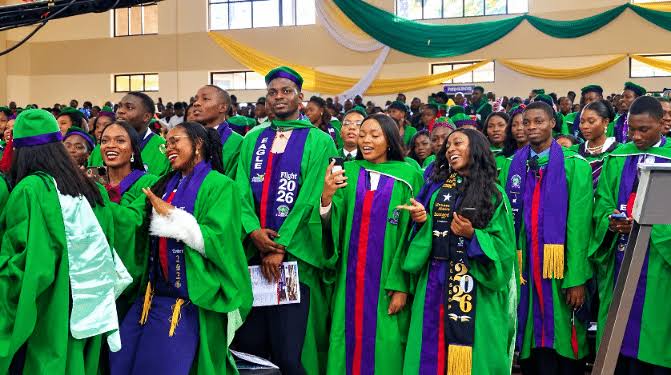
Covenant University produced 371 First-Class graduates among 1,843 students at its 2026 convocation, with Etta Queendolin topping the class

UK student visa financial requirements will rise from November 30, 2026, increasing the living-cost funds international students must show
The United Kingdom will increase the minimum living-cost funds international students must demonstrate when applying for student visas from November 30, 2026, requiring applicants studying in London to show access to at least £14,130 for a course lasting nine months or longer.
Also read:2027 Polls: NSCDC Chief Charges Officers on Professional Conduct
The revised requirements, introduced by the UK Home Office, will affect prospective students from Nigeria and other countries who plan to study at British universities.
The maintenance funds are separate from tuition fees and other visa-related charges.
Under the new rules, students studying in London will need to demonstrate access to £1,570 per month, up from the current £1,529.
For courses lasting nine months or longer, the maximum maintenance requirement will increase from £13,761 to £14,130, a rise of £369.
Students attending institutions outside London will also face higher thresholds.
Their required monthly living allowance will increase from £1,171 to £1,203, while the maximum amount for a nine-month course will rise from £10,539 to £10,827, an increase of £288.
The maintenance requirement is intended to demonstrate that applicants have enough money to support themselves during their studies. It does not cover tuition fees, which students must budget for separately.
Applicants must also account for the student visa application fee and the Immigration Health Surcharge, which generally provides access to the UK’s National Health Service under the applicable rules.
The changes mean Nigerian students preparing to apply for UK study visas will need to review their budgets and ensure they meet the relevant financial threshold based on where their university is located.
They must also provide acceptable evidence that the required funds are available.
International students remain an important part of the UK’s higher education sector.
Figures cited in the report put international enrolment at approximately 685,565 students during the 2024/2025 academic year, representing about 24 per cent of the total student population.
Of that number, around 622,000 students came from outside the European Union, while approximately 63,600 were from EU countries.
Professor Padam Simkhada, Dean of Global Impact and Research at the University of Chester, was cited as saying international students contributed approximately £41.9 billion to the UK economy during the 2021/2022 academic year.
However, international students continue to face financial pressures linked to accommodation costs, employment limitations and restrictions on working hours.
Also read:2027 Polls: NSCDC Chief Charges Officers on Professional Conduct
With the revised thresholds due to take effect on November 30, prospective students will need to factor the increased maintenance requirements into their study plans alongside tuition fees, visa charges and healthcare costs.
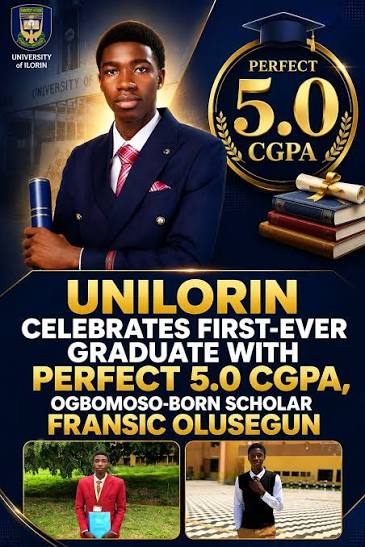
Francis Olusegun graduates as UNILORIN’s best student with a perfect 5.00 CGPA, crediting consistency, self-belief and support from others
University of Ilorin Mathematics graduate Francis Olusegun has emerged as the institution’s best graduating student for the 2025/2026 academic session, earning a perfect 5.00 Cumulative Grade Point Average (CGPA).
Also read: Deadly Nigeria Floods Kill 245, Displace 214,997
In an interview published by the Union of Campus Journalists, University of Ilorin, Olusegun attributed his achievement to self-belief, consistency and adaptability.
He said his first-year results convinced him that graduating with a perfect score was possible.
“I began to imagine graduating with a 5.00 CGPA after seeing my 100-level results. That was when the thought came to me that we could actually break the record,” he said.
Olusegun said becoming the overall best graduating student had been a personal ambition long before he set his sights on a perfect CGPA.
“I had set that goal for myself and believed that if I worked hard, I could achieve it,” he added.
Olusegun said he remained flexible with his study routine rather than follow a rigid timetable.
He revised lessons on the day they were taught, researched difficult concepts and used available tools to improve his understanding.
“Maintaining a perfect CGPA is not easy, but the first thing is that I had already won in my mind,” he said.
He also monitored his test scores closely because continuous assessment contributes to final grades.
He aimed to score above 70 per cent, giving himself a margin ahead of examinations.
His interest in Mathematics, which began in primary school, helped sustain his commitment to the subject.
“I have always enjoyed solving mathematical problems,” he said. “There is a connection between me and Mathematics, and that made it easy for me to choose it.”
The achievement comes as UNILORIN holds its 41st convocation ceremony for the 2025/2026 academic session.
Vice-Chancellor Professor Wahab Egbewole, SAN, said 16,152 graduands would receive degrees and other qualifications, including 365 students who earned first-class honours.
The ceremony was scheduled for October 21 to 23.
Olusegun acknowledged that social media sometimes distracted him, prompting him to step away from it when he needed to concentrate.
He said he also limited activities that did not align with his long-term ambitions.
One of his most difficult experiences came in his first year, when his phone became faulty and could not be repaired before his first-semester examinations.
A friend lent him another phone, allowing him to continue reading and practising.
Financial difficulties also affected his university experience.
Olusegun said he asked for help when he could not afford necessities, including food, rather than allow his circumstances to prevent him from pursuing his goals.
He said his parents were not educated and did not constantly push him academically, so much of his motivation came from within.
“My parents are not educated, so I cannot say that somebody was constantly pushing me academically. I pushed myself because I knew what I wanted to achieve,” he said.
He credited his parents, church members, friends and former students of his department with providing financial assistance, encouragement and academic guidance throughout his studies.
Olusegun described his perfect CGPA as a personal milestone and a starting point for further academic work.
He said he had consistently been the best graduating student from primary school through university and was the first person in his immediate family to earn a first-class degree.
He is considering pursuing a master’s degree or proceeding directly to a PhD, with research as his main priority.
“My next step is to further my education, either by pursuing a master’s degree or going directly for a PhD. I am interested in research, so that is the direction I want to explore,” he said.
His interests include mathematical biology and the use of mathematical models to understand and forecast infectious diseases.
He hopes such models can help public health agencies analyse disease patterns and allocate resources more effectively.
Also read: Deadly Nigeria Floods Kill 245, Displace 214,997
Olusegun also wants to explore how Mathematics and artificial intelligence can be combined to address public health and epidemiological challenges.
-
Politics3 years ago
13 Ondo Assembly Members Disown Endorsement of Aiyedatiwa
-
Politics3 years ago
APC Group, Ondo Govt, Quarrel Over Money for Endorsement
-

 Trending News6 years ago
Stop unsavoury, inciting statements – DSS warns
-

 Others5 years ago
Adron Homes Celebrates 10 Years Of Housing Excellence
-

 Humanity5 years ago
President Buhari Commiserates With Ambassador Maureen Tamuno Over The Loss Of Her Father
-

 Others7 years ago
EX- CUSTOMS BOSS, IBRAHIM MERA’S DWINDLING FAME
-

 Business3 years ago
Bigi Carbonated Soft Drinks Treats 40 Consumers to an Epic Easter Movie Hangout
-

 Business2 years ago
Wema Bank Shines at Global SME Finance Forum Conference Awards 2024 …Awarded: • SME Financier of the Year (Africa) • Platinum Award for Best Financier for Women Entrepreneurs (Africa)