
Opinion
Aftermath of Fubara’s declaration: why a guber bid remains unlikely


An analysis suggests Governor Siminalayi Fubara’s possible 2027 governorship ambition faces political, legal and structural challenges in Rivers State
Kayode Adebiyi

The political atmosphere in Rivers State has once again been stirred following the recent press release by Governor Siminalayi Fubara, in which he reportedly clarified that he is not participating in the APC governorship primary ahead of the 2027 election.
Also read: Roy Murray-Bruce Named Chairman of Silverbird Group
Expectedly, the development has triggered a wave of reactions among political observers and supporters. Some, driven more by emotion than political realism, have already begun speculating that Governor Fubara may eventually defect to another political platform, including fringe or emerging parties, to pursue a governorship ambition in 2027.
But such assumptions appear more emotional than strategic.
Anyone who has carefully observed Governor Fubara’s antecedents, disposition, and political conduct would understand why such a move remains highly improbable.
This is not to diminish his intellectual capacity or professional accomplishments. By every indication, Governor Fubara appears to be a brilliant, chartered accountant whose rise through the civil service reflects competence, discipline, and administrative excellence. His educational background and career trajectory speak for themselves.
However, excellence in bureaucracy does not automatically translate into political dexterity.
Fubara’s natural makeup appears more aligned with the world he occupied before politics thrust him into executive leadership: a highly educated, career driven technocrat who rose through an organised bureaucratic structure to become the Rivers State Accountant-General through diligence and competence and would ordinarily retire quietly and honourably after distinguished service.
There is absolutely nothing wrong with that.
But it also says something important about political temperament.
Politics, particularly Rivers politics, is not the civil service. It is not governed merely by procedure, technical expertise, or professional competence.
It is a jungle of competing interests, shifting alliances, betrayals, power calculations, and survival instincts.
It demands tactical patience, emotional restraint, strategic thinking, and, above all, an understanding that power is rarely exercised emotionally.
This is precisely why the suggestion that Governor Fubara would independently leave for another political party and mount a fierce governorship battle in 2027 appears farfetched.
But even beyond questions of political temperament, there is now a significant legal and procedural hurdle: the Electoral Act 2026.
The new electoral framework has substantially narrowed the pathway for opportunistic political defections and last-minute political realignments.
Political parties are now required to submit membership registers to INEC well ahead of their primaries, and only individuals whose names appear in those registers can validly participate as aspirants.
In practical terms, the old political culture where a politician simply loses out in one platform and suddenly migrates to another to secure an election ticket has become considerably more difficult.
This means that even if Governor Fubara were hypothetically inclined to pursue a governorship ambition through another platform, the legal pathway is no longer as flexible as it once was. Timing, party membership, compliance with INEC regulations, and pre-established political structures now matter far more than before.
Yet even this legal reality is only part of the story.
The deeper issue remains political disposition.
The stakes in Rivers politics are extraordinarily high. It is not a terrain for reluctant combatants or political idealists. It rewards organisation, resilience, tactical aggression, and the ability to survive prolonged political warfare.
And if there is one thing recent history has shown, it is that Governor Fubara does not appear naturally wired for that kind of politics.
It is difficult to forget that barely six months into office, he openly found himself in conflict with the very political establishment that produced him, including the Rivers State House of Assembly and the power bloc that facilitated his emergence.
For those who understand the laws of power, this development was always curious.
Political history teaches that a governor handpicked by an entrenched political structure must tread carefully, dine with a long spoon, consolidate quietly, and, most importantly, secure political survival by securing his second term ticket before attempting to assert full independence. Timing, in politics, is often just as important as ambition.
Yet Governor Fubara appeared to move against entrenched interests almost immediately he got into office.
To some, this reflected courage and principle.
To others, it exposed an incomplete understanding of how power is acquired, managed, preserved, and strategically deployed within deeply structured political systems.
That distinction matters.
Because the same political instincts required to survive a confrontation with an established power bloc are the same instincts needed to independently build a political structure strong enough to contest and win a governorship election in Rivers State without the backing of a formidable political machine.
That is no easy task.
Rivers politics is not for the faint hearted. It is not won by sentiment. It is sustained through strategic alliances, political endurance, and calculated patience.
From all indications, Governor Fubara appears more suited to structured governance than the brutal, unpredictable realities of survival politics.
Again, this should not be mistaken for an attack on his intelligence or competence. Not every effective administrator is necessarily built for the rough edges of power politics.
Some people excel within organised institutions. Others thrive in political combat.
They are not always the same thing.
Which is why the idea that Governor Fubara would suddenly emerge as an independent political war general under another smaller platform in 2027 appears, at least for now, highly unlikely.
In Rivers politics, ambition alone is never enough.
Disposition matters. Timing matters. Structure matters.
Also read: Roy Murray-Bruce Named Chairman of Silverbird Group
And above all, political instinct matters.


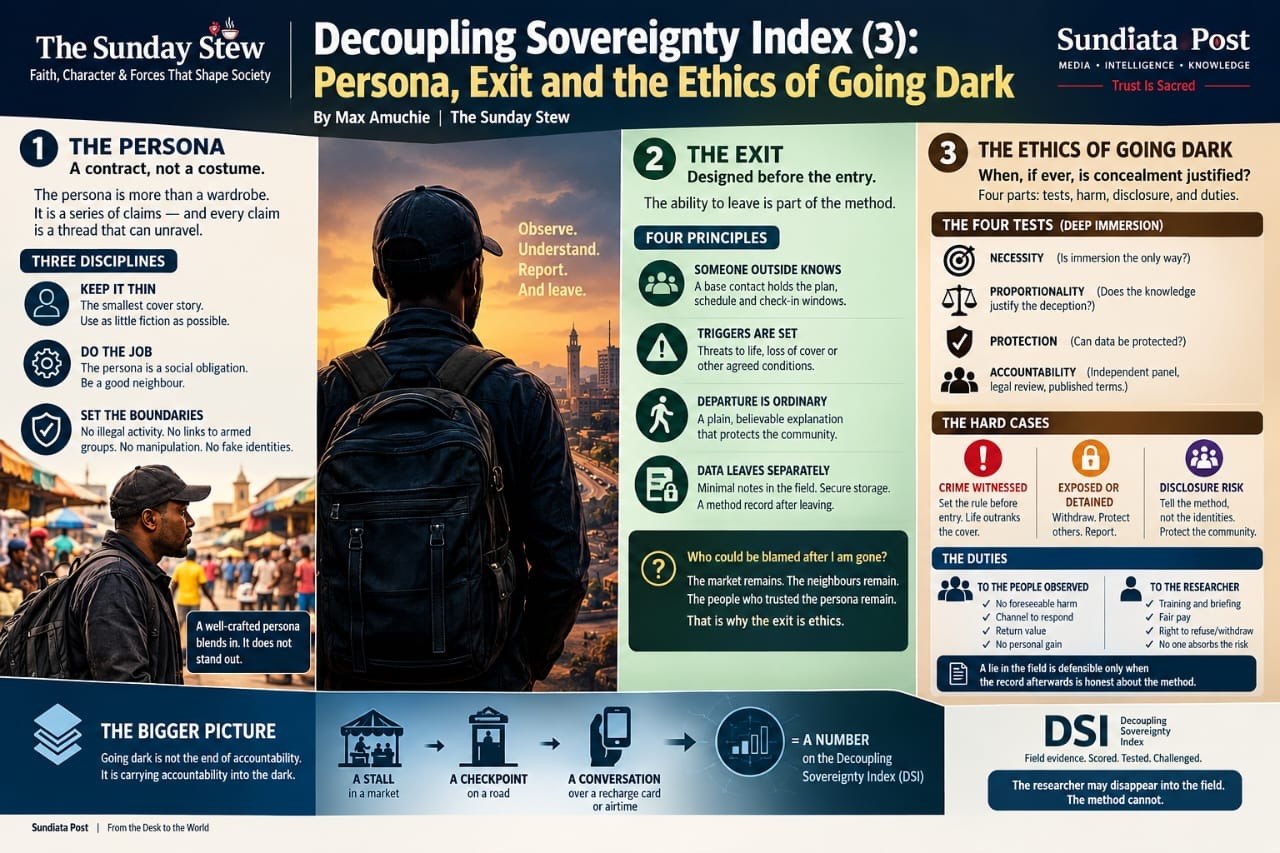
In the latest instalment of his Decoupling Sovereignty Index series, Max Amuchie examines the ethical obligations that arise when researchers adopt temporary identities to study decoupled zones.
Writing in The Sunday Stew, the Sundiata Post CEO and theorist argues that any methodology requiring a researcher to live under a borrowed role creates three unavoidable duties: the role must be disciplined, the researcher must be able to leave, and the deception must be ethically justified.
Amuchie treats the persona as a contract rather than a costume. He advises keeping the cover story thin, performing the assumed job properly, and setting clear boundaries before entering the field. These boundaries include never participating in illegal activity, never passing information to armed groups, never manipulating relationships solely to extract information, and never assuming the identity of a real person.
He stresses that the exit must be designed before entry. At the Sundiata Post Knowledge Lab, no researcher enters a zone until the exit plan is written down. This includes external check-ins, pre-agreed triggers for withdrawal, an ordinary departure story, and separating data from the person so that the community is not exposed after the researcher leaves.
On the ethics of “going dark,” Amuchie applies four tests: necessity, proportionality, protection and accountability. Immersion is justified only when remote or rapid methods cannot answer the research question.
The knowledge gained must outweigh the deception, and no observed person should face foreseeable harm. An independent panel must review and can veto any covert plan.
He addresses three hard cases: what to do if the researcher witnesses a crime, what happens if the persona is exposed, and how to disclose the method without endangering people. Life outranks the cover. Where imminent danger exists, the researcher must warn or withdraw even if it ends the assignment.
Amuchie insists that the duty runs both ways. The people observed must not pay a price for the findings, and the researcher must be trained, fairly paid and free to refuse or withdraw without penalty.
The column concludes that a lie in the field is defensible only when the later account is fully honest about the method. The people may be protected; the method may not.
Part 4 of the series will examine how field evidence is translated into scores on the Decoupling Sovereignty Index.

By Seun Oloketuyi
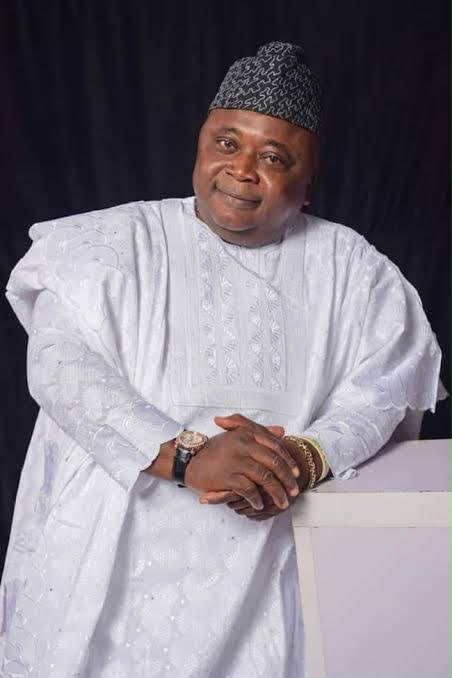
The omission of Ladi Adebutu and his running mate, Yemi Sowunmi-Kolapo, from the Independent National Electoral Commission’s (INEC) list for the 2027 Ogun State governorship election may have raised concerns within the Peoples Democratic Party (PDP), but there are reasons the party remains confident that its candidate can still make the list.
At the centre of the dispute is Adebutu’s membership registration. His camp maintains that he completed the PDP’s digital registration, had his membership card printed and verified, and fulfilled the necessary requirements within the stipulated period. The Ogun PDP has also insisted that his name was included in the membership register submitted to INEC.
If the party can back these claims with verifiable records, it will have a strong basis to challenge the omission and ask the commission to reconsider its decision.
Another point in Adebutu’s favour is that INEC officials monitored the PDP governorship primary held on September 27, 2026, where he emerged as the party’s candidate. While monitoring the primary does not automatically settle the separate membership register issue, it forms part of the process that produced the PDP ticket.
INEC has explained that the omission of affected candidates is linked to compliance with membership register requirements under the Electoral Act 2026. The Supreme Court upheld the relevant provisions in its September 24 judgment. The law must be respected, but the facts surrounding each disputed case must also be properly examined.
The PDP has an opportunity to notify INEC of the omission and present supporting documents before the October 24, 2026 deadline. This gives the party a chance to demonstrate that it complied with the requirements and that Adebutu’s exclusion should be reviewed.
For Adebutu, the key is proving that his registration and the party’s submission of its membership register met the law. If the documents support the PDP’s position, INEC would have grounds to reconsider the omission in accordance with the law.
The issue also matters to Ogun voters, who deserve a fair opportunity to choose among candidates who meet the electoral requirements. Adebutu’s supporters believe he should have the opportunity to contest if he has fulfilled the conditions set by law.
Ultimately, political reactions will not decide this matter; the evidence will. The PDP must present its records, and INEC must assess them fairly.
Adebutu’s return to the list is not yet confirmed, but the case is far from over. If the PDP can prove that the requirements were met and his omission was unjustified, there is a strong basis for his name to be restored to INEC’s list.
Seun oloketuyi Author of How to Win Elections in Nigeria writes from Lagos.


On the 2nd of October, 2026, an XEJet aircraft lifted off from Abuja and touched down at Gusau International Airport. For the people of Zamfara, that moment had been thirty years in the making.
Also read: Governor Dauda Lawal Announces Nationwide Nutrition Emergency, National Intervention Fund at Addis Ababa Summit
This was no ordinary commercial flight launch; for a northwestern state that had never had an airport since its creation in 1996, it was long overdue.
While many still lazily define Zamfara as a den of kidnappers, Governor Dauda Lawal has spent most of three years pouring concrete into a runway that tells a different story.
Before Gusau International Airport existed, anyone in Zamfara needing to fly had to endure hours on the road to Sokoto or Kano.
For Muslims embarking on the Hajj pilgrimage to Saudi Arabia, that overland journey was itself an ordeal.
For a state blessed with agricultural riches and mineral potential, the absence of an air corridor meant investors looked elsewhere, farm produce could not efficiently reach external markets and the movement of talent was shackled by sheer distance.
This isolation was not natural. It was the product of decades of governance failure.
A previous administration had announced the airport’s construction in 2019, claiming a $1 billion public-private partnership would deliver it.
By the time Lawal took office in May 2023, what remained was a graveyard of unfinished concrete and a financial record clouded in opacity.
Governor Lawal inherited not just an abandoned project but a treasury hollowed out by years of mismanagement and lack of foresight.
In June 2024, construction restarted and by March 2026, a Federal Government Bombardier Challenger 605 completed a historic test flight at Gusau International Airport, confirming that the runway, navigation aids and ground handling systems met airworthiness standards which was met with commendation from the aviation industry players.
It was a timeline compressed to its limits. In Nigeria, a state-level airport project typically takes years, sometimes over a decade, from conception to operation.
Lawal’s team did it in under two years of hard work. More significant is the technical validation.
Official records show Gusau International Airport became the only airport in Nigeria to pass all 17 International Civil Aviation Organisation quality assurance steps.
That detail may escape the average traveller but it means this is not a vanity project dressed up for ribbon-cutting photographs. It is infrastructure built to international specifications.
On the 15th of May, 2026, the first Hajj flight departed from Gusau, carrying 415 pilgrims on a Max Air aircraft directly to Saudi Arabia.
At the inaugural ceremony, Lawal said many people doubted whether this could become a reality.
That sentence captured the story of a state that had been underestimated for far too long, finally proving its doubters wrong.
Critics asked, does a state with stubbornly high poverty rates really need an international airport?
That question ignores the most basic causal relationship between infrastructure and economic development. Zamfara’s agricultural potential has been strangled by transport bottlenecks for decades.
The state produces hibiscus, sesame seeds, groundnut seeds, cotton seeds, Sorghum (Guinea Corn) & Millet precisely the commodities in high demand in international markets.
But without air cargo links and efficient logistics, farmers sell raw materials cheaply to middlemen while the bulk of the profit flows elsewhere.
Lawal with an investment banker background understands that what he is building is not just an airport but an ecosystem.
On the 21st of September, 2026, the Zamfara State Government signed an air route development agreement with XEJet, establishing regular commercial flights between Gusau and Abuja, operating Bi-weekly.
On the 2nd of October, 2026, two days after commercial flights began, he flagged off a 95-kilometre road project in Tsafe Local Government Area.
The road, connecting farming communities like Yandoton Daji, Cediya and Doka, includes five bridges. Its purpose is unambiguous; let farm produce out, let security forces in.
“When roads connecting farmlands are motorable, the heavy machinery we procured can reach the fields,” Lawal said at the groundbreaking. “After harvest, agricultural produce can move smoothly to markets.” Governor Lawal Said.
This is not an isolated project; it’s a coherent chain, the airport opens external gateways, the roads open internal circulation and together they transform the deadlock of “farmers can grow but cannot sell” into a living economy where produce moves, markets expand and money stays in local pockets.
On the surface, this is a simple route. Symbolically, it is a rupture. It means Gusau is no longer a dot on the map that requires a gruelling journey to reach. It is a destination accessible from the capital in about an hour.
For investors, the decision cost of travelling to Gusau drops from a full day on the road to a short 40-minute flight from Abuja.
For civil servants, traders, students and patients, this route redraws the boundaries of what is possible in daily life.
The airport terminal offers free internet access. Lawal’s team clearly intends for Gusau to be connected not only physically to the national grid of transportation but digitally to the networks of the knowledge economy.
In a state seeking to nurture IT talent and attract tech-enabled businesses, connectivity is not a luxury; it is the foundation.
What the airport represents is a shift in trajectory a proof that Zamfara can conceive, execute and complete a project of national significance within a single political term.
In years to come, when Zamfara farmers are exporting hibiscus, sesame and other agricultural produce directly to buyers in Europe and the Middle East, when investors are flying in for meetings rather than avoiding the state altogether, when a young person from Gusau can board a flight to Abuja for a job interview and return the same day, the true value of this airport will become apparent.
Starting and finishing a project of that magnitude in under three years is the mark of a government serious about development at every level.
Governor Lawal deserves the accolades. More importantly, the people of Zamfara deserve the future this runway has opened for them.
Also read: Governor Dauda Lawal Announces Nationwide Nutrition Emergency, National Intervention Fund at Addis Ababa Summit
The rescue mission is not complete; the planes are flying, for a state that spent three decades grounded, this development is nothing short of a revolution.
-
Politics3 years ago
13 Ondo Assembly Members Disown Endorsement of Aiyedatiwa
-
Politics3 years ago
APC Group, Ondo Govt, Quarrel Over Money for Endorsement
-

 Trending News5 years ago
Stop unsavoury, inciting statements – DSS warns
-

 Others5 years ago
Adron Homes Celebrates 10 Years Of Housing Excellence
-

 Humanity5 years ago
President Buhari Commiserates With Ambassador Maureen Tamuno Over The Loss Of Her Father
-

 Others7 years ago
EX- CUSTOMS BOSS, IBRAHIM MERA’S DWINDLING FAME
-

 Business2 years ago
Bigi Carbonated Soft Drinks Treats 40 Consumers to an Epic Easter Movie Hangout
-

 Business2 years ago
Wema Bank Shines at Global SME Finance Forum Conference Awards 2024 …Awarded: • SME Financier of the Year (Africa) • Platinum Award for Best Financier for Women Entrepreneurs (Africa)