
Politics
Race For APC Chairmanship, Not A Do Or Die Affair Says Sen. Akume


Senator George Akume, the Minister of Special Duties and Inter-Governmental Affairs says the race for All Progressives Congress (APC) Chairmanship should not be seen as a do-or-die affair by contenders.

Akume, a former governor of Benue said this on Thursday in Abuja when he received members of Middlebelt Youth Vanguard who paid him a courtesy visit.
He said that his major concern was for the position to be zoned to the North-Central.
“We are still going on with our state congresses, after that it will be the National Convention. Our prayer is that let this position be zoned to the North-Central.
“I have not declared, but after appropriate consultations and the zoning, we will do the needful. When that occasion arises I will be depending on you. Whoever gets your support is close to getting the victory.
“Also in our zone, we are all committed that whoever emerges will get the support of all of us. It is not a do-or-die affair,” Akume said.
He said that the President Muhammadu Buhari-led Federal Government was committed to youth’s development as demonstrated in the signing of the Not-Too-Young-To-Run Act.
He added that this was also demonstrated in other youths focused programmes being implemented by the administration.
“No nation toils with the destiny of its youths,” Akume said.
Race For APC Chairmanship, Not A Do Or Die Affair Says Sen. Akume
The minister said that the administration was committed to the development of the country through infrastructure especially road and rail projects.
He noted that in spite of obvious challenges, the country has done well under the Buhari-led administration, saying that what was needed was the support of Nigerians for it to do more.
Akume thanked the group for the visit and urged members to continue to use the platform to pursue things that unite the region and Nigeria, rather than things that sought to create division in the country.
He advised Nigerian youths to continue to project things that unite the country, which he said were many, stressing, “We are better off as one untied and indivisible nation.”
Earlier, Mr Prince Miaphen, the President of the group, disclosed that Akume has been endorsed as the preferred candidate of the group for the position of APC national chairman.
He said the group endorsed him at the last Executive Council meeting in Plateau because he stood out among other aspirants.
“We are here today to tell you that the Middlebelt Youth Vanguard is adopting you as our candidate for APC national chairman 2021.
“Haven considered the characters and positions of all aspirants from the North-Central and other geo-political zones, we said it would be proper and most appropriate for us to zero-in on one person that will better represent us as a region.
“And the person that has the connection beyond the region that can deliver for APC in the 2023 general elections is Akume.
“This was supported by further nominations and confirmations across virtually the entire North-Central, so we arrived at a consensus that not only should we adopt you, but to also canvas support for you,” he said.
He added that the group would embark on a campaign especially in the North and South to draw support for Akume to ensure that he emerged as the APC national chairman.
The group also appointed Akume as its grand patron to replace former Deputy Senate President, Ibrahim Mantu, who died recently.


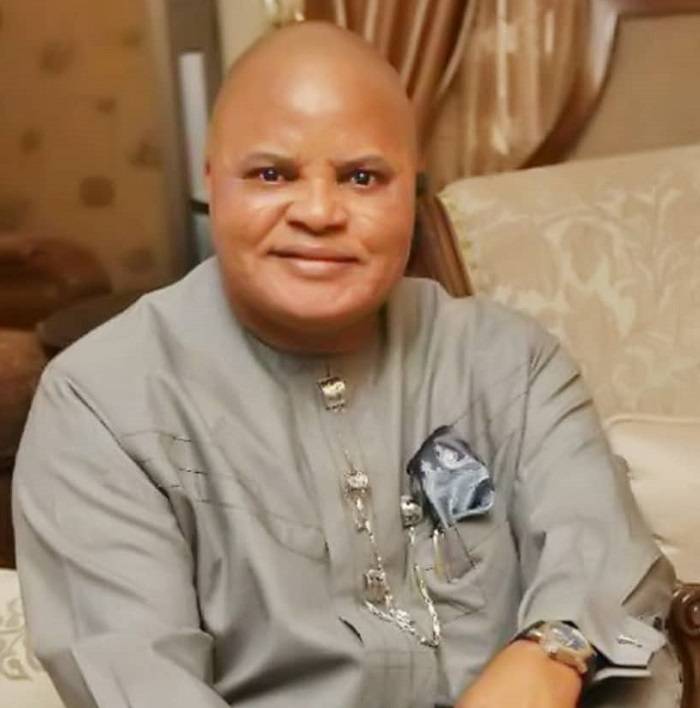
A group, the Imo First Group (IFG) has described the purported Magistrate court order to arrest Senator Ifeanyi Araraume and the former governor of Imo State, Rochas Okorocha, over alleged criminal conspiracy and forgery, as a ruse and fake news
The group stated this in a statement issued on Saturday in Abuja.
IFG challenged those peddling the fake news to make the court order public.
The statement reads ” The fabricated and concocted story was first posted on social media by Hon. Ambrose Nwaogwugwu, a media aide to Governor Hope Uzodimma, before it was picked up by other media outfits, including Arise TV.
According to the statement, those behind the report claimed that a Senior Magistrate Court sitting in Abuja issued a Bench Warrant dated September 9, 2026, following a petition written by the Resident Electoral Commissioner (REC) in Imo State, Barr. Chukwuemeka Ibejiako, to the Police and DSS on October 8, 2026, over alleged presentation of fake APC primary results.
The Group debunked the existence of any such order.
“We want to state categorically and unequivocally that no jSenior Magistrate ordered or issued any bench warrant for the arrest of Araraume”
IFG however challenged anyone in possession of the purported court order to publish it.
“If you claim to have a court order present same for the public to see,
“This fabricated bench warrant contain in the report is filled with inconsistencies, the bench warrant was dated September 9, 2026, while the REC’s petition that supposedly triggered it was dated October 8, 2026, with case number CR/M/084/2026.
The statement further stated that the purveyors and harbinger of the fake news tried to trick the magistrate via exparte order but was rebuked
“The magistrate bluntly refused to grant their exparte and threatened to arrest them, yet they carried their falsehood about. What’s the problem of occupants of office that never won free and fair elections and tried to destroy reputable Imo sons that have won elections. We challenge anyone in this macabre surugede dance to show the court order or warrant of arrest. It’s preposterous to blackmail decent Imo sons on the altar of dirty politics.”

News
Panic-stricken Enugu APC begins flag-off of already flagged of roads in Nsukka after PDP’s Chijioke Ugwu’s homecoming


-
Politics3 years ago
13 Ondo Assembly Members Disown Endorsement of Aiyedatiwa
-
Politics3 years ago
APC Group, Ondo Govt, Quarrel Over Money for Endorsement
-

 Trending News5 years ago
Stop unsavoury, inciting statements – DSS warns
-

 Others5 years ago
Adron Homes Celebrates 10 Years Of Housing Excellence
-

 Humanity5 years ago
President Buhari Commiserates With Ambassador Maureen Tamuno Over The Loss Of Her Father
-

 Others7 years ago
EX- CUSTOMS BOSS, IBRAHIM MERA’S DWINDLING FAME
-

 Business2 years ago
Bigi Carbonated Soft Drinks Treats 40 Consumers to an Epic Easter Movie Hangout
-

 Business2 years ago
Wema Bank Shines at Global SME Finance Forum Conference Awards 2024 …Awarded: • SME Financier of the Year (Africa) • Platinum Award for Best Financier for Women Entrepreneurs (Africa)