
Opinion
Beware of 2027 election false prophets and political delusion

Why the Opposition May Lose Again – Not Because President Bola Ahmed Tinubu Is Unbeatable, but Because His Opponents Are Unprepared

By Nosa Osaikhuiwu,
There is a dangerous political delusion taking hold in Nigeria ahead of the 2027 presidential election: the belief that because millions of Nigerians are unhappy with the government, the opposition will automatically defeat President Bola Ahmed Tinubu.
Also read: Babafemi Ojudu: Rising Cost of Elections Shutting Capable Nigerians Out of Politics
That assumption could prove to be one of the opposition’s biggest mistakes. There is another narrative that has become almost unquestionable in some political circles: that the opposition actually won the 2023 presidential election and that its victory was stolen.
I do not subscribe to that narrative, because the conclusions are baseless without empirical data, unsubstantiated and unfounded.
Let me state my position clearly. I am not an APC supporter, nor am I a supporter of any political party in Nigeria. My position is based on political realities and my commitment to good governance, culture change, ethical transformation and a better Nigeria.
I believe Nigerians must learn to distinguish between what we wish had happened and what actually happened. Because as the saying goes “if wishes were horses baggers will ride all day”.
THE 2023 ELECTION: POLITICAL MATHEMATICS MATTERED
The 2023 presidential election was fundamentally different from the elections that preceded it because Nigeria’s traditional two-party political contest was disrupted by the emergence of Peter Obi and the Labor Party as a major electoral force.
Before Peter Obi left the PDP, the presidential contest was largely expected to be between the PDP and APC. Then the equation changed.
Peter Obi left the PDP and joined the Labor Party. His candidacy captured the imagination of millions of Nigerians, particularly young people and voters who wanted a fundamental change in the political system.
But there was an important consequence that many people appear unwilling to acknowledge: The opposition vote was divided.
A substantial portion of the electorate that might otherwise have supported the PDP moved toward Labor. This move was a game changer for the political and electoral landscape.
It transformed what could have been essentially a two-way contest into a three-way presidential election. This was not a minor development. It changed the mathematical calculus of the election.
The APC entered the election as the incumbent governing party, with the enormous political advantages that come with incumbency and an established national political structure.
The PDP had its own extensive national structure, but it was weakened by internal divisions and the emergence of the Labor Party.
The Labor Party, meanwhile, generated enormous enthusiasm but did not possess the national political structure of either the APC or PDP.
The electoral outcome was predictable from a political-mathematical standpoint. The opposition was divided. The APC was sufficiently consolidated. Consequently, the APC won.
That conclusion does not require anyone to be an APC supporter. It requires only an honest examination of the political circumstances surrounding the election.
WAS THE 2023 ELECTION PERFECT?
An unbiased and responsible review of the 2023 presidential elections will acknowledge that it was not perfect. Frankly, there are no perfect elections anywhere in the world.
There were controversies, alleged irregularities and unverified claims of record manipulation during the election.
But we must distinguish between two different arguments. The first is that the election contained irregularities. The second is that those irregularities were sufficient to change the final outcome.
The first proposition is not particularly controversial. The second requires credible evidence to substantiate the claims made.
An election does not become automatically invalid simply because irregularities occurred. Elections around the world experience administrative failures, logistical problems, disputes, allegations of malpractice and other imperfections.
The relevant question is whether those problems were sufficient to change the outcome. That is where political argument must give way to evidence.
The more important lesson from 2023, therefore, is not that somebody “stole” an election that was already won.
The more important lesson is that a divided opposition made it easier for the incumbent party to win. And that lesson is extremely relevant to 2027.
TINUBU’S BIGGEST ADVANTAGE MAY BE THE OPPOSITION
Let us be brutally honest. President Tinubu’s administration has significant economic and political challenges. Inflation, rising cost of living, unemployment, insecurity, hardship and declining purchasing power have created genuine pain for millions of Nigerians.
The government’s economic reforms may have been motivated by legitimate concerns about the sustainability of Nigeria’s economy.
But good intentions do not exempt a government from performance evaluation. Government must ultimately be judged by results.
If Nigerians were voting exclusively on economic performance, the APC would have plenty to worry about.
But elections are not mathematics based solely on economic indicators. They are political contests. And politics is about organization, structure, messaging, coalition-building, voter mobilization and the ability to convert public sentiment into votes. This is where the opposition is making a potentially catastrophic mistake.
The opposition appears to believe that dissatisfaction with Tinubu is equivalent to support for the opposition.
It is not. Millions of Nigerians can be unhappy with the APC and still refuse to vote for an opposition party. Millions can complain about the economy and still have no confidence in the alternative. Millions can criticize Tinubu and still ask:
“Who exactly are you bringing to replace him?”
That is the question the opposition has yet to answer convincingly.
SOCIAL MEDIA IS NOT THE BALLOT BOX
One of the greatest political illusions of modern Nigeria is the belief that social-media popularity represents electoral strength. It does not. A politician can dominate Facebook, X, Tik-Tok or YouTube and still lose an election. Why? Because elections are not won by likes, reposts, hashtags, viral videos, but are won by voters going to the polls and making choices known.
They are won by organizing voters geographically from ward level, communities to their polling units by having a ground game that actively engages local leaders, traditional institutions, religious institutions, professional associations, youth organizations and community networks to ensure they deliver their votes. The party that understands this reality will have an enormous advantage.
The opposition cannot spend the next year fighting political battles on the internet while the APC builds and maintains political structures across the country.
The internet can amplify a political movement. It cannot substitute for a political organization.
THREE THINGS THE OPPOSITION MUST DO
If the opposition genuinely wants to defeat the APC in 2027, it must act now.
- CONSOLIDATE
The opposition parties need to stop pretending that each one can independently defeat the APC. PDP, Labor, ADC and other opposition forces must seriously consider forming a genuine political coalition or adopting a common platform.
The objective cannot simply be “anything but Tinubu.”
That is not enough. Nigeria needs an alternative government, not merely an anti-Tinubu movement.
The coalition must develop a credible economic, security, educational, industrial and governance agenda. It must tell Nigerians exactly what it intends to do differently.
- PRESENT ONE CANDIDATE
This may be the most important issue of all. The opposition cannot repeat 2023. If multiple opposition candidates enter the presidential race and divide the anti-APC vote again, they may once again hand the election to the incumbent.
One presidential candidate.
One national platform.
One coherent message.
One campaign structure.
One political strategy.
That is the only realistic pathway toward transforming widespread dissatisfaction into an electoral majority.
The process of choosing that candidate must not become another ethnic or regional contest. Nigeria needs a candidate who can build a national coalition.
A candidate who can win in the North.
A candidate who can win in the South.
A candidate who can appeal to Christians and Muslims.
A candidate who can appeal to young and old.
A candidate who can convince Nigerians that the alternative government will be competent, ethical and capable.
- TAKE THE CAMPAIGN TO THE STREETS
The opposition must get off the internet.
Go to the communities.
Go to the wards.
Go to the villages.
Go to the markets.
Go to the universities.
Go to the workplaces.
Talk to farmers.
Talk to traders.
Talk to artisans.
Talk to young people.
Talk to women.
Talk to professionals.
Talk to people who have never posted a political message on social media.
Most importantly, listen to them. A political party cannot build a national movement by speaking only to people who already agree with it. It must persuade people who are undecided. That is how elections are won.
STOP BLAMING THE REFEREE
There is a deeper cultural problem that Nigeria must confront.
We have developed an extraordinary culture of avoiding responsibility. A student fails an examination and blames the teacher.
A football team loses and blames the referee.
A driver causes an accident and blames the devil.
A politician loses an election and immediately claims that the election was stolen.
Sometimes those accusations are justified.
But not always.
Sometimes we simply failed.
Sometimes we were not prepared.
Sometimes our opponent was better organized.
Sometimes our strategy was poor.
Sometimes our candidate was not popular enough.
Sometimes we did not have enough votes.
There is nothing undignified about acknowledging defeat.
In fact, the ability to honestly analyze failure is one of the foundations of ethical leadership.
Nigeria cannot build a culture of accountability while politicians refuse to accept responsibility for their own strategic failures.
If the opposition loses in 2027, it should not automatically blame INEC, the APC, the judiciary, technology, vote buying or electoral manipulation.
It should first ask:
Did we do everything necessary to win?
Did we have the structure?
Did we mobilize the voters?
Did we have one candidate?
Did we have a credible message?
Did we build a national coalition?
Did we protect our votes?
Did we understand the political terrain?
Did we actually convince undecided voters?
If the answer to these questions is no, then perhaps the problem was not simply the election.
Perhaps the problem was the opposition.
2027 IS NOT YET A FOREGONE CONCLUSION
Let me be clear: I am not predicting that President Tinubu will certainly win the 2027 election.
No responsible political analyst should make that claim at this stage.
Elections can change dramatically.
Political alliances can collapse.
New movements can emerge.
Economic conditions can change.
A powerful opposition coalition can alter the entire political equation.
But based on the political structure that exists today, the APC has a significant advantage.
And if the opposition continues to operate as it did in 2023, fragmented, internally divided and without a single national candidate, it could lose again.
Not necessarily because Tinubu’s government has performed exceptionally well. Not necessarily because Nigerians are satisfied.
But because the alternative has failed to organize itself sufficiently to take power. That is the uncomfortable truth many opposition politicians and the supporters do not want to hear.
THE FALSE PROPHETS ARE COMING
As 2027 approaches, Nigerians should expect a flood of political predictions. Some will tell you that the opposition has already won. Some will tell you that a particular candidate is “unstoppable.”
Those in the faith arena proclaim from the roof top that God has revealed the winner to them and that a candidate in the opposition rank or the incumbent president is the one chosen by God.
Others will interpret social-media trends as evidence of an inevitable electoral victory.
Some will publish elaborate electoral maps based on nothing more than wishful thinking. Many will blame every political setback on conspiracy.
Nigerians must be careful.
Political prophecy is not political strategy.
A viral video is not an election.
A poll is not an election.
A political rally is not an election.
A crowd is not an election.
An angry population is not automatically an opposition electorate.
The only thing that ultimately matters is whether a political organization can convert public sentiment into votes.
NIGERIA NEEDS A COMPETENT OPPOSITION
I want the opposition to compete, not because I support any particular political party, but because democracy requires a credible alternative.
A healthy democracy needs a government that knows it can be challenged.
It needs an opposition that can scrutinize government policies.
It needs political parties that can present alternative economic policies.
It needs leaders who can accept responsibility.
It needs citizens who can distinguish facts from political propaganda.
Most importantly, Nigeria needs a political culture in which elections are contests of ideas, competence and character rather than ethnic calculations, religious mobilization and personality cults.
The opposition still has time.
But it must wake up.
Stop fighting one another.
Stop living on social media.
Stop waiting for the APC to collapse.
Stop assuming economic hardship automatically translates into opposition votes.
Stop telling Nigerians that you already won an election you did not win.
Stop blaming everyone else.
Organize. Consolidate. Choose one candidate. Build a national coalition. Develop a credible alternative agenda. Go to the grassroots. Mobilize voters. Protect the votes.
Then compete.
If the opposition does that and still loses, it will at least have earned the right to demand a serious examination of the electoral process.
But if it refuses to do the work and loses again, Nigerians should not be surprised.
Also read: Babafemi Ojudu: Rising Cost of Elections Shutting Capable Nigerians Out of Politics
The APC may win, not because it is unbeatable, but because its opponents were unwilling or unable to become a credible alternative. That would be the greatest tragedy of all. Because Nigeria does not merely need a new government.
Nigeria needs a better political culture.
And that culture change must begin with accepting one simple principle:
If you want to win, prepare to win.
Anything less is political delusion.



The above title is a combination of the theme of the 5th convocation ceremony of Trinity University, Yaba, Lagos, and the title of its convocation lecture delivered by Professor Bode Ayorinde. The Vice-Chancellor, Professor Clement Olusegun O. Kolawole, had kicked off the convocation activities on Monday, 12 October 2026, with a press conference, followed by other week-long activities which included the presentation of its Nursing Science and Medical Laboratory Science graduates for induction into the Nursing and Midwifery Council of Nigeria and the Medical Laboratory Science Council of Nigeria respectively.
From a private university that started with just nine pioneering students in 2019, Trinity University graduated a total of 323 students across various disciplines penultimate week, with 79 of them achieving First Class honours, two of whom got a perfect 5.0 Cumulative Grade Point Average (CGPA).
I wish every graduating student from Nigerian universities — private as well as public — had the opportunity to listen to Ayorinde’s convocation lecture titled “Navigating the Troubled World: Understanding the World, Confronting Its Troubles, and Equipping the Next Generation for Survival and Significance”, which was delivered on Thursday, 15 October 2026. A one-time member of the House of Representatives, Ayorinde is the Pro-Chancellor and Chairman of Council of Achievers University, Owo, Ondo State.
He started by saying he chose the word “navigating” deliberately because “a navigator does not simply react to events but studies the terrain, knows the direction of travel, spots the dangers, chooses a route, adjusts as conditions change, and keeps the destination in view.” According to him, the navigator must learn to “navigate a world of extraordinary opportunities and formidable challenges. It is a world of great scientific achievements and of persistent human suffering. Information is abundant, yet truth and wisdom are scarce. Communication has become instant but human beings have not necessarily become more understanding.”
To successfully make this journey, Ayorinde counselled that we must learn not to lose faith, integrity and sense of purpose. “The world is not merely a troubled place to be endured. It is a complex human environment to be understood, navigated and, where possible, transformed. Its troubles come from human choices, failing institutions, economic pressure, technological disruption, damage to the environment and spiritual disorientation.
They differ from country to country, from one person to another, and from one state to the next. Here in Nigeria, we face serious problems of security and welfare, and the opportunities for survival, let alone prosperity, are limited.” Hearing these, I sighed!
Our World Is Complex
Ayorinde then admonished that as graduates of a Christian university, their task is threefold. “First, to understand the world as it is. Second, to develop the competence and character to survive in it. Third, to use your education and faith to make it better.” He therefore built his lecture around three questions: What is the world we live in made of? What has made it troubled? How can we navigate this world and still shine?
Ayorinde divided the world into the physical and natural world (made up of land, water, air, forests, minerals, oceans, plants, animals, and the ecosystems which sustain life and which we depend on for food, shelter, energy, medicine, transport and industry); the human world or “the world of people”, as he called it; the political and institutional world (made up of governments, constitutions, courts, legislatures, regulatory authorities, international and business organisations — all of which are the bodies through which society exercises authority); and the economic and financial world (responsible for the production of goods and services, trade, employment and investment, together with banking, insurance, taxation, public finance and the distribution of resources — which all of us take part in, whether as workers, entrepreneurs or consumers).
He then charged the graduates that “understanding the economic world is essential. A degree gives you academic knowledge but financial literacy teaches you how to earn, save and invest.”
The other “worlds” that he listed include the scientific and technological world, and the question for the fresh graduates, he said, “is not whether technology will affect your life. It will. The question is whether you will understand it well enough to benefit from it and to manage its risks”; the cultural and moral world or the “world of values” where the role of education is not only to sharpen the intellect but also to “free the mind and equip the learner to weigh the values of the world around them before making choices”; and the international and interconnected world where, whereas nations are “separated by oceans and man-made barriers… yet nations are bound together by trade, finance, migration, technology, diplomacy, security arrangements and environmental systems. No nation lives in complete isolation.”
In clear reference to the Strait of Hormuz debacle, Ayorinde said “a conflict thousands of kilometres away can change the price of fuel in Nigeria.” While an interconnected world “creates room for cooperation and prosperity, it also lets shocks cross borders quickly”; as a result of which he counselled that we need to “understand the world beyond our immediate surroundings.”
Finally, he spoke of the spiritual world and described human beings as “moral and spiritual beings searching for identity, belonging and purpose in the world we live in… Rightly understood, spirituality does not pull us away from the problems of society. It strengthens our resolve to face them.”
Ayorinde then described the world in which we live as troubled, but added that this is nothing new. “Every generation has faced wars, whether local, national, regional or global, as well as disease, economic hardship, social tension and uncertainty. What sets our time apart is the speed, scale and interconnectivity of many of these challenges.”
Wars, geo-political rivalries and insecurity; poverty, unemployment and economic insecurity; inflation, indebtedness and rising cost of living; climate change and environmental degradation; misinformation, social division and the crisis of truth; loneliness, mental pressure and the crisis of meaning; the crisis of values and loss of purpose; and the crisis of drug abuse were some of the other “troubles” of our world that Ayorinde painted in a picture that troubles the soul.
Describing the rate of drug abuse, particularly among our youth, as “sobering”, he said the country’s first national drug use survey carried out in 2018 with the support of the United Nations Office on Drugs and Crime “found that 14.4 per cent of Nigerians aged 15 to 64 had used a psychoactive substance other than alcohol and tobacco in the previous year.” That, I dare to say, must be stale news! The figures must be far higher by now. He then advised that the National Drug Law Enforcement Agency be invited to talk to students on the adverse effects of drug abuse.
Adding Value to Degrees and Certificates
Ayorinde admonished that whereas university degrees remain valuable, they may no longer be enough.
“You must understand the community, the state, the country and the world in which you intend to live and prosper.” So the question for a university graduate is not just “Where can I find a job?” but “What problem can I solve? What value can I create? What can I contribute to national development?” You must also accept this basic fact that despite all the challenges the world faces, honest people still survive, and they go beyond survival to achieve significance.
So today’s graduating students should endeavour to anchor their lives in enduring values, be financially literate, use technology with judgement, look after themselves (health is wealth), expect disappointments and setbacks (tough times never last but tough people do), stay honest under pressure, live for others, and work hard. While Ayorinde stressed survival instincts, he insisted that this should not be seen as the ultimate. “We should aspire to be significant,” he added.
“The future is not shaped only by presidents, governors, chief executives or global institutions. It is also shaped by the decisions of ordinary people who choose to act responsibly. You may not all become famous. You may not all hold public office, build large businesses or become wealthy. But every one of you can become a person of integrity, competence and positive influence, and that is a worthy ambition.”
Yes, it is! You can guess that I thoroughly enjoyed the lecture, the opportunity cost of which was foregoing some other equally important engagements.
Appeal to the FG
The convocation ceremony took place the next day, Friday, 16 October 2026. In attendance were the university’s Chancellor, Dr Samuel Adedoyin, OFR, and his wife; Pro-Chancellor and Chairman of Council, Pastor Samuel O. Olatunji; the Executive Secretary of the National Universities Commission (NUC) was represented; members of the Board of Trustees and of the Governing Council; the Vice-Chancellor and principal officers of the university, Senate members, representatives of sister institutions, staff, students and invited guests.
In his address, the Vice-Chancellor explained why the university was holding two convocation ceremonies within one year. “The Governing Council of the university approved management’s recommendation to bring the convocation ceremony… near the calendar year that the students conclude their programmes of study and, thus, release them for the mandatory national youth service, their admission into foreign universities, which take them far and near, and prevent a situation where only a few of the students concerned show up, particularly after they have participated enthusiastically in their professional induction ceremonies, which usually take place before the convocation ceremony itself.”
Congratulating the graduating students, Kolawole said they had been found worthy of both learning and character, warning that no one who falls short in any of the two would be awarded the university’s honours.
The university has come a long way, he said, reeling out achievements which include increased staffing, additional classrooms, laboratories, offices and hostel facilities. “The Governing Council approved the promotion of Dr Christiana Modupe-Ade Adetunji to the rank of Professor, the first in the history of the university. In addition, five other academic members of staff are currently being processed for elevation to the professorial rank, and we trust that the process will be completed soon.”
Kolawole also disclosed that three academic programmes have been added to the programmes on offer in the university; all courses are accredited by the relevant professional bodies; the Senate of the university also recently approved the establishment of another Faculty to increase the number to four. The university has also taken interest in ensuring that its students have skills that can help them to be gainfully employed when they graduate, thereby making skills acquisition a compulsory part of its curriculum.
Kolawole did not end his speech before appealing to the Federal Government to allow “students in private universities and institutions… to benefit from the innovative financial support that those in public institutions enjoy under NELFUND. Similarly, private institutions and their workforce should also benefit from the support of TETFund because they are Nigerians who should not be discriminated against simply because they are studying or working in private institutions.”
Well said!
Bola Ahmed Tinubu, with his claims to knowledge of many things, knows nothing about the Egypt he has been deriding in his rudderless journey to the unattainable promised land he waves before Nigerians.
Egypt in Exodus, and subsequent books in the Bible, is alluded to as a land of slavery, incomparable, excruciating suffering that the Almighty was leading the Israelites out of, to a land he promised them was flowing with milk and honey.
Tinubu’s poor understanding of the context of Egypt, his threat that Nigerians will not go back to Egypt, was a full display of his ill-digested ideas on many spheres that question how he runs Nigeria.
He deserves pity. Where will the pity come from? Will it be from the very people he has dedicated his presidency to pushing into penury? Or those who keep deceiving him that the North is with him?
Which North? The North where Tinubu’s campaign billboards will not last a day without being destroyed? The North’s rejection of Tinubu is so outright that they need to provide security for Tinubu’s billboards.
Did you hear that the Emir of Katsina, Alhaji Abdulmumini Kabir Usman, accorded Team Tinubu a warm reception with the truth when Senator Abdulaziz Yari, Director-General of the campaign, went to the palace to solicit royal blessings?
Alhaji Usman challenged his guests on:
• Insecurity, which has adversely affected farming and schooling. He asked the government to arrest bandit leader Turji if it wanted to campaign in Katsina.
• Economic hardship was another point the Emir raised. He remarked that the administration’s “Renewed Hope” slogan was “renewed hunger”.
• Rejection of campaign handouts of rice, cash and temporary gifts was expected from the people. Acceptance of the gifts will not guarantee votes.
• Accountability before God. The Emir reminded the delegation that judgement awaited leaders who deceive the public for political power.
The Emir spoke for Katsina and all who Tinubu’s policies have afflicted.
A return to Egypt in Tinubu’s analogy is a frightening picture of a chaotic Nigeria Tinubu paints that would result from a loosening of his economic strangulation of Nigeria while he makes no efforts to halt the slide of the country into more poverty and possible bankruptcy.
Tinubu, with the guile he guided his party to snatch leadership of the country, will need to address his “return to Egypt” to the epochal junctures of the country’s political and economic journey since 2015.
When he speaks of the Egypt of President Goodluck Jonathan, does he know how Nigerians long for those days?
Tinubu and company accused the administration of corruption and mismanagement of security and the economy, citing fuel subsidy as an example.
How did Muhammadu Buhari’s fare? Multiple times worse than Jonathan’s, in facts and figures. Costs of living, insecurity and corruption soared.
One of the few truths that Tinubu repeatedly regurgitates with unmissable pride is how he made Buhari president for eight years. He is proud of imposing that affliction on Nigerians.
The embarrassing levels of corruption among Buhari’s ministers that Tinubu is making feeble attempts to prosecute show an administration, a political party and its leadership steeped in corruption.
Renewed corruption appears to be the new order under Tinubu.
Some Tinubu men and women find it disgusting enough to speak.
Spokesman for Tinubu’s Presidential Campaign Council, Alwan Hassan, stated Thursday night on Arise TV what had been speculation — that ministerial appointees in Bola Ahmed Tinubu’s administration bought their positions with billions of naira.
“A lot of ministers paid billions to be appointed. The first thing they think of is how to recoup that money after being appointed.
“The most criminal elements in government are ministers,” Hassan said.
Who collected the billions of naira? Were appropriate taxes paid?
And talking of taxes, a fuel tax will be added next year to Nigerians’ burdens if Tinubu wins.
Minister of Finance and Coordinating Minister of the Economy, Taiwo Oyedele, has denied saying a fuel tax was coming, though he was recorded saying so.
In an interview with Rotus Odiri, Arise News Business Correspondent, at the 2026 International Monetary Fund and World Bank annual meetings in Bangkok, Thailand, Oyedele said the tax would come when income levels improve enough for Nigerians to accommodate it.
“At the appropriate time, when the economy has stabilised and income levels will be able to accommodate it, those taxes will come. Not because we want to impose taxes,” the famed tax man said.
Oyedele alluded to taxes of between 20 and 80 per cent of pump prices in some countries.
It is a major policy leak that adds to Tinubu’s duplicity. While he claims he has a 90-day economic policy to lower prices — essentially to deceive voters that the economy has improved — he has another tax planned on fuel, whose price is a major cause of turbulence in the economy.
Even Buhari’s Egypt remains better in terms of how his non-economic policies affected our people than what our Chicago-trained economist is offering.
Corruption is so permissive that it sinks whatever pretence Tinubu makes about fixing Nigeria.
Obviously, his eyes are on the election and further deceits and blames on Egypt for the closet Tinubu and his party have led Nigerians into in just 11 years.
Tinubu is continuing his experiments with the lives of Nigerians. For him, Nigerians are nothing — almost less than nothing.
Finally…
The passing of Dr Emmanuel Eweta Uduaghan, former Governor of Delta State, on 19 October, three days to his 72nd birthday, left many who knew him in shock. He was a great administrator who left indelible marks across infrastructure, sports and education. My condolences to his families, friends and associates. May the Almighty rest him.
Isiguzo is a major commentator on minor issues.
In the earlier instalments of this series, we left the comfort of capital city seminar rooms to confront the reality of fractured spaces. We established the operational safety protocols and deep immersion methodologies necessary for a researcher to step onto the tarmac and observe a territory where the formal state has receded.
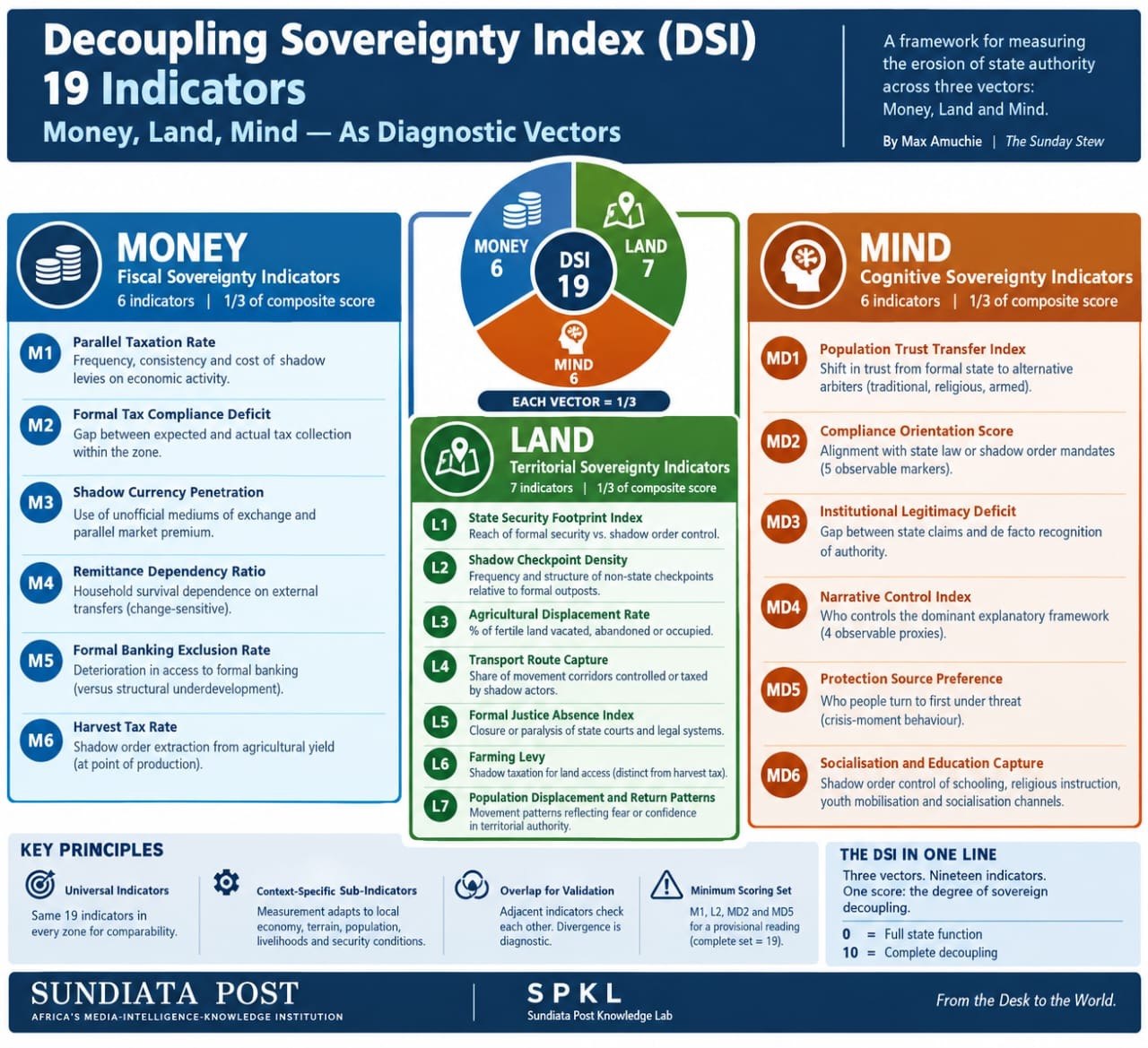
But collecting raw street-level observations is only the first half of the battle. This instalment lays out the full indicator architecture of the Decoupling Sovereignty Index (DSI) — the nineteen-indicator diagnostic engine designed by the Sundiata Post Knowledge Lab to score, weight, and track the velocity of sovereign decay across three vectors: Money, Land, and Mind.
The Three-Vector Operational Matrix
The DSI does not look at states as passive recipients of macro-shocks. It maps the active, asymmetric peeling away of de facto governance across three vectors. Each vector is calculated on a scale of zero to ten based on specific, observable field indicators. A score of zero represents total formal state function. A score of ten represents complete sovereignty decoupling. The nineteen indicators are distributed across three vectors: six for Money, seven for Land, and six for Mind. Each vector contributes equally — one third — to the composite DSI score, regardless of the number of indicators it contains. This weighting ensures that no single dimension of sovereignty decoupling dominates the composite or masks developments across the other two.
Why Nineteen Indicators
The nineteen indicators are a deliberate design, not an accumulation. Shadow Order environments punish single-source measurement: respondents self-censor, official data is compromised, and any one signal can be an artefact of local circumstance. The DSI therefore builds in overlap on purpose. Adjacent indicators, such as L2 and L4 or M6 and L6, observe related phenomena from different angles, so each score can be checked against its neighbour. Where they diverge, the divergence is itself diagnostic. Because each vector carries one third of the composite, the seven Land indicators weigh slightly less individually than those of the Money and Mind vectors.
This is intended: territorial decoupling has more dimensions, but it is not allowed to dominate the composite.
Where full fieldwork is not feasible, a minimum scoring set of anchor indicators (M1, L2, MD2 and MD5) gives a provisional reading, to be completed to all nineteen for the formal DSI record.
Universal Indicators, Context-Specific Sub-Indicators
The nineteen indicators are universal. They measure the same dimensions of sovereignty decoupling in every zone, which keeps scores comparable across contexts. How each indicator is observed, however, depends on the setting. Each indicator therefore carries context-specific sub-indicators, selected according to the peculiarities of the zone under assessment, including its economic structure, terrain, population characteristics, livelihood systems, settlement patterns, and prevailing security and governance conditions. These factors determine how sovereignty decoupling manifests and how it can be observed in different environments, whether agrarian, pastoral, mining, riverine, or urban.
Such adaptations shape how each indicator is measured without altering its underlying meaning, thereby preserving consistency across zones.
The sub-indicators used, and the reasons for choosing them, are recorded with every zone score. Their detailed specification is set out in the DSI Methodology and Indicator Manual.
The Money Vector: Fiscal Sovereignty Indicators
This vector measures the structural insulation of a local economy from the formal state apparatus and central bank — tracking the exact point where state fiscal tools lose their operational teeth. It carries six indicators.
M1 — Parallel Taxation Rate The frequency, consistency, and monetary toll of shadow levies imposed by non-state actors on commercial activity, market stalls, artisans’ work permits, and the transport of goods. M1 is the anchor indicator of the Money vector — the most directly observable and earliest signal of fiscal sovereignty decoupling. It is scored through direct field count of shadow levy collection points and trader testimony on levy frequency, amount, and enforcement character. Levies on agricultural output at the point of production are scored under M6.
M2 — Formal Tax Compliance Deficit The gap between the state’s projected revenue expectations and actual tax collection within the micro-environment — measured primarily through field observation rather than state-published data, which in high-decoupling zones is itself a product of the Institutional Mirage. Observable through the proportion of businesses reporting formal tax payment in the current cycle and the operational status of revenue offices within the zone.
M3 — Shadow Currency Penetration The degree to which unofficial mediums of exchange displace official legal tender in commercial transactions. Scored through the proportion of observed market transactions conducted in foreign currency, commodity barter, or informal tokens, and through the parallel market exchange rate premium within the zone. Scoring thresholds are anchored to IMF parallel market premium research, World Bank informal economy thresholds, and context-specific Central Bank data — weighted inversely to the zone’s overall DSI score, since the higher the decoupling the less reliable formal monetary authority data becomes.
M4 — Remittance Dependency Ratio The extent to which household survival depends on external transfers rather than state-linked economic activity. M4 is a change-sensitive indicator — only remittance dependency that has intensified during or following decoupling onset contributes to the score. A pre-decoupling baseline is required for reliable scoring. Without it, M4 must carry a reliability flag in the composite DSI record.
M5 — Formal Banking Exclusion Rate The deterioration of formal banking access to wealth storage and credit during or following sovereignty decoupling onset — distinct from pre-existing structural underdevelopment of financial infrastructure. M5 measures deterioration rather than absolute absence, ensuring the DSI does not conflate structural underdevelopment with active sovereignty decoupling. A pre-decoupling baseline is required.
M6 — Harvest Tax Rate The shadow order’s direct extraction from agricultural yield at the point of production — the monetary toll imposed on farmers at the moment their labour crystallises into a tangible, countable, and transportable commodity. Distinct from farming levies which tax land access and belong to the Land vector.
The Land Vector: Territorial Sovereignty Indicators
This vector maps the physical and spatial contraction of the state’s productive geography — tracking roads, fields, courts, and checkpoints not as lines on a map but as the active arteries and organs of shadow order territorial control. It carries seven indicators — one more than the Money vector, reflecting the greater empirical complexity of territorial sovereignty decoupling across its physical, spatial, and institutional dimensions.
L1 — State Security Footprint Index The true geographic and operational reach of formal state security forces versus the territorial perimeter dominated by a Shadow Order — capturing whether formal forces are garrisoned in isolated urban barracks or can safely and consistently patrol the interior. The critical distinction is between operational and ceremonial security presence. A formal security convoy that moves only between fixed points on a predictable schedule without engaging shadow order activity scores closer to ten than zero regardless of its physical presence within the zone.
L2 — Shadow Checkpoint Density The frequency, location, and structural permanence of non-state territorial control points and roadblocks relative to formal military or police outposts along critical transit corridors. Scored through direct field count of shadow checkpoints per kilometre of transit corridor and transporter testimony on checkpoint consistency and enforcement character. Transport cost differentials between zones with and without confirmed shadow checkpoints provide a corroborating economic signal — shadow checkpoint taxation embeds itself in transport pricing as a structurally observable market reality.
L3 — Agricultural Displacement Rate The percentage of fertile productive agrarian land vacated, abandoned, or forcibly occupied due to non-state violence or shadow order territorial control. L3 requires a pre-decoupling baseline to distinguish sovereignty-driven displacement from natural causes.
L4 — Transport Route Capture The proportion of primary and secondary movement corridors controlled, monitored, or systematically taxed by shadow actors. Analytically distinct from L2 — shadow checkpoint density measures the nodes of control while transport route capture measures the arteries. A zone can have low checkpoint density but high route capture where shadow authority is enforced through mobile rather than fixed control mechanisms. Both indicators are necessary for a complete territorial sovereignty picture.
L5 — Formal Justice Absence Index The physical retreat, closure, or total operational paralysis of state magistrate courts, police divisions, and formal legal enforcement mechanisms — and the degree to which shadow order dispute resolution has filled the resulting vacuum. L5 is directly corroborated by MD1 — Population Trust Transfer Index — in the Mind vector. Where formal justice is entirely absent and shadow dispute resolution commands community compliance, the Mind vector should independently corroborate through measurably reduced institutional trust in formal state authority.
L6 — Farming Levy The shadow order’s territorial taxation of the right to occupy and use productive agricultural land — imposing recurring levies on farmers for continued land access, distinct from harvest tax which extracts from yield. L6 is the Land vector’s most direct empirical link to the Money vector. Its placement in the Land vector reflects its primary character as a territorial control mechanism — the shadow order asserting ownership rights over productive land rather than merely extracting commercial revenue from it. Farming levies must be distinguished from legitimate customary land use tribute systems that predate decoupling and carry community consent.
L7 — Population Displacement and Return Patterns The degree to which civilian movement into, out of, and within the zone reflects confidence in or fear of the prevailing territorial authority. L7 is simultaneously a territorial sovereignty signal and a cognitive sovereignty signal — people vote with their feet for the authority they believe can protect them. A pre-decoupling baseline is required for reliable scoring.
The Mind Vector: Cognitive Sovereignty Indicators
This vector targets the ultimate battlefield — the invisible shift in human consciousness that determines which authority the population recognises, obeys, and protects. The Mind vector is the most methodologically challenging of the three because cognitive sovereignty is the least directly observable dimension of decoupling.
Its six indicators are therefore designed around behavioural proxies — what people demonstrably do — rather than attitudinal surveys alone, which are unreliable in Shadow Order environments where respondents self-censor.
MD1 — Population Trust Transfer Index The measurable expressed shift in trust away from formal judicial and administrative state bodies toward alternative traditional, religious, or armed arbiters. MD1 measures institutional trust — which body the population believes has legitimate authority to govern and adjudicate. Distinct from MD5 which measures immediate protection preference. Scored through civilian testimony on where disputes are taken first and observed attendance at formal versus shadow arbitration sessions. Behavioural proxies override attitudinal responses where the two diverge.
MD2 — Compliance Orientation Score The behavioural alignment of the population — whether daily rules of engagement are oriented toward formal state law or Shadow Order mandates. MD2 is the Mind vector’s most behaviourally grounded indicator, scored through five specific observable markers: property boundary compliance, movement compliance, commercial compliance, dispute initiation, and civic duty orientation. Its five-marker architecture ensures scoring is based on observable conduct rather than stated attitudes — making it the most resistant to self-censorship bias.
MD3 — Institutional Legitimacy Deficit The structural gap between the formal state’s rhetorical claims to sovereign authority and the population’s de facto acknowledgement of that authority as binding. Legitimacy is the deepest cognitive dimension — distinct from trust and compliance. Trust asks whether an institution will serve well. Compliance asks whether its rules are followed. Legitimacy asks whether the institution has the right to govern at all. Legitimacy loss is the hardest to reverse — it survives even after security conditions improve and requires active legitimacy reconstruction rather than merely security restoration.
MD4 — Narrative Control Index Which actor controls the dominant explanatory framework governing how the population interprets local events, security incidents, and governance decisions. Scored through four observable proxies: crisis explanation — whose account the population repeats and acts upon; warning compliance — whose security directives the population follows; information source preference — where the population turns first for zone intelligence; and blame attribution — which actor the population holds responsible for governance failure.
Behavioural responses to information override stated media preferences where the two diverge.
MD5 — Protection Source Preference The truest vote of confidence a population can cast — who they turn to first when physical safety is threatened. MD5 measures the immediate survival decision made under conditions of acute threat rather than general institutional preference. It is the Mind vector’s most immediate and least self-censored indicator — crisis-moment behaviour bypasses the social desirability bias that distorts attitudinal surveys in Shadow Order environments. Scored through community testimony on contact sequence during the most recent security incident and response time comparison between formal state and shadow order intervention.
MD6 — Socialisation and Education Capture The degree to which the shadow order has extended cognitive sovereignty reach into the formation of the next generation — through control of schooling, religious instruction, youth mobilisation, and community socialisation channels. MD6 is the Mind vector’s leading indicator — it measures future cognitive sovereignty trajectory rather than current alignment. A zone scoring low on MD1 through MD5 but high on MD6 is in a deceptively stable condition. The next generation is being formed entirely within shadow order cognitive parameters while current cognitive sovereignty appears partially intact. A high MD6 score is a critical forward-looking warning signal regardless of the current Mind vector composite score.
The foregoing presents the nineteen universal indicators of the DSI and the general principles governing their application. The detailed scoring rubrics, operational thresholds, context-specific sub-indicators, evidence protocols and aggregation procedures will be set out in the DSI Methodology and Indicator Manual, to be issued by the Sundiata Post Knowledge Lab (SPKL).
However, scoring the nineteen indicators is only the first step. How those scores interact across the three vectors, and what they imply for the order in which sovereignty can be restored, is the subject of the next instalment.
-
Politics3 years ago
13 Ondo Assembly Members Disown Endorsement of Aiyedatiwa
-
Politics3 years ago
APC Group, Ondo Govt, Quarrel Over Money for Endorsement
-

 Trending News5 years ago
Stop unsavoury, inciting statements – DSS warns
-

 Others5 years ago
Adron Homes Celebrates 10 Years Of Housing Excellence
-

 Humanity5 years ago
President Buhari Commiserates With Ambassador Maureen Tamuno Over The Loss Of Her Father
-

 Others7 years ago
EX- CUSTOMS BOSS, IBRAHIM MERA’S DWINDLING FAME
-

 Business3 years ago
Bigi Carbonated Soft Drinks Treats 40 Consumers to an Epic Easter Movie Hangout
-

 Business2 years ago
Wema Bank Shines at Global SME Finance Forum Conference Awards 2024 …Awarded: • SME Financier of the Year (Africa) • Platinum Award for Best Financier for Women Entrepreneurs (Africa)