
Opinion
Beyond oil: Niger Delta attracts new investments for economic growth and development


Niger Delta Summit in Port Harcourt targets $5bn investment and 500,000 jobs through diversification and innovation
By Ehi Braimah

In the mangrove-fringed creeks and bustling markets of the Niger Delta, the scent of crude oil has long defined daily life.
Also read: Nigeria inflation rises to 15.38% as food prices surge
For decades, the region’s nine states – Akwa Ibom, Bayelsa, Cross River, Delta, Edo, Imo, Ondo, Rivers, and Abia – have powered Nigeria’s economy through vast hydrocarbon reserves.
Yet for many residents, that black gold has delivered more curses than blessings: environmental degradation from oil spills, youth unemployment fueling unrest, and a sense of abandonment amid federal wealth that rarely trickled down.
Families in fishing villages watched their waters turn toxic; young graduates in Port Harcourt scanned job boards dominated by oil multinationals, only to face cycles of militancy and amnesty programmes that offered temporary relief but little lasting dignity.
Now, a quiet but determined shift is underway.
Local business leaders are rewriting the script, betting that the Niger Delta region’s true wealth lies not just in its subsoil but in its people, rivers, farmland, and untapped entrepreneurial spirit.
At the heart of this pivot is the maiden Niger Delta Economic and Investment Summit (NDEIS), scheduled for May 19 – 21, 2026, in Port Harcourt, Rivers State, with the theme: Driving investment, innovation, and industrial growth in the Niger Delta.
Organised by the Niger Delta Chamber of Commerce, Industry, Trade, Mines and Agriculture (NDCCITMA), the event carries an audacious goal: catalysing up to five billion dollars in structured investments over the next five years and creating more than 500,000 direct and indirect jobs.
Ambassador Idaere Gogo-Ogan, NDCCITMA chairman, framed the ambition plainly during a pre-summit media briefing in March 2026. “The region is ready to deliver 500,000 new jobs, inclusive of investment drive and wealth creation,” he said, describing the summit as a platform to deliberate on “investment mobilisation, enterprise growth, industrial expansion, and regional coordination.”
President Bola Tinubu is expected as special guest of honour, with Barbados Prime Minister Mia Amor Mottley delivering the keynote, an intriguing nod to lessons from small-island economies that have thrived through diversification and resilience.
Dr. Solomon Edebiri, NDCCITMA secretary and local organising committee chairman, struck a note of pragmatic optimism. The summit, he explained, is “a strategic initiative designed to reposition the Niger Delta as a competitive hub for investment, enterprise development, and sustainable industrialisation.” While the world knows the Delta for oil and gas, its real legacy, he argued, rests on “a wealth of diverse and largely untapped opportunities” that the gathering aims to unlock.
Those opportunities are starting to crystalise.
Discussions at the summit and related roundtables point to concrete sectors beyond crude: agriculture and agro-processing to leverage the region’s fertile soils and waterways; manufacturing and logistics to turn Port Harcourt and Warri into industrial nerve centers; blue economy initiatives harnessing fisheries, shipping, and coastal tourism; energy transition projects that optimise the existing oil-and-gas value chain (a shift toward renewable energy), and small-and-medium-enterprises (SME) scaling that could empower local entrepreneurs.
Recent analyses echo this vision, highlighting how five billion dollars in inflows could reshape the economy by reducing oil dependency and channeling capital into youth-driven ventures in farming, light manufacturing, and services.
The Niger Delta Development Commission (NDDC) has thrown its weight behind the effort, signaling institutional buy-in for broader regional plans.
Chairman Chiedu Ebie and Managing Director/CEO Samuel Ogbuku have championed infrastructure upgrades, skills programmes, and sustainable projects that align with the summit’s goals – efforts that extend beyond flashy announcements to the gritty work of roads, power, and training centres that make investment viable on the ground.
This local momentum dovetails with a national story of cautious investor re-engagement.
Despite persistent security challenges, rankings on global terrorism indices, sporadic attacks in the northeast, and lingering instability in parts of the north-central zone, foreign and domestic capital is showing renewed interest in Nigeria, and the Niger Delta Chamber of Commerce, Industry, Trade, Mines and Agriculture is poised to announce the region to the world as a land full of opportunities for investors.
While speaking on a recent Sunrise Daily broadcast on Channels TV, I pointed to President Tinubu’s UK visit last month and a high-level investment forum hosted by the Central Bank of Nigeria alongside the UK’s Foreign, Commonwealth and Development Office.
Reforms such as exchange-rate unification, fuel-subsidy removal, and strengthened banking capital requirements have begun to stabilise macroeconomic indicators and rebuild confidence.
I noted that 28 percent of recent capital inflows came from foreign investors, with 34 banks meeting the new CBN recapitalisation thresholds.
For the Niger Delta, the development agenda feels personal. During the interview, I specifically praised the region’s push to mobilise local capital and foster self-reliant growth, urging the six regional development commissions to adopt their template.
The message is clear: reducing dependence on federal allocations and oil rents is no longer optional, it is the path to dignity and sustainable development.
Yet nuance demands caution. Skeptics will recall past summits, master plans, and billions pledged that evaporated into reports and photo-ops.
Youth unemployment remains painfully high; environmental remediation lags; and trust between communities, government, and investors is still fragile.
Roadshows across the Delta states, Abuja, and Lagos at some point will definitely amplify the mission, thereby turning ideas into bankable projects, but execution will test whether discipline and speed can match the ambition. As Edebiri emphasised, the shift from “ambition to implementation” is everything.
Still, the human stakes are unmistakable.
Picture a young woman in Yenagoa who once saw her family’s fishing nets come up empty because of pollution; today she eyes training in aquaculture under blue-economy initiatives.
Or the engineering graduate in Uyo who once joined restive groups out of frustration but now dreams of a manufacturing startup backed by summit-linked investors.
These are not abstract statistics – they are the 500,000 jobs, lives that could move from survival to aspiration if the pieces align.
As Port Harcourt prepares to host investors, business leaders, CEOs, development finance executives, members of the diplomatic community, heads of MDAs, young innovators, exhibitors, media practitioners, policy analysts, changemakers, and members of business membership organisations, the Niger Delta stands at a crossroad.
The oil rigs will not disappear overnight, but value-chain optimisation remains part of the transition. Indeed, the narrative is broadening.
What was once dismissed as a region of perpetual crisis is quietly positioning itself as a diversified engine of national economic growth, rooted in agriculture, innovation, and human capital rather than a single extractive resource.
The world is watching. The Niger Delta is home to over 30 million people and the economic engine of Nigeria.
It contributes more than 90 percent of Nigeria’s oil revenue, and holds the vast majority of the nation’s gas reserves. Even with the immense natural wealth, the region remains economically underserved.
NDCCITMA was established with a mandate to facilitate rapid, even and sustainable development of the Niger Delta into a region that is economically prosperous, socially stable, ecologically regenerative, and politically peaceful.
The chamber serves as the private sector implementation arm of the region’s development strategy to attract investment, marking a critical pivot from aid-based development to enterprise-driven growth.
If the summit delivers even a fraction of its promise, the creeks that were once a major security flashpoint, may yet sparkle with a new possibility of attracting investors from around the world for the Niger Delta people and Nigeria.
Also read: BoI signs strategic partnership framework deal with German Int’l Agency to accelerate MSME growth
Clearly, the journey beyond oil has begun which marks a new dawn of development for the region.


By Ehi Braimah
There is perhaps no clearer illustration of Nigeria’s governance failures than its inability to provide reliable electricity to millions of citizens. For decades, successive administrations have promised to fix the power sector, committed enormous resources to it and announced ambitious reforms. Yet the experience of ordinary Nigerians remains largely unchanged: erratic supply, prolonged blackouts, rising electricity bills and an almost compulsory dependence on generators.
The frustration is particularly evident in Lagos, Nigeria’s commercial nerve centre, where households and businesses struggle with unpredictable electricity supply. Ikeja Electric, one of the country’s electricity distribution companies, serves several communities across Lagos and parts of Ogun State. Even in highbrow neighbourhoods such as Ikeja GRA, where residents reasonably expect dependable public services, electricity supply has become increasingly unreliable.
If residents in relatively affluent communities are struggling to enjoy stable electricity, what hope is there for people in less privileged neighbourhoods?
Consider the routine messages customers receive from Ikeja Electric whenever power supply is interrupted:
“The current power outage is due to a system outage on the feeder supplying your vicinity. Efforts are currently underway to resolve the fault and restore the power supply as soon as possible. Kindly bear with us.”
The message may sound polite and professional, but it offers little comfort to customers who remain without electricity for hours or days.
What exactly is the fault? When will it be repaired? How long should customers continue to bear with a distribution company that collects money for electricity services but repeatedly fails to provide dependable supply?
These are legitimate questions. Customers are not asking for favours; they are demanding a service for which they pay. Ikeja Electric and other distribution companies must move beyond routine apologies and demonstrate that customer complaints translate into timely repairs and improved service delivery.
Decades of promises, little relief
Nigeria’s electricity challenge predates the privatisation of the power sector. From the days of Bola Ige as Minister of Power to successive administrations and ministers, including Babatunde Fashola and Adebayo Adelabu, the country has struggled to translate policy pronouncements into dependable electricity.
Joseph Tegbe, who assumed office as Minister of Power in June 2026, has inherited a sector weighed down by decades of structural weaknesses, poor infrastructure, financial challenges and inconsistent implementation of reforms.
The political leadership since 1999 has not demonstrated sufficient determination to resolve the electricity crisis. Nigerians are tired of excuses, policy announcements and promises that repeatedly fail to produce lasting results.
The generation, transmission and distribution trap
The familiar explanation is that electricity supply is constrained by problems across three interconnected segments: generation, transmission and distribution.
While this diagnosis is correct, repeating it without delivering lasting solutions has become an exercise in public frustration.
Nigeria has installed generation capacity considerably higher than the electricity it consistently delivers to consumers. Gas supply constraints, inadequate maintenance, ageing infrastructure, liquidity problems and the inability of the national grid to evacuate available electricity have combined to keep actual output below its potential.
Transmission infrastructure remains another major bottleneck. The Transmission Company of Nigeria (TCN) must efficiently transport electricity from generating stations to distribution networks. Weak transmission capacity, obsolete equipment, inadequate substations and repeated grid disturbances undermine the entire electricity value chain.
Distribution companies, meanwhile, contend with infrastructure deficits, overloaded transformers, inadequate feeders, commercial losses, electricity theft and poor revenue collection. These challenges are real, but they cannot become permanent excuses for poor service delivery.
The Nigerian Electricity Regulatory Commission’s (NERC) second-quarter 2026 performance report illustrates the scale of the problem. Grid-connected power plants recorded average hourly generation of 4,022.40 megawatt-hours, while average aggregate technical, commercial and collection losses across distribution companies stood at 36 per cent, against an allowed average target of 16.92 per cent.
The national metering rate was 62 per cent.
These figures underscore the need for greater efficiency in transmitting, distributing, metering, billing and collecting revenue across the electricity value chain.
Band A: Paying more without getting what was promised
The introduction of service-based electricity tariffs was presented as a major reform. The argument was straightforward: customers receiving better electricity supply would pay higher tariffs, while those receiving fewer hours would pay less.
Under the service-based arrangement, Band A customers are expected to receive a minimum of 20 hours of electricity daily, Band B 16 hours, Band C 12 hours, Band D eight hours and Band E four hours.
In principle, the arrangement is reasonable. Consumers should pay according to the quality of service delivered. However, the system becomes indefensible when customers are charged premium rates but receive substantially less electricity than promised.
For residents of Ikeja GRA and other communities supplied by Ikeja Electric, the experience can be particularly frustrating. There is something fundamentally wrong with charging customers Band A tariffs on the basis of a 20-hour supply commitment while prolonged outages become commonplace.
NERC has established regulatory mechanisms for monitoring feeder performance, downgrading feeders that fail to meet their service commitments and adjusting tariffs where supply falls below stipulated thresholds.
These provisions must not remain on paper.
A distribution company that consistently fails to meet its obligations should face regulatory consequences. Customers should not have to embark on endless correspondence, petitions, telephone calls, social media complaints or protests before receiving relief.
Electricity consumers deserve a transparent, accessible complaints and compensation mechanism that promptly identifies service failures and ensures appropriate tariff adjustments.
Solar power and the flight from the national grid
Another troubling consequence of the electricity crisis is the growing number of Nigerians abandoning the national grid wherever they can afford to do so.
Households, offices, hotels, factories and commercial establishments are investing in solar panels, inverters and battery storage systems. For those with sufficient financial resources, solar energy offers a measure of independence from unpredictable electricity supply.
Understandably, distribution companies are concerned about what they describe as loss of revenue.
But this transition raises a fundamental question: should access to reliable electricity become a privilege reserved for wealthy Nigerians?
Small businesses that cannot afford alternative energy solutions remain particularly vulnerable. Manufacturers spend heavily on diesel and gas-powered generators, increasing production costs and undermining their competitiveness. These expenses eventually find their way into the prices consumers pay for goods and services.
The irony is that Nigeria is blessed with abundant sunlight and considerable renewable energy potential, yet millions of citizens remain without dependable electricity.
Solar energy, mini-grids and other decentralised solutions should therefore be encouraged as complementary components of a diversified national electricity strategy.
The Electricity Act 2023 also provides a framework for states to participate more actively in electricity generation, transmission and distribution within their jurisdictions. This creates opportunities for state governments, private investors and communities to develop solutions suited to local circumstances.
However, decentralised electricity must complement the national grid, not become an excuse for abandoning efforts to fix it.
What must change?
First, government must establish clear, measurable performance targets across the electricity value chain. Generation companies, TCN and distribution companies should publish regular performance data that citizens can independently verify.
Nigerians need to know how much electricity is generated, how much is transmitted, how much reaches distribution networks and how much is ultimately delivered to consumers.
Second, investment in transmission and distribution infrastructure must become an urgent national priority. New generating capacity is of limited value if the grid cannot evacuate the electricity. TCN requires modern substations, transformers, transmission lines, digital monitoring systems and adequate maintenance funding.
Distribution companies must similarly invest in feeders, transformers and network upgrades to improve the quality and reliability of supply.
Third, the gas-to-power challenge must be addressed decisively. Nigeria has substantial natural gas reserves, but inadequate gas infrastructure, payment difficulties and supply constraints continue to undermine electricity generation.
Government must develop a credible gas supply framework, ensure that generating companies can meet their obligations and address outstanding payment liabilities across the sector.
Fourth, distribution companies must be held accountable for service delivery. NERC should intensify independent feeder-level monitoring, enforce the minimum supply commitments attached to each tariff band and impose appropriate sanctions for persistent violations.
Where customers pay Band A tariffs without receiving Band A service, automatic tariff adjustments and compensation should follow. Ikeja Electric must demonstrate that its customer engagement is matched by operational performance.
Fifth, Nigeria must accelerate the provision of prepaid meters. Estimated billing remains a major source of distrust between electricity companies and consumers. Customers should pay for electricity actually consumed, not arbitrary estimates.
Closing the metering gap will improve transparency, strengthen revenue collection and reduce disputes between customers and distribution companies.
Sixth, the financial sustainability of the electricity market must be resolved. Cost-reflective tariffs may be necessary to attract investment and sustain operations, but tariff increases alone cannot repair a dysfunctional system.
Government must provide transparent, targeted subsidies for vulnerable households, settle legitimate outstanding obligations and ensure that revenues collected are reinvested in improving service delivery.
Finally, electricity reform must be treated as a national economic emergency rather than another ministerial programme.
Federal and state governments, regulators, investors and operators must work within a coordinated framework with clearly defined responsibilities, measurable targets and deadlines.
A test of leadership
Minister Tegbe has an opportunity to approach the power sector differently. His professional background in economic and institutional reforms may provide useful experience, but Nigerians will judge him by results, not credentials or policy presentations.
The Tinubu administration must also recognise that electricity is not simply another item on its infrastructure agenda. It is fundamental to economic growth, industrialisation, job creation, education, healthcare and national productivity.
How can Nigeria compete as an investment destination when businesses cannot plan production around predictable electricity supply? The country cannot build a trillion-dollar economy on generator fumes.
For residents of Ikeja GRA, the immediate concern is simple: when will electricity return, and how long will it stay? For millions of other Nigerians, the question is equally urgent.
The time for explanations has passed. Nigerians have endured decades of promises, reform announcements, tariff adjustments and technical excuses. What they need is a power sector that works.
Electricity should not be a luxury, a political slogan or an expensive gamble. It is an essential public utility and a foundation of modern economic life.
The success of any Minister of Power, regulator or electricity distribution company will not be measured by the number of meetings held or policy documents released, but by the number of hours Nigerians actually enjoy electricity, the reliability of that supply and the affordability of the service.
Until that changes, Nigeria’s electricity crisis will remain one of the most enduring indictments of its governance.
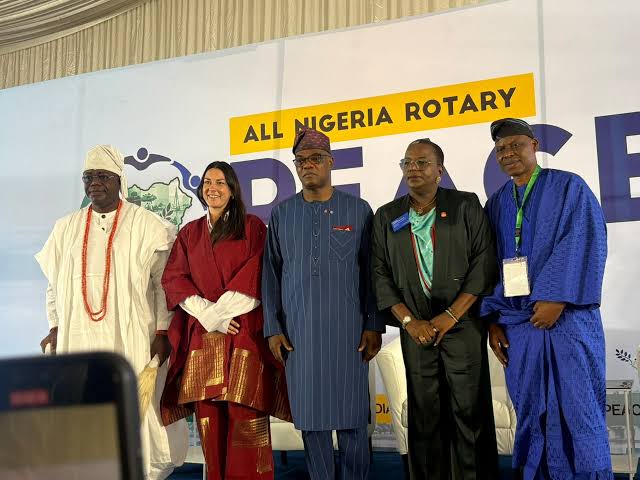
Distinguished leaders of government, members of the diplomatic community, representatives of security and law-enforcement agencies, traditional and religious leaders, distinguished guests, fellow Rotary members, ladies and gentlemen:
It is an honour to welcome you to the “All Nigeria Rotary Peace Summit.”
The question before us is how to come together, work toward a shared national future, and achieve true and lasting peace.
Nigeria has enormous potential. We have contributed to peace and stability across Africa, including through our work with the Economic Community of West African States and United Nations peacekeeping and Peace Support operations.
Our work in Liberia and other parts of Africa shows that we have the experience and ability to help prevent and manage conflict beyond our borders.
Now it is time to turn those energies inward — to bring our commitment to building peace among our neighbors and the world back home.
But we cannot impose peace. We must nurture it from the very roots of our society so it may grow into a great tree that will feed and shelter all of us under its protective embrace.
As a member of Rotary, when I consider this idea, I look to the philosophy of Positive Peace.
Peace, through this lens, is so much more than the absence of violence. To achieve true and lasting peace, we must consider the attitudes, institutions, and structures that create and sustain peaceful societies.
Here in Nigeria, meaningful peace cannot rely on our security forces and government institutions alone. It requires every level of society to come together for the betterment of all.
To grow Positive Peace from the ground up, Rotary starts from the very foundation of life, as we have done here.
In 2022, Rotary began a program called, “Together for Healthy Families in Nigeria.”
Members of Rotary here in Nigeria and as far away as Germany partnered with federal and state health ministries to make giving birth safer for both mother and child.
The program has helped expectant mothers across three states and the capital receive better and more frequent prenatal care.
Community health workers made nearly 60,000 visits to homes of expectant mothers and spoke with them and their families. We supplied 158 health facilities with contraceptives, medicine, and equipment.
We have already seen positive outcomes. Maternal deaths were reduced by 77%, and newborn deaths were reduced by 45% at supported facilities.
There is more work to do, but we are making progress. This is one way we plant the seeds of peace in Nigeria and around the world — we listen to the community, work with people so they can make their own lives better, and we stay committed to our goals.
With each child born safely to a healthy mother, we ease the burden carried by the Federal Ministry of Health and Social Welfare. We give families a greater sense of safety and security.
This is the beginning of Positive Peace. But members of Rotary do not stop once the seeds of peace are planted.
Since 2020, Nigeria has been free of the deadly grip of the wild poliovirus, which paralyzed and sometimes killed children when their lives had barely begun. And we continue to work with our friends at the World Health Organization and others to keep it that way and address the more recent outbreaks of variant poliovirus.
Rotary also builds peace directly. Members of Rotary clubs across Nigeria devote themselves to building peace every day.
And the year after Nigeria was declared wild polio-free, Rotary worked with Makerere University in Uganda to open a Peace Center, where students — called Peace Fellows — can learn how to build lasting peace both here in Nigeria and across Africa.
Over the years, more than 75 Rotary Peace Fellows have come from Nigeria. Some of our Peace Fellows are even here with us today.
I tell you this not to advertise Rotary (although we can always use new members). I tell you this because I want you to know that Rotary is already a quiet partner in peacebuilding — not only around the world — but here in our shared home.
As members of Rotary, we are not soldiers, ambassadors, or diplomats. We bring people together to find common purpose through service to others. We are here for Nigeria, and we are here to stay.
This year, I have called on every member of Rotary to Create Lasting Impact, and today, my brothers and sisters of Nigeria, I ask the same of every one of us.
I ask us to look at every level of society in Nigeria and consider how we can make all our lives better — not only today, but far into the future of this great nation. We may not speak the same language, worship the same way, or live the same way, but our nation’s future depends on all of us working together.
This summit is an opportunity to turn our shared commitment to peace into practical action — to take mere words and transform them into a bright future for us and all our children.
To my dear friends and family of Rotary here today, I challenge you to make peacebuilding in Nigeria our legacy of lasting impact.
As I have said to the Rotary world time and time again, we must consider how everything we do contributes to peace and pursue that peace purposefully and deliberately.
Rotary can help build confidence between institutions and communities, strengthen public trust, and ease the burden of everyday life that makes peacebuilding that much harder … but we must do so with purpose.
And before we can Create Lasting Impact in Nigeria, we must first have the courage to change ourselves, whether we are members of Rotary or not.
We cannot continue to do what we have always done and expect our great tree of peace to magically sprout from the ground. We must nurture our country and ourselves with all our being.
Give yourselves permission to be changed by what you see and hear at this summit.
That is how lasting impact is achieved — through people who are willing to change, institutions that are prepared to work for everyone, and communities that have the capacity to sustain progress.
And once we allow ourselves to change, we open ourselves to a new future — a future where the circumstances of someone’s birth do not determine their access to justice, opportunity, or dignity.
A future where differences are respected, where violence is rejected, and where we all come together, not as different groups in competition, but as Nigerians in harmony.
As we begin this summit, let us commit to more than resolutions and declarations. Let us commit to stability through change.
Remember that our true measure of success is not the words we share among ourselves today, but the impact of our actions that lasts generation after generation.
And if our commitment to peace is true — if our capacity for change is enough — our children, and their children after them, will enjoy the fruits of our labor under our great tree of peace — protected, safe, and free.
Thank you.

Nigeria’s democratic development depends not only on credible elections but also on responsible journalism and an informed electorate. In the view of Nosa Osaikhuiwu, sections of the Nigerian media and political commentary class have fallen short of this responsibility, particularly in their coverage and interpretation of the 2023 presidential election.
Writing from Houston, Texas, Osaikhuiwu argues that rather than critically examining the political realities behind the outcome, some media platforms amplified unsubstantiated allegations of electoral fraud by defeated candidates without sufficiently interrogating the evidence. This, he says, has contributed to public distrust and weakened confidence in critical democratic institutions, particularly the Independent National Electoral Commission (INEC) and the judiciary.
He highlights a key principle of electoral politics that he believes has been largely overlooked: when opposition forces divide their strength among competing candidates, they can strengthen the position of an incumbent under a winner-takes-all system. He cites examples from the United States, including Ross Perot’s impact in 1992 and Ralph Nader’s role in 2000.
Applying the same principle to Nigeria in 2023, Osaikhuiwu notes that Peter Obi and Atiku Abubakar contested separately against President Bola Tinubu. Although their combined votes exceeded Tinubu’s total, elections are decided by the votes secured by individual candidates under established rules, not by post-election addition of rivals’ tallies.
Looking ahead to 2027, he observes a similar opposition configuration emerging, with Atiku and Obi again pursuing separate ambitions. While acknowledging the economic hardships associated with Tinubu’s reforms and the administration’s political vulnerability, Osaikhuiwu stresses that public dissatisfaction does not automatically translate into an organised electoral movement capable of defeating an incumbent.
He criticises suggestions by some media personalities that the 2027 elections will be rigged even before they take place, describing such pronouncements as irresponsible. Journalists, he argues, must interrogate claims, examine evidence and educate the public rather than merely amplify the statements of political actors.
Osaikhuiwu maintains that while there may have been logistical shortcomings in 2023, these did not materially alter the final outcome, which was declared by INEC and upheld through the judicial process. Disagreement with a result, he says, is not in itself evidence of fraud.
He concludes that if the opposition genuinely seeks to defeat Tinubu in 2027, it must address its divisions and build a viable electoral coalition. Individual popularity, social media enthusiasm and public dissatisfaction cannot substitute for organisation, coalition-building and grassroots mobilisation.
“Journalism must educate, not mislead. Political commentary must analyze, not merely amplify. And democracy must be grounded in electoral reality, not political wishful thinking,” he writes.
-
Politics3 years ago
13 Ondo Assembly Members Disown Endorsement of Aiyedatiwa
-
Politics3 years ago
APC Group, Ondo Govt, Quarrel Over Money for Endorsement
-

 Trending News6 years ago
Stop unsavoury, inciting statements – DSS warns
-

 Others5 years ago
Adron Homes Celebrates 10 Years Of Housing Excellence
-

 Humanity5 years ago
President Buhari Commiserates With Ambassador Maureen Tamuno Over The Loss Of Her Father
-

 Others7 years ago
EX- CUSTOMS BOSS, IBRAHIM MERA’S DWINDLING FAME
-

 Business3 years ago
Bigi Carbonated Soft Drinks Treats 40 Consumers to an Epic Easter Movie Hangout
-

 Business2 years ago
Wema Bank Shines at Global SME Finance Forum Conference Awards 2024 …Awarded: • SME Financier of the Year (Africa) • Platinum Award for Best Financier for Women Entrepreneurs (Africa)