
Business
Dangote Transport Unveils Safer Real-Time Driver Monitoring

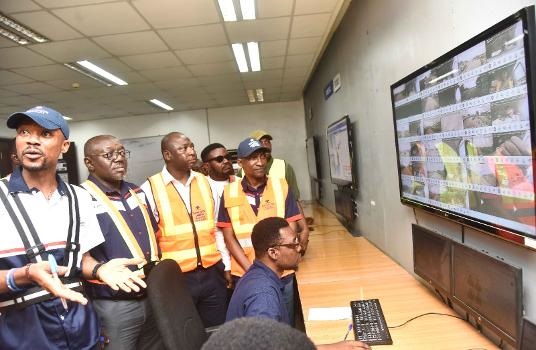
Dangote Transport unveils real-time driver monitoring in Ibese, using technology to improve road safety, driver performance and fleet control
Dangote Transport unveiled its new real-time driver monitoring control room in Ibese, Ogun State, on Friday, August 21, 2026, introducing a technology-led system designed to improve driver safety and reduce road risks across Nigeria.
Also read: BREAKING: Tinubu Redirects EFCC Funds, Dividends to Student Loans

The facility forms part of Dangote Transport’s broader investment in road safety and operational efficiency as the company manages a large fleet moving materials and finished products across the country.
During a guided tour of the operational centre, David Idiege, Head of Operations at Dangote Transport’s Ibese operation, described the facility as a significant addition to the company’s safety architecture.
“We are constantly looking for innovative ways to strengthen safety across our transport operations,” Idiege said. “The Driver Monitoring Control Room represents another significant milestone in our efforts to ensure that all journeys are conducted safely and responsibly.”
The system gives transport control personnel live visibility of drivers while trucks are on the road. It is designed to help the company identify risky behaviour, monitor compliance with safety requirements and intervene where necessary.
Ifeanyi Ezeala, Head of Transport Control, said the on-board camera system installed across thousands of Dangote trucks was deployed with technology partner Nova Tracks.
The cameras provide live feeds and alerts, allowing transport managers to assess driver conduct while journeys are still under way.
“Our objective is preventive rather than punitive,” Ezeala said. “We want to identify potential risks before they develop into incidents.”
The approach reflects a wider shift in fleet management, where real-time data and monitoring systems are increasingly being used to complement traditional driver training and supervision.
Dangote Transport said technology remains only one part of its safety strategy. Existing measures include speed limiters, vehicle immobilisers, speed-control systems, facial recognition devices, journey management procedures, mandatory drug and alcohol testing, compulsory rest periods and periodic driver recertification.
Regular training and retraining programmes are also used to reinforce professional driving standards.
Idiege said fatigue management was particularly important because drivers are required to observe mandatory rest schedules and journey management procedures.
“We do not encourage driver fatigue,” he said. “Every driver is required to comply with our journey management procedures and mandatory rest schedules.”
The new control room therefore represents more than an additional layer of surveillance. The company says its purpose is to provide earlier visibility of potential problems and enable timely support before unsafe situations escalate.
The initiative comes against the wider challenge of improving road safety in Nigeria, where commercial vehicles regularly operate over long distances and through varying road and traffic conditions.
Dangote Transport said its safety framework combines technology with operational procedures, driver welfare, competency assessments and continuous capacity building.
The company also said the monitoring system provides operational information that can strengthen fleet management and support more informed decisions.
For a transport operation with thousands of trucks on Nigerian roads, the ability to monitor journeys in real time could offer a powerful additional tool for preventing incidents and encouraging safer driving behaviour.
Also read: INEC Hails Osun Election as Strong Blueprint for 2027
Dangote Transport said it would continue investing in technology and other safety measures as part of its effort to improve driver performance, protect road users and advance operational standards across its nationwide logistics network.



President Bola Tinubu has reaffirmed the Federal Government’s commitment to rehabilitating and repositioning Nigeria’s dormant national refineries, declaring that the facilities will not be allowed to become stranded assets.
Tinubu was represented by the Permanent Secretary of the Ministry of Petroleum Resources, Mrs Patience Oyekunle, at the 20th OTL Africa Downstream Energy Week in Lagos on Monday.
The President said the government is adopting a more rigorous and commercially sustainable approach to the rehabilitation of the Port Harcourt, Warri and Kaduna refineries.
“At the same time, the government remains committed to ensuring that existing national refining assets are not allowed to become stranded investments,” the statement said.
“We are pursuing a more rigorous, commercially sustainable approach to the rehabilitation and repositioning of our refineries, supported by technical assessment, stronger partnerships, and improved operational discipline.”
The objective, according to the administration, is for Nigeria to refine more of its crude oil, create greater domestic value and become a reliable supplier of energy to Africa.
The national refineries, managed by the Nigerian National Petroleum Company Limited (NNPC), have remained largely inactive for years despite significant spending on turnaround maintenance. The NNPC has signed a memorandum of understanding with Chinese firms as part of ongoing efforts to revive the facilities.
Tinubu also noted the contribution of private refining capacity, particularly the Dangote Refinery, which has reached its 650,000 barrels-per-day nameplate capacity, in strengthening Nigeria’s prospects of becoming a net exporter of refined petroleum products.



AICL GMD Maureen Tamuno calls for stronger diaspora investment in Africa through trust, transparency, skills transfer and sustainable partnerships
-
Politics3 years ago
13 Ondo Assembly Members Disown Endorsement of Aiyedatiwa
-
Politics3 years ago
APC Group, Ondo Govt, Quarrel Over Money for Endorsement
-

 Trending News5 years ago
Stop unsavoury, inciting statements – DSS warns
-

 Others5 years ago
Adron Homes Celebrates 10 Years Of Housing Excellence
-

 Humanity5 years ago
President Buhari Commiserates With Ambassador Maureen Tamuno Over The Loss Of Her Father
-

 Others7 years ago
EX- CUSTOMS BOSS, IBRAHIM MERA’S DWINDLING FAME
-

 Business3 years ago
Bigi Carbonated Soft Drinks Treats 40 Consumers to an Epic Easter Movie Hangout
-

 Business2 years ago
Wema Bank Shines at Global SME Finance Forum Conference Awards 2024 …Awarded: • SME Financier of the Year (Africa) • Platinum Award for Best Financier for Women Entrepreneurs (Africa)