
Politics
Tinubu Govt Accuses Opposition Over Fake AI Rally Photos

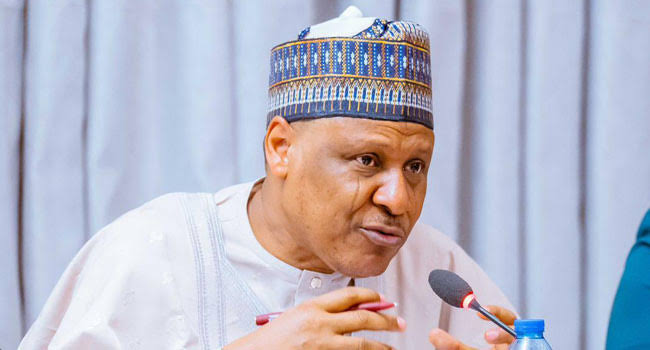
Information Minister Mohammed Idris accuses opposition parties of circulating fake AI rally photos ahead of Nigeria’s 2027 elections
Nigeria’s Minister of Information and National Orientation, Mohammed Idris, has accused opposition parties of using artificial intelligence (AI) to circulate fabricated campaign rally photographs ahead of the 2027 general elections, rejecting allegations that the ruling All Progressives Congress (APC) has deployed manipulated images to exaggerate public support for President Bola Tinubu.
Also read:Nigerian Breweries Celebrates 80 Years With N80m Reward

Idris made the allegations on Wednesday, 18 November 2026, while responding to journalists on the sidelines of the 2026 World Public Relations Forum (WPRF) in Abuja.
The minister dismissed suggestions that the ruling party was responsible for circulating AI-generated images of large campaign gatherings, insisting that opposition groups were behind the alleged practice.
He said the government had also observed the circulation of misleading digital content but maintained that the APC should not be blamed for activities he attributed to its political opponents.
“It’s wrong for you to say that the ruling party has been accused of issues of fake news, misinformation, and misuse of AI, for example.
“We have seen that. We, as a ruling party, are also seeing that this is not really our forte. We feel that it’s actually the opposition that is using that,” Idris said.
However, the minister did not identify the opposition parties allegedly responsible or provide specific examples of the disputed photographs during the exchange with journalists.
His comments come amid growing concerns about the use of artificial intelligence to manipulate political narratives, manufacture public support and influence voters through misleading images, videos and audio recordings.
Idris acknowledged the dangers associated with the technology, warning that its irresponsible use could undermine public confidence and deepen divisions within society.
He said the challenge was not necessarily the technology itself but how individuals and political organisations deployed it.
“The aim of this conference is that all of us will come together to see how technology can help us to do our business, to foster better communication amongst the African people,” he said.
The minister added that technological innovation could not be reversed, making responsible use of artificial intelligence increasingly important.
“AI is very useful to us. But responsible use of AI is what is desirable, you know, to foster greater understanding, greater unity among the African people.
“The misuse of it can create chaos, can create division, can create disunity. And that’s part of what you are alluding to,” Idris stated.
The WPRF 2026, which runs from 15 to 22 November in Abuja, is themed ‘Responsible Communication: The Voice of the World’.
The gathering brings together communication professionals, policymakers and institutional leaders to discuss the role of responsible communication in building public trust and addressing misinformation.
The minister’s remarks also come against the backdrop of growing preparations for the 2027 general elections, with concerns that manipulated digital content could complicate political communication and make it harder for voters to distinguish authentic campaign activities from fabricated material.
In September 2026, the Independent National Electoral Commission (INEC) Chairman, Professor Joash Amupitan, urged Nigerian media organisations to strengthen their fact-checking and digital verification systems ahead of the elections.
Amupitan warned that generative AI, voice cloning and deepfake technology could be used to produce fabricated videos of political figures and electoral officials, cloned audio recordings and manipulated election documents.
He also disclosed that INEC had established a dedicated Artificial Intelligence Division within its Information and Communication Technology Department to strengthen its capacity to identify discrepancies in election-related information.
Similarly, a National Summit on AI, Foreign Information Manipulation and Interference, and Electoral Information Integrity held in Abuja on 2 and 3 November 2026 recommended stronger collaboration between INEC, political parties, media organisations, technology companies and independent fact-checkers.
The summit warned that manipulated photographs, fabricated announcements and misleading claims about election results could undermine public confidence and electoral credibility.
Its communiqué also stressed that responses to misinformation must be supported by credible evidence and should not undermine freedom of expression, media freedom or legitimate political disagreement.
Against this background, the minister urged African governments, political actors and other stakeholders to adopt responsible communication practices and ensure that digital platforms promote understanding rather than hostility.
Beyond the controversy surrounding AI-generated campaign photographs, Idris also disclosed that African ministers of information had agreed to strengthen cooperation and present a common position on issues affecting the continent.
He said the agreement emerged from discussions held alongside the World Public Relations Forum, where ministers considered shared challenges involving poverty, economic development, international representation and access to finance.
According to him, African countries need to work together to address historical challenges and improve the continent’s ability to communicate its priorities to the international community.
He also highlighted discussions on strengthening African financial and credit-rating institutions to improve access to capital for businesses and entrepreneurs.
Idris said better cooperation among African countries could make it easier for businesses to secure credit, attract investments and contribute to economic development.
The minister’s comments place responsible communication at the centre of the continent’s broader development priorities, particularly as artificial intelligence continues to reshape political campaigns, public relations and information sharing.
Also read:Nigerian Breweries Celebrates 80 Years With N80m Reward
With the 2027 elections approaching, the challenge for political parties, government institutions and the media will be ensuring that campaign information is authentic, verifiable and not deliberately manipulated to mislead voters.



Politicians trade accusations over ‘Ba ma yi’ protests in northern Nigeria, with some alleging sponsorship and others citing economic hardship.
Governor Dauda Lawal inaugurates Zamfara APC campaign council, insisting his mission to rescue the state remains unfinished ahead of 2027

Ehi Braimah warns that rising political violence, inflammatory rhetoric and weak enforcement could threaten Nigeria’s 2027 general elections
-
Politics3 years ago
13 Ondo Assembly Members Disown Endorsement of Aiyedatiwa
-
Politics3 years ago
APC Group, Ondo Govt, Quarrel Over Money for Endorsement
-

 Trending News6 years ago
Stop unsavoury, inciting statements – DSS warns
-

 Others5 years ago
Adron Homes Celebrates 10 Years Of Housing Excellence
-

 Humanity5 years ago
President Buhari Commiserates With Ambassador Maureen Tamuno Over The Loss Of Her Father
-

 Others7 years ago
EX- CUSTOMS BOSS, IBRAHIM MERA’S DWINDLING FAME
-

 Business3 years ago
Bigi Carbonated Soft Drinks Treats 40 Consumers to an Epic Easter Movie Hangout
-

 Business2 years ago
Wema Bank Shines at Global SME Finance Forum Conference Awards 2024 …Awarded: • SME Financier of the Year (Africa) • Platinum Award for Best Financier for Women Entrepreneurs (Africa)