
News
Abia to roll out 20 electric buses as Gov Otti highlights cost-effective road project


Abia State Governor Alex Otti has announced that 20 electric buses will be introduced into the state’s transport system within the next two months, revealing that his administration completed the Port Harcourt Road reconstruction for $22 million, significantly less than the $29 million spent by the previous government without yielding results
Abia State Governor, Alex Otti, has announced ambitious plans to revolutionise the state’s public transport system with the introduction of 20 electric buses within the next two months.
Also read: Sanwo-Olu Flags Off Road Project To Link Ojota-Opebi Link Bridges, Approach Roads

This revelation came during a thanksgiving carnival organised by the Aba community at Umuagbai Secondary School, Port Harcourt Road, celebrating the successful reconstruction of the long-abandoned road.
Governor Otti informed the appreciative crowd that bus terminals are currently under construction across the state to support the new transport system.
“In the next two months, not more than two months, our transport system will start working,” he declared. “We have paid for the 20 electric buses.
So, they are bringing the buses to carry you and me, and the buses will be beautiful.” He emphasised the modern nature of the buses, stating, “The only difference is that these buses will not use petrol.
It will not use diesel. It will not use gasoline. They will be electric buses.”
During his address, Governor Otti also used the occasion to highlight his administration’s fiscal prudence in completing the Port Harcourt Road, a project abandoned for over three decades.
He contrasted his government’s expenditure with that of the immediate-past administration, revealing a stark difference in cost and outcome.
“In 2017, they awarded this Port Harcourt Road. The amount at that time was N9.8bn and they paid out the entire money. But the road was not done,” Governor Otti recounted.
In 2025, $22m was spent and a standard road is done and delivered for use.
He then provided a detailed financial breakdown to counter “noisy opposition” criticisms regarding the current project cost. “In 2025, the road cost N36.5bn, they started making noise.
So, I said, since you people understand mathematics, the average exchange rate in 2017 was N333 to a Dollar. Now, if you apply that, the N9.8bn was actually $29m (equivalent).”
He continued, illustrating his government’s efficiency: “In 2025, at the average exchange rate of N1,600, N36.5bn is actually $22.8m equivalent.
So, let us do the mathematics. $29m and $22m, which is higher? The real issue is that in 2017, $29m was spent, and no road was done. In 2025, $22m was spent and a standard road is done and delivered for use.”
The Governor expressed gratitude to the Aba people for their consistent support since his first gubernatorial contest in 2015.
In a notable gesture, he rewarded a Keke (tricycle) driver in Aba with N1.4 million for his honesty in returning N2.4 million forgotten by a passenger.
Senator Darlington Nwokocha and the Speaker of the Abia State House of Assembly, Emmanuel Emeruwa, both commended Governor Otti’s achievements in Aba and the state, describing them as a testament to focused leadership.
Representatives of the Aba business community and the Aba Landlord’s Association, including Chief David Onuoha, Chief Leo Okoye, Chief Alphonsus Odigbo, and carnival convener Chief Onyeka Udeajah, lauded the governor, particularly highlighting the completed Port Harcourt Road as a landmark achievement.


Ultimate Communications announces the HAMZAT biopic premiere at Ikeja City Mall, featuring Nollywood stars and Oba Elegushi as Royal Father of the Day
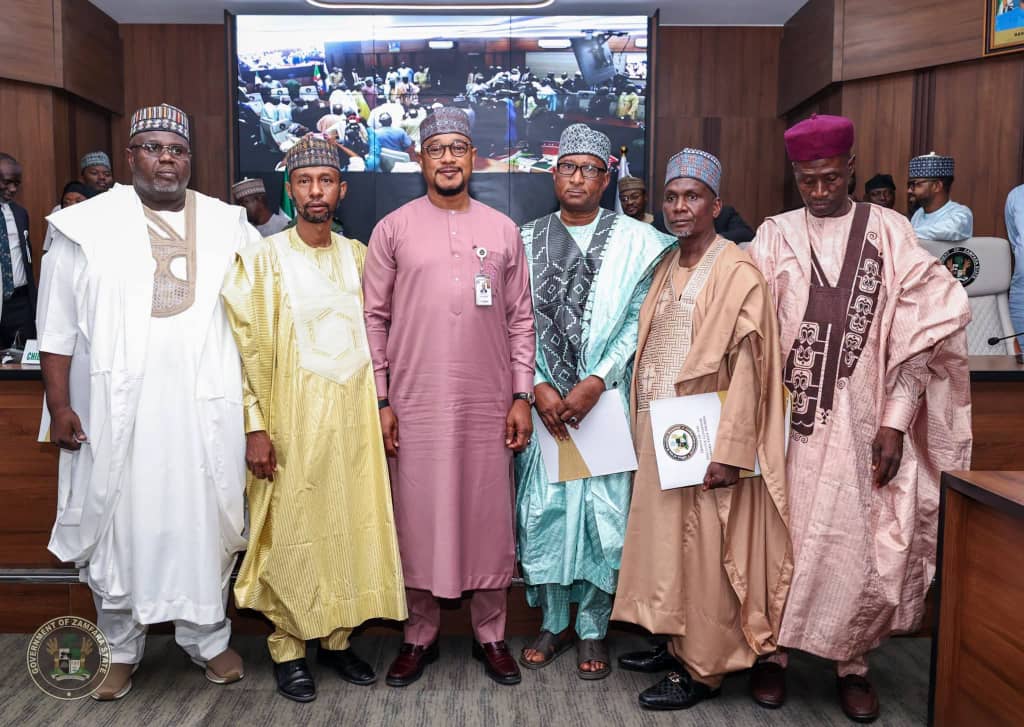
Dauda Lawal swears in five permanent secretaries in Zamfara, urging them to follow public service rules, financial regulations and relevant laws
Zamfara State Governor, Dauda Lawal, has sworn in five new permanent secretaries, urging them to comply with Public Service Rules, financial regulations and other relevant laws in the discharge of their duties.
Also read: 2027: 21 Adamawa LG Chairmen, 226 Councillors Dump PDP for APC
The swearing-in ceremony took place on Thursday at the Grand Chamber of the Government House in Gusau, the state capital.
The newly appointed permanent secretaries are Ahmad S. Zamfara, Nasiru Halilu Anka, Mu’azu Jibril Guraguri, Adamu Abdullahi Kanoma and Sani Muhammad Shinkafi.
The Chief Judge of Zamfara State, Justice Kulu Aliyu, administered the oath of office to the appointees, who pledged allegiance to the Federal Republic of Nigeria in accordance with the Constitution and the law.
Speaking at the ceremony, Lawal congratulated the new permanent secretaries, describing their appointments as recognition of their experience, abilities and readiness to take on greater responsibilities.
He said their roles extended beyond personal career advancement, noting that their decisions and conduct would influence government performance and the welfare of residents.
“The Permanent Secretary is central to Government, providing administrative leadership, institutional continuity, and policy advice while implementing approved programs,” the governor said.
He added that permanent secretaries were responsible for maintaining discipline, coordinating their establishments and ensuring that public resources were used for their intended purposes.
Lawal said his administration remained committed to strengthening government institutions and improving public administration to support Zamfara’s development priorities.
He noted that the civil service played a critical role in translating government decisions into practical results, particularly in the delivery of essential services.
The governor urged the new appointees to align their work with his administration’s priorities through proper planning, realistic implementation strategies, effective supervision and continuous assessment of results.
He also called on them to maintain constructive and professional relationships with commissioners and other political officeholders.
According to Lawal, political leaders are responsible for setting policy, while career civil servants provide the institutional knowledge, technical advice and administrative capacity needed to implement it.
He stressed that mutual respect and cooperation between political officeholders and career civil servants were essential to effective governance.
Also read: 2027: 21 Adamawa LG Chairmen, 226 Councillors Dump PDP for APC
The governor urged the permanent secretaries to uphold discipline and professionalism while ensuring that their departments supported the administration’s development agenda and served the needs of the people of Zamfara.

Troops rescue four kidnap victims in Zamfara and Kebbi during separate military operations targeting suspected terrorists and criminal groups
-
Politics3 years ago
13 Ondo Assembly Members Disown Endorsement of Aiyedatiwa
-
Politics3 years ago
APC Group, Ondo Govt, Quarrel Over Money for Endorsement
-

 Trending News5 years ago
Stop unsavoury, inciting statements – DSS warns
-

 Others5 years ago
Adron Homes Celebrates 10 Years Of Housing Excellence
-

 Humanity5 years ago
President Buhari Commiserates With Ambassador Maureen Tamuno Over The Loss Of Her Father
-

 Others7 years ago
EX- CUSTOMS BOSS, IBRAHIM MERA’S DWINDLING FAME
-

 Business2 years ago
Bigi Carbonated Soft Drinks Treats 40 Consumers to an Epic Easter Movie Hangout
-

 Business2 years ago
Wema Bank Shines at Global SME Finance Forum Conference Awards 2024 …Awarded: • SME Financier of the Year (Africa) • Platinum Award for Best Financier for Women Entrepreneurs (Africa)