
Trending News
Despite COVID-19, Lasaco Records GPW Of N10.937billion In 2020, Says Teju Philips At Annual 41st AGM

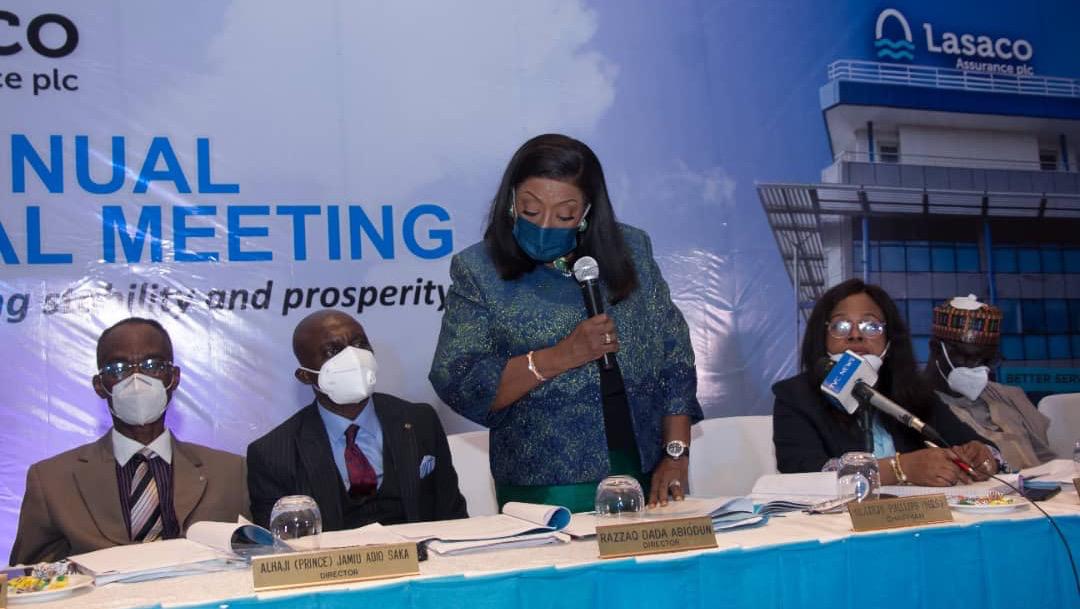
The Chairman of Lasaco Assurance Plc, Mrs Olateju Philips, has disclosed that in spite of the challenging situation experienced in the year 2020 has a result of the COVID-19 pandemic, the company was able to deliver an awesome performance with a record Gross Premium Written of N10.937billion.

Mr Philips who made this known during the company’s 41st Annual General Meeting held at Marriott Hotel, Ikeja GRA Lagos, added that Lasaco Assurance Plc was able to generate N8.05billion in net underwriting income as against N6.71billion made in 2019, signifying an increase of 20% year on year.
According to her,”In spite of the challenging situation experienced during the course of the year, the company was able to deliver an awesome performance in 2020 and grew stakeholders’ value. We recorded a Gross Premium Written of N10.937billion.
“This signifies a 17% growth in performance compared to Gross Premium Written in 2019. The company made N8.05billion in net underwriting income as against N6.71billion made in 2019 signifying an increase of 20% year on year.
“100% increase was recorded in profit before tax from N315.7billion in 2019 to N679.4million in 2020. Our total asset grew from N18.5billion to N20.5billion signifying 11% increase while shareholders’ fund declined by 2% from N7.98billion in 2019 to N7.80billion in 2020.
Speaking further, she said that with the array of economic events which the company was able to manage in the previous year and strategies put in place by the leadership of the organization, 2021 promises to be better for Lasaco Assurance Plc.
“We are also hopeful that the economic policy adjustments and reforms will aid the business environment positively.
“In the last one year, we have worked assiduously to map out strategies to improve our identity and visibility to increase sales and market share. Our strategies to improve our identity and visibility to increase sales and market share.
“Our strategic digital transformation plan will aid customer experience and the diversification of income streams deepening will add tremendous value to the bottom line.
“Plans have also been devised for the diversification of our Investment portfolio. This will spur the organization to growth through increase in investment income.
She lamented that the COVID-19 pandemic placed Nigeria in a critical condition in 2020 as the country locked down economic activities at the beginning of quarter 2020 in order to minimize the spread of COVID-19 virus.
She said the country entered the crisis with the failing per capital income, high inflation, and governance challenges which affected every aspect of business and economic lives.
“The Nigeria’s economy experienced a 3.6% contraction in the first three quarters of 2020 leading to the worst recessions in decades, oil prices improved and the authorities employed policies to counter the economic distress.
“The economy even with the various unrest experienced across the country, returned to growth albeit marginally, in the final quarter of year 2020, with GDP expanding 0.11% year -on year beating market expectations of 1.9% decline.
“Inflation galloped to a 34- month high 15.75% in December 2020 from 11.98% same period in 2019, fueled by increase food prices due to constraints on domestic supplies and the effect of an exchanged premium that widened to about 24%.
Mrs Philips lamented that citizens agitations in many parts of the country, especially End SARS protest also disrupted lots of activities leading to lost of lives and properties.
She stated that this affected insurance businesses in the country as claims in both high frequency,high severity and near catastrophy were recorded country wide.
“In 2020, Nigeria financially markets based her actions on the monetary policy. The equity market rose to 50% in 2020. It tops performance is over a decade. However, stock performance in 2021 depends on the direction of monetary policy and relative to business environment.
“Nigeria economy is anticipated to grow by 1.8% in 2021. Despite the current encouraging external situation with oil prices recovery and growth in advance economies, reform shortfall would hinder the renewed economic expansion and undermine progress towards Nigeria’s development goals.
“Hopefully, policy adjustments and reforms designed to shift the country from it dependence on oil and to diversify the economy towards private sector -led growth will set Nigeria on a more sustainable path to recovery,” she averred.
She assured the shareholders, board members, management, and staff of Lasaco Assurance Plc, that it is the dawn of new era adding that together with their continuous supports, the legacy of the organization will be sustained.



Tinubu audit targets ghost workers and fake agencies as Nigeria confronts costly gaps in payroll, budgets and public-sector governance
News
URGENT APPEAL FOR SUPPORT FOR H.E. ADEBOWALE (DEBO) ADESINA, FORMER NIGERIAN AMBASSADOR TO TOGO.

The former Nigerian envoy to Togo has remained hospitalised in Canada after suffering a massive stroke, with outstanding medical bills exceeding CAD $205,000
-
Politics3 years ago
13 Ondo Assembly Members Disown Endorsement of Aiyedatiwa
-
Politics3 years ago
APC Group, Ondo Govt, Quarrel Over Money for Endorsement
-

 Trending News5 years ago
Stop unsavoury, inciting statements – DSS warns
-

 Others5 years ago
Adron Homes Celebrates 10 Years Of Housing Excellence
-

 Humanity5 years ago
President Buhari Commiserates With Ambassador Maureen Tamuno Over The Loss Of Her Father
-

 Others7 years ago
EX- CUSTOMS BOSS, IBRAHIM MERA’S DWINDLING FAME
-

 Business2 years ago
Bigi Carbonated Soft Drinks Treats 40 Consumers to an Epic Easter Movie Hangout
-

 Business2 years ago
Wema Bank Shines at Global SME Finance Forum Conference Awards 2024 …Awarded: • SME Financier of the Year (Africa) • Platinum Award for Best Financier for Women Entrepreneurs (Africa)