
Trending News
Fayemi, Akeredolu absent as South-West Leaders moves to endorse ranching, state police

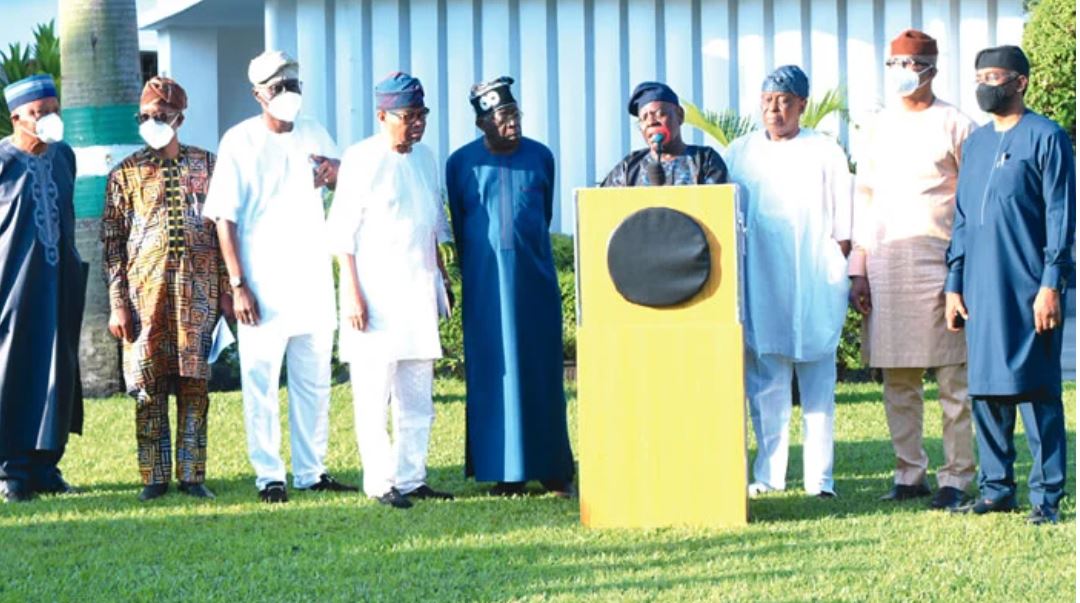
All Progressives Congress Leaders in South-West states, including the Speaker of the House of Representatives, Femi Gbajabiamila, and governors in the region, on Sunday reinstate the call for true federalism and ban of open grazing in the country.

The leaders met in Lagos to back some of the decisions of the Southern governors in Asaba, Delta State, saying there was the need for the Federal Government to address insecurity in the country.
The meeting had in attendance; National Leader of the APC, Asiwaju Bola Tinubu governors of Lagos, Ogun and Osun states, Mr Babajide Sanwo-Olu, Mr Dapo Abiodun and Mr Adegboyega Oyetola, respectively; a former interim chairman of the APC, Chief Bisi Akande; General Alani Akinrinde (rtd.); a former governor of Ogun State, Aremo Segun Osoba; Minister of Industry, Trade and Investment, Otunba Niyi Adebayo, Pius Akinyelure, among others.
The prominent leaders in the state read the nine points communiqué at the end of the deliberation, Akande, who convened the meeting, said they were concerned about the state of the nation.
The communiqué reads partly, “For Nigeria to overcome these challenges, we must do so with unity of purpose and action. The desire for peace and the chance for a prosperous and just society are universal and transcend all regional, religious or ethnic divisions. Sadly, many public figures have made statements that spark division and undermine the needed unity of purpose.
“We hold to the view that true federalism where more power and resources are allocated to the states will be an essential part in strengthening society and improving democratic governance so that we beat the present challenges but also engender durable peace and security.
“True federalism and the reallocation of resources and authority that comes with it will empower the states to solve localised issues before they spread and transform into national ones. In addition to mitigating political competition for control of the national government, greater federalism will empower grassroots economic development and political reforms that will stand as bulwarks against the terrorism and criminality now experienced in too many parts of the nation. A hallmark of this enhanced federalism will be the establishment of state police forces.
“We endorse the position of the southern governors taken at their May 11, 2021 summit in Asaba, Delta State, regarding ranching. We do so because such a decision will lessen tensions between farmers and herders while also helping the long-term economic viability of both the farming and herding communities.
“We are mindful of the short-term dislocation this might cause but are also mindful that this position is in the best interests of all parties concerned. We, therefore, recommend that the federal and state governments cooperate fully with each other to enact the necessary measures to encourage this more effective and modern method of cattle-rearing so that both farmers and herders can pursue their livelihoods with greater productivity and in a more cooperative relationship that minimizes the friction between these two important pillars of our agricultural economy.”
However, the Ondo State Governor Rotimi Akeredolu and his Ekiti State counterpart, Dr Kayode Fayemi, were not at the meeting.
Efforts to speak to Akeredolu’s Chief Press Secretary, Olabode Olatunde, and the state Commissioner for Information, Donald Ojogo, were not successful.
Dipe said, “I honestly will not know whether he was at the meeting or not.”
A source close to the governors said they did not attend the meeting because it was anchored on the ambition of an individual.
He said, “We cannot be part of such meeting which was held under the guise of somebody’s ambition when the country is facing myriad of crises.”
But Adebayo was said to have apologised on behalf of Akeredolu and Fayemi, saying they had other previous scheduled engagements.


Tinubu audit targets ghost workers and fake agencies as Nigeria confronts costly gaps in payroll, budgets and public-sector governance
News
URGENT APPEAL FOR SUPPORT FOR H.E. ADEBOWALE (DEBO) ADESINA, FORMER NIGERIAN AMBASSADOR TO TOGO.

The former Nigerian envoy to Togo has remained hospitalised in Canada after suffering a massive stroke, with outstanding medical bills exceeding CAD $205,000
-
Politics3 years ago
13 Ondo Assembly Members Disown Endorsement of Aiyedatiwa
-
Politics3 years ago
APC Group, Ondo Govt, Quarrel Over Money for Endorsement
-

 Trending News5 years ago
Stop unsavoury, inciting statements – DSS warns
-

 Others5 years ago
Adron Homes Celebrates 10 Years Of Housing Excellence
-

 Humanity5 years ago
President Buhari Commiserates With Ambassador Maureen Tamuno Over The Loss Of Her Father
-

 Others7 years ago
EX- CUSTOMS BOSS, IBRAHIM MERA’S DWINDLING FAME
-

 Business3 years ago
Bigi Carbonated Soft Drinks Treats 40 Consumers to an Epic Easter Movie Hangout
-

 Business2 years ago
Wema Bank Shines at Global SME Finance Forum Conference Awards 2024 …Awarded: • SME Financier of the Year (Africa) • Platinum Award for Best Financier for Women Entrepreneurs (Africa)