
Opinion
Between Fela and Whizkid…. 2


By Bola BOLAWOLE
Michael Jackson has now arrived in Jamaica for a meeting with Bob Marley. Read on!

“Kingston, Jamaica, October 23rd, 1978. 8:30 p.m: The exclusive Pegasus Hotel’s penthouse suite was buzzing with quiet conversation when Michael Jackson walked through the heavy wooden doors… Michael had an agenda beyond social pleasantries.
Also read: PDP Criticises Kwara Governor Over Deadly Bandit Attack
He wanted to propose something that would reshape both (his and Bob Marley’s) careers forever.
The contrast between the two men was immediately striking. Michael wore an expensive silk shirt, perfectly tailored pants, and his signature sequin glove, representing everything successful about the American music industry.
Bob, in contrast, wore simple jeans and a cotton shirt, his dreadlocks flowing naturally, embodying the authentic spiritual energy that had made him reggae’s most respected voice…
Bob looked up as Michael approached, setting down his guitar with the measured calm that characterized everything he did. “Michael Jackson,” Bob said with a slight smile, gesturing to the empty chair across from him. “The prince of pop music. Bless up, brethren.”
Michael slid into the chair, immediately struck by the difference between this intimate setting and their brief backstage encounter three years earlier.
Here, face-to-face, he could see the profound intelligence in Bob’s eyes—the spiritual weight he carried, the way he seemed to be listening to something beyond their conversation.
“Bob, it’s an honor to finally sit with you properly”, Michael said, his nervous energy evident despite his attempt to appear confident. “I’ve been hoping for this opportunity for years.
Bob’s expression remained warm but curious. “What brings the King of Pop to Jamaica, Michael? What’s on your heart?”
Michael leaned forward across the small table between them, his excitement building as he outlined his vision. “Bob, I want to propose something that could change music history. A full collaboration—an album, a world tour, maybe even a concert film. We could combine your consciousness with my reach, your message with my platform.”
Bob studied Michael’s face carefully, reading not just his words, but his intentions… “Tell me more about this vision,” Bob said, folding his hands on the table.
Michael’s excitement grew as he painted his picture, gesticulating with typical enthusiasm. “Picture this: your spiritual lyrics with my melodies and production values. Your authentic message
reaching mainstream audiences who have never heard conscious music. We could reach 100 million people with messages about unity, love, and social justice.” Michael outlined the scope of his vision with genuine passion.
Record executives had estimated the project could generate over $50 million in revenue.
The tour would hit every major American city, introducing reggae to audiences who had never heard conscious music before.
Bob listened intently, occasionally nodding, but his eyes never left Michael’s face.
Across the table, he could sense Michael’s genuine enthusiasm—but also the fundamental misunderstanding that lay beneath the proposal.
“And how would this collaboration work practically?” Bob asked quietly. “Would my message change to fit your audience or would your audience change to receive my message?”
The question hung in the air between them like smoke from sacred fire.
Michael hadn’t expected such a direct philosophical challenge, and Bob’s steady gaze made it impossible to avoid the deeper implications of what he was proposing.
“We could find a middle ground, hopefully” Michael suggested. “Keep your message but make it more accessible to mainstream audiences who might not be ready for the full intensity of Rastapharian philosophy.”
Bob leaned back slightly, creating physical space that somehow made his next question more powerful. “What does more accessible mean, Michael?”
Sitting across from Bob in the intimate setting of the suite, Michael felt the weight of having to articulate something he’d never fully examined.
“Maybe less political content, more universal themes like love and unity that don’t make people uncomfortable—songs that can play on mainstream radio without causing controversy.”
Bob’s response was gentle but penetrating, his voice cutting through Michael’s commercial enthusiasm like truth through illusion.
“Universal love that avoids uncomfortable truths isn’t universal love, Michael. It’s comfortable love. And comfortable love never changed anything.”
The face-to-face setting made every word feel more significant, more personal.
Michael could see the compassion in Bob’s eyes, but also the unwavering commitment to principles that couldn’t be compromised for any amount of success.
Bob continued with an insight that would haunt Michael for years. “When you perform, Michael, what are you trying to accomplish? What do you want people to carry with them when they leave your concert?
Michael straightened in his chair, suddenly feeling like a student being examined by a master teacher. “I want to entertain people, make them happy, give them an escape from their problems, and I want to wake people up.”
Bob replied, his voice carrying the same authority that made his music so powerful. (In contrast, explaining what he seeks to accomplish when performing, Bob said): “To help them understand their problems and find the strength to solve them. Both callings have value, but they cannot be the same thing.” Bob’s voice took on the teaching quality that made his conversations as influential as his songs.
“Michael, you have tremendous talent, tremendous gifts from Jah. Your ability to move people through music is extraordinary. But this collaboration you are proposing—it would require one of us to compromise our essential nature.”
The conversation continued for over an hour with Bob patiently explaining his philosophy while Michael tried desperately to find ways to make the collaboration work.
But sitting face-to-face, seeing Bob’s unwavering spiritual commitment up close, Michael began to understand that this wasn’t about business strategy or creative compromise.
It was about two fundamentally different approaches to the purpose of music.
Bob continued with profound gentleness. “When Marcus Garvey spoke about black pride, white people were uncomfortable. When Martin Luther King spoke about justice, white people were uncomfortable. When Jesus spoke about loving your enemies, everyone was uncomfortable. Discomfort is often the first sign that consciousness is awakening.”
Bob paused, allowing his words to settle. “When you perform, you give people what they want—happiness, excitement, escape. When I perform, I give people what they need—truth, consciousness, spiritual awakening. Both serve Jah’s purpose, but they cannot be the same thing.”
“But think about the impact we could have together”, Michael said desperately, leaning forward across the table. “The number of people we could reach with positive messages.”
Bob’s response became legendary among those who witnessed the meeting. “Michael, reaching many people with a diluted message is less powerful than reaching fewer people with a pure message. Quality of consciousness matters more than quantity of audience. Better to awaken one person completely than to entertain a million people temporarily.”
Michael felt the collaboration slipping away, but he made one last attempt. “What if we could do it your way? What if I adapted my style to your message instead of asking you to adapt your message to my style?”
Bob appreciated Michael’s willingness to consider this approach, but his answer revealed the deeper issue.
“Michael, you are already perfect at what Jah called you to do. Your gift for bringing joy to people is precious and necessary. Don’t diminish that gift by trying to become something you are not. And don’t ask me to diminish mine by becoming something I am not.”
As their meeting neared its end, Bob said: “You are a star, and stars are meant to shine bright and bring joy to people. I respect that calling deeply. But I am not a star. I am a messenger. And messengers must deliver the message exactly as Jah gave it to them.”
Bob stood slowly, extending his hand across the table. “We both serve the same creator through different expressions. Your path is perfect for you. Mine is perfect for me. To change either would diminish both.”
When they shook hands, Michael felt both disappointed and enlightened. Bob had rejected the biggest collaboration offer in music history…The proposed Michael Jackson–Bob Marley collaboration never happened. But both artists went on to achieve their destinies authentically.
Michael became the undisputed king of pop, using entertainment to bring joy to billions worldwide. Bob remained reggae’s spiritual messenger until his death in 1981.
Years later, Michael would credit that face-to-face meeting with teaching him about artistic integrity. “Bob taught me”, Michael said, “that every artist has to choose between being famous and being important.”
Bob chose importance over fame every time…When Bob died in 1981, Michael was among the artistes who publicly honored his memory…The face-to-face meeting that could have created music history’s greatest collaboration instead created something more valuable—mutual understanding between two masters who recognized that their separate paths served the same goal of uplifting humanity through music.
The Michael Jackson–Bob Marley collaboration that never was reminds us that sometimes the most important artistic decisions are the ones that prioritize authenticity over opportunity, message over money, and spiritual integrity over commercial success.”
We can pigeon-hole Fela and Bob Marley together and Michael Jackson and Whizkid likewise.
Everyone is blessed with talents; everyone is used by God for different purposes; everyone is a star in his own right; everyone, like Frantz Fanon posits, discovers their mission, to fulfil or betray it, taking different routes.
There is no basis, therefore, for comparison. We cannot compare apples with oranges.
Also read: PDP Criticises Kwara Governor Over Deadly Bandit Attack
Financial success and audience followership are poor yardsticks of measurement because conscious music (Bob Marley/Fela) is not the same as entertainment music (Michael Jackson/Whizkid).



Writer Ehi Braimah has called on Rotary clubs across West Africa to prioritise lasting partnerships over short-term projects as the region prepares for the 2026 West Africa Project Fair.
The Fair, hosted by Rotary International Districts 9111 and 9112, is scheduled to hold from November 10 to 17 at the Balmoral Convention Centre, Sheraton Hotel, Ikeja, Lagos.
It will be flagged off by Rotary International President Olayinka Babalola and is expected to draw clubs, Rotarians, Rotaractors and international partners from nine districts across the region.
Braimah noted that the theme, “Partnerships for Lasting Impact,” reflects a shift from simply launching projects to ensuring that interventions continue to serve communities long after commissioning.
He argued that many development challenges in West Africa — including healthcare, education, water, sanitation, food security and environmental issues — transcend national borders and require collaborative solutions.
According to him, a common weakness in development work is the “project mentality,” where attention focuses on starting and completing initiatives rather than guaranteeing their long-term usefulness.
Braimah stressed that true partnerships go beyond sponsorship. They involve shared responsibility, technical expertise, institutional support, monitoring and local ownership.
He said the Project Fair offers a marketplace for clubs seeking funding or technical help to connect with partners who can provide resources, knowledge or institutional backing.
The column concluded that lasting impact is achieved when Rotary’s community presence is combined with the strengths of governments, businesses and development organisations, creating solutions that communities can sustain.

Columnist Ikeddy Isiguzo has raised fresh questions about the Lagos-Calabar Coastal Highway project and President Bola Tinubu’s second-term campaign strategy.
In his latest piece, Isiguzo criticised what he described as inconsistencies in explanations offered by Works Minister David Umahi regarding changes to the multi-billion-dollar highway.
He argued that the project, originally presented as a flagship infrastructure plan, has faced technical and financial challenges that were not adequately addressed at the outset.
Isiguzo recalled earlier concerns he raised in 2024 about the absence of detailed technical designs, environmental assessments and competitive bidding processes.
He also commented on the political dimensions of the project, noting recent statements by the minister linking adjustments to the route with presidential directives.
Turning to the 2027 elections, the columnist suggested that President Tinubu appears reluctant to campaign extensively across the country, preferring to rely on party structures and selected regional appearances.
Isiguzo listed proposed campaign locations and questioned the exclusion of certain states, interpreting the itinerary as a sign of limited political confidence.
He further criticised the ruling party’s internal dynamics, including competition among senior figures for future positions.
The column concluded with a brief reference to recent comments by the Edo State APC chairman on Peter Obi, describing them as extreme.
Isiguzo’s article continues his pattern of sharp commentary on governance and infrastructure under the current administration.
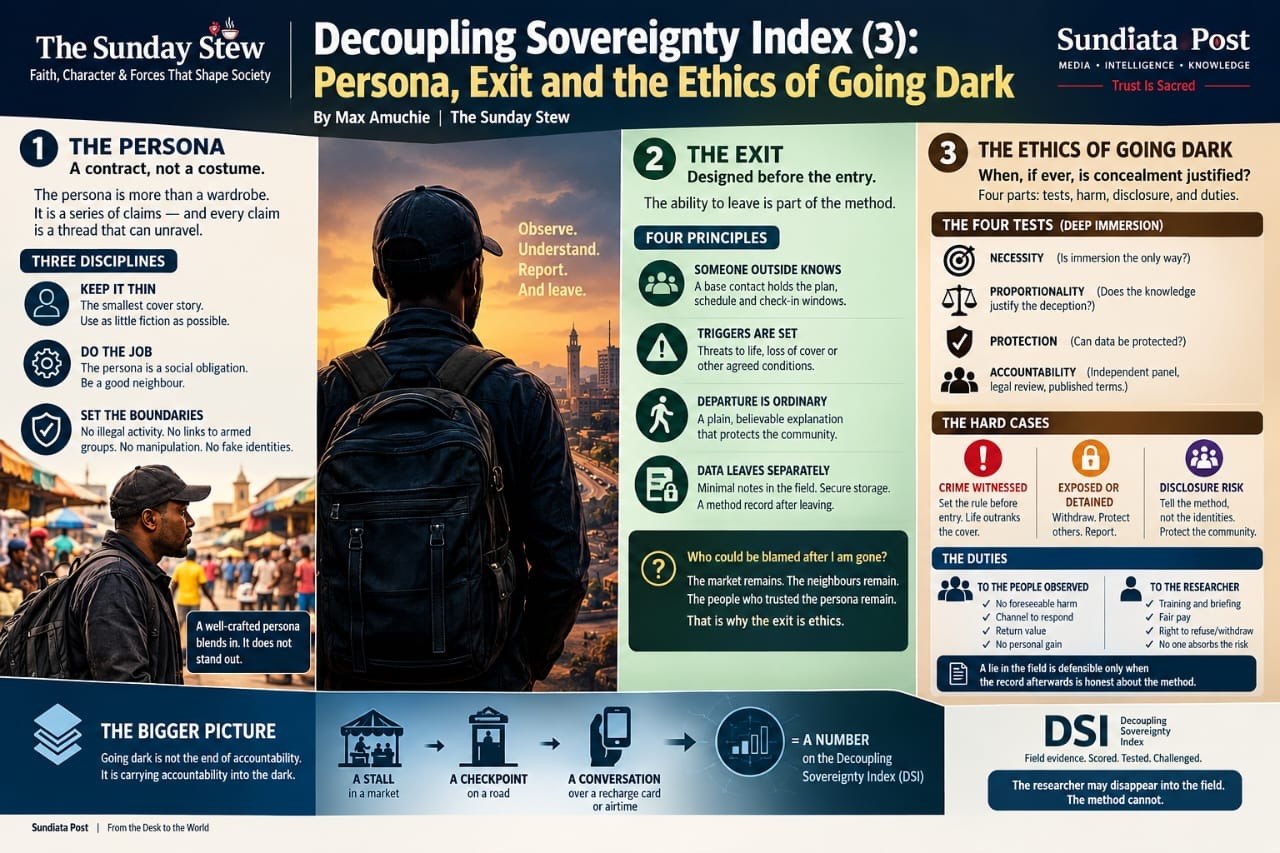
In the latest instalment of his Decoupling Sovereignty Index series, Max Amuchie examines the ethical obligations that arise when researchers adopt temporary identities to study decoupled zones.
Writing in The Sunday Stew, the Sundiata Post CEO and theorist argues that any methodology requiring a researcher to live under a borrowed role creates three unavoidable duties: the role must be disciplined, the researcher must be able to leave, and the deception must be ethically justified.
Amuchie treats the persona as a contract rather than a costume. He advises keeping the cover story thin, performing the assumed job properly, and setting clear boundaries before entering the field. These boundaries include never participating in illegal activity, never passing information to armed groups, never manipulating relationships solely to extract information, and never assuming the identity of a real person.
He stresses that the exit must be designed before entry. At the Sundiata Post Knowledge Lab, no researcher enters a zone until the exit plan is written down. This includes external check-ins, pre-agreed triggers for withdrawal, an ordinary departure story, and separating data from the person so that the community is not exposed after the researcher leaves.
On the ethics of “going dark,” Amuchie applies four tests: necessity, proportionality, protection and accountability. Immersion is justified only when remote or rapid methods cannot answer the research question.
The knowledge gained must outweigh the deception, and no observed person should face foreseeable harm. An independent panel must review and can veto any covert plan.
He addresses three hard cases: what to do if the researcher witnesses a crime, what happens if the persona is exposed, and how to disclose the method without endangering people. Life outranks the cover. Where imminent danger exists, the researcher must warn or withdraw even if it ends the assignment.
Amuchie insists that the duty runs both ways. The people observed must not pay a price for the findings, and the researcher must be trained, fairly paid and free to refuse or withdraw without penalty.
The column concludes that a lie in the field is defensible only when the later account is fully honest about the method. The people may be protected; the method may not.
Part 4 of the series will examine how field evidence is translated into scores on the Decoupling Sovereignty Index.
-
Politics3 years ago
13 Ondo Assembly Members Disown Endorsement of Aiyedatiwa
-
Politics3 years ago
APC Group, Ondo Govt, Quarrel Over Money for Endorsement
-

 Trending News5 years ago
Stop unsavoury, inciting statements – DSS warns
-

 Others5 years ago
Adron Homes Celebrates 10 Years Of Housing Excellence
-

 Humanity5 years ago
President Buhari Commiserates With Ambassador Maureen Tamuno Over The Loss Of Her Father
-

 Others7 years ago
EX- CUSTOMS BOSS, IBRAHIM MERA’S DWINDLING FAME
-

 Business2 years ago
Bigi Carbonated Soft Drinks Treats 40 Consumers to an Epic Easter Movie Hangout
-

 Business2 years ago
Wema Bank Shines at Global SME Finance Forum Conference Awards 2024 …Awarded: • SME Financier of the Year (Africa) • Platinum Award for Best Financier for Women Entrepreneurs (Africa)