
Business
Maritime Agents Shut MSC Apapa Office Over Freight Hike


Maritime agents shut MSC Apapa office in protest over freight increase, citing rising costs and inflation pressures on Nigeria’s import economy

Agents operating in Nigeria’s maritime sector, including members of the African Association of Professional Freight Forwarders and Logistics of Nigeria and the Association of Nigeria Licensed Customs Agents, Western Zone, shut down business operations at the Apapa office of the Mediterranean Shipping Company (MSC) on Monday, protesting a recent hike in shipping charges.
Also read: Lekki Deep Seaport access road boosts maritime confidence
The agents warned that the increase in freight rates would fuel inflation in an already fragile economy.
They demanded that operations remain suspended from 6 a.m. on Tuesday until the shipping company reverted to its former charges.
Frank Ogunojemite, National President of the African Association of Professional Freight Forwarders and Logistics of Nigeria, blamed the Nigerian Shippers’ Council (NSC) for failing to regulate the sector.
He warned that the council’s office might also face shutdown if the issue is not resolved.
“Yes, it was shut down. We have sent a letter to the presidency, and we suspect a compromise at the Nigerian Shippers’ Council. We may likely shut down the NSC if the issue is not addressed,” Ogunojemite said.
A maritime research group, Sea Empowerment Research Centre (SEREC), stressed that the port and maritime sector remains critical to trade, revenue generation, and economic stability.
Eugene Nweke, Head of Research at SEREC, noted that while concerns over tariff hikes are valid, protests must adhere to professional industrial relations standards.
“While stakeholder concerns regarding arbitrary and disproportionate tariff increases are legitimate, the methods adopted must align with international best practices. Sustainable solutions lie not in confrontation, but in credible regulation, responsible leadership, and collective discipline,” Nweke stated.
Thomas Alor, Ports & Terminal Multiservice Chapter Chairman of NAGAFF, criticised the timing of stakeholder meetings convened by MSC, saying it was inconvenient and appeared to push the increase through without proper consultation.
Other industry figures highlighted operational inefficiencies, including delayed container refunds, as compounding the impact of rising charges. Femi Anifowose, ANLCA Western Zone Coordinator, warned that unchecked shipping fees and inefficiencies undermine trade facilitation and worsen inflationary pressures in Nigeria’s import-dependent economy.
Responding, a source at the NSC indicated that engagements with stakeholders would soon take place. MSC’s Africa Regional Controller, Jesse Chege, defended the hike, noting it was approved by the NSC in December 2025 after two years of deliberation, citing rising operational costs.
Also read: Nigerian navy 69th anniversary showcases commitment to Nigeria maritime security
The protest highlights ongoing tensions in Nigeria’s maritime sector as agents and regulators navigate rising costs, operational inefficiencies, and the impact on the wider economy.


Tinubu Niger Delta summit opens in Port Harcourt as investors and policymakers gather to drive investment, innovation and industrial growth

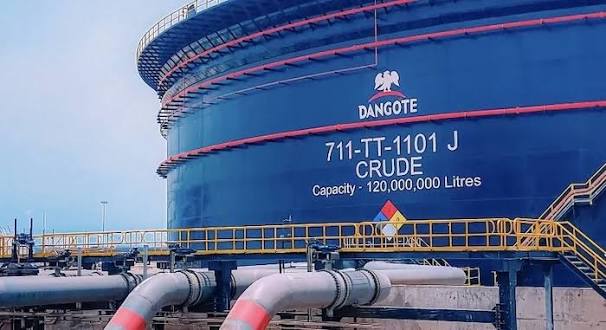
Dangote Petroleum Refinery has set its initial public offering price at ₦525 per share, with the company seeking to raise about ₦2.15 trillion as it prepares to enter Nigeria’s public equities market.
The Securities and Exchange Commission has approved the offer for 4.1 billion ordinary shares at ₦525 each. If fully subscribed, the offer would generate approximately ₦2.15 trillion, equivalent to about $1.6 billion at current exchange rates.
The offering is expected to open on 14 September 2026, according to Aliko Dangote, the president of Dangote Industries. The planned sale is positioned to become one of the largest equity offerings in Africa.
The IPO marks a significant step in Dangote Group’s plans to broaden ownership of the refinery and raise additional capital for expansion.
The refinery currently has a stated processing capacity of 650,000 barrels of crude oil per day. Dangote has said the company plans to increase that capacity to 1.4 million barrels per day as part of its longer-term expansion strategy.
The planned share sale follows a $1 billion underwriting programme completed in August, providing additional financial backing ahead of the public offering.
The refinery, located in the Lekki area of Lagos State, is one of Africa’s largest industrial projects and has become an increasingly important player in Nigeria’s fuel supply market since beginning operations.
The public offering will give Nigerian investors an opportunity to acquire shares in the refinery directly, while providing Dangote Petroleum Refinery with fresh capital to support its next phase of growth.
The company has also indicated ambitions to expand beyond its current Nigerian operations, with Dangote recently announcing plans for another refinery project in Kenya.
-
Politics2 years ago
13 Ondo Assembly Members Disown Endorsement of Aiyedatiwa
-
Politics2 years ago
APC Group, Ondo Govt, Quarrel Over Money for Endorsement
-

 Trending News5 years ago
Stop unsavoury, inciting statements – DSS warns
-

 Others5 years ago
Adron Homes Celebrates 10 Years Of Housing Excellence
-

 Humanity5 years ago
President Buhari Commiserates With Ambassador Maureen Tamuno Over The Loss Of Her Father
-

 Others7 years ago
EX- CUSTOMS BOSS, IBRAHIM MERA’S DWINDLING FAME
-

 Business2 years ago
Bigi Carbonated Soft Drinks Treats 40 Consumers to an Epic Easter Movie Hangout
-

 Business2 years ago
Wema Bank Shines at Global SME Finance Forum Conference Awards 2024 …Awarded: • SME Financier of the Year (Africa) • Platinum Award for Best Financier for Women Entrepreneurs (Africa)