Humanity
Game Changer 2.0

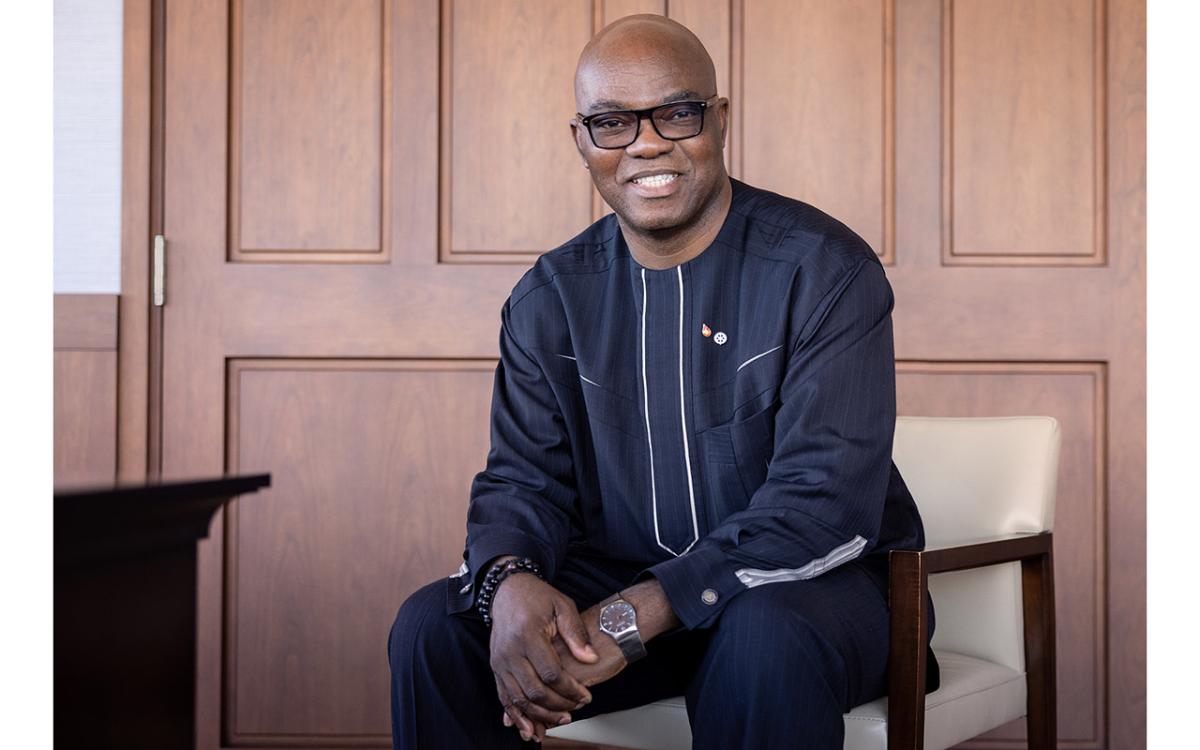
Olayinka Hakeem Babalola becomes Rotary International 2026-27 president, focusing on creating lasting change across communities and members’ lives

Olayinka “Yinka” Hakeem Babalola is sitting on the wrong side of his desk, staring at the tiny squares on the laptop perched in front of him.
Also read: All six Nigerians progress to UCL knockout phase in 2025/26
He’s just finished speaking on a call with 300 Rotaractors from the African continent and other parts of the world, Rotary’s president-elect explains as he turns down the volume.
“They held a celebration for me because I’m a past Rotaractor,” he says. By seeing Babalola, himself once in their shoes, embarking on the highest position in Rotary, who knows how many of the 300 he will inspire.
It’s early October, less than two months since the Rotary International Board of Directors selected Babalola to lead Rotary, in a special session in late August after the resignation of RI President-elect SangKoo Yun, who died shortly after, following months of cancer treatment.
It’s only the second trip to Rotary headquarters for Babalola, of the Rotary Club of Trans Amadi in Nigeria, since his selection.
His office is nearly empty, void so far of all the gifts Rotary leaders tend to accumulate during their travels as an incoming president.

Image credit: Monika Lozinska
While he’s new to the position, he has a long history with Rotary, starting as a Rotaractor in 1984 and then as a Rotarian in 1994.
“One thing is for certain, preparing me for this role are my many years of engaging with Rotary” — over four decades, he says. “Not many people who get to this position have that privilege.”
In that time, he’s served not only as RI vice president and a member of the RI Board of Directors but also as an active leader and participant in RI committees such as the End Polio Now Countdown to History Campaign Committee and the Nigeria PolioPlus Committee. Babalola was a trustee of ShelterBox.
His Rotary honors include the Regional Service Award for a Polio-Free World, the Service Above Self Award, and a Rotary Foundation Citation for Meritorious Service.
He and his wife, Preba, a member of the Rotary Club of Port Harcourt Passport, are Arch Klumph Society members.
That’s all on top of his professional life. He worked for 25 years in the oil and gas industry, holding senior positions with Shell.
He is the founder of two companies: Riviera Technical Services Ltd., an oil and gas infrastructure delivery company, and Lead and Change Consulting, an executive coaching and organizational performance advisory group.
Rotary magazine senior staff writer Diana Schoberg sat down with Babalola to find out more about the president-elect.
He was inspired to join Rotary because of something he saw on TV.
On summer break between his last year of high school and his first year of college, Babalola was hanging out at home watching TV when a well-dressed man on the screen caught his eye.
The man was wearing all white, and “his English was something else,” Babalola recalls.
Curious, he listened more closely. The man was talking about Rotary. “It was the first time I heard anything about Rotary,” Babalola says. “Like with most TV interviews, it probably lasted one or two minutes, but he made an impression on me.”
Fast forward to Babalola’s second year at the university, when the school’s public image director, a member of the Rotary Club of Bauchi, approached him with a proposal: Would Babalola like to help organize a Rotaract club at the school? “I still tell people I have no idea why he approached me,” Babalola says.
He recalled the well-spoken man in white and asked if the director was somehow connected.
It turns out the director knew the man on TV, who was the past district governor.
Babalola was sold on the connection and went on to become the Rotaract club’s charter president.
He met his wife at a Rotaract meeting.
After finishing up his university education, Babalola moved to Port Harcourt and joined the community-based Rotaract Club of Trans Amadi. At one event, he recalls noticing a beautiful woman, the president of a university-based club.
He pointed her out to a friend and said, “That’s the one.” He was right.
But Yinka and Preba aren’t the only members of their family who have been involved in Rotary. Their oldest daughter was the charter president of the Interact club at her secondary school.
She moved to North America for college and today belongs to the Rotary Club of Winnipeg in Manitoba.
Another daughter was the president of her university’s Rotaract club.

Image credit: Monika Lozinska
His nickname is “the game changer.”
Babalola served as district governor in 2011-12 while employed by Shell, a multinational energy company.
This was unlike his predecessors, who were either retired or running their own businesses while they held that role. He knew things had to change for him to be successful.
At his first meeting with the assistant governors and committee chairs, he asked them to include what would be the “game changer” in their proposals: how they used to do things, and how their approach would change going forward. “If they have no answer,” he says, “the proposal is thrown away. They need to present it again.
“It occurred to people that this guy actually wants something different,” he continues. “I’m called the game changer, but the ideas that changed the game were not mine.”
He raised $80,000 with a text message.
Part of Babalola’s effort to make changes as district governor involved his use of technology.
On 1 November, the start of Rotary Foundation Month, he woke up around 3 a.m. and sent a request to a district group on a BlackBerry messaging app asking everyone on the platform to give something to the Foundation that day, no matter how small. Then he went back to sleep.
When he woke up a few hours later, he made his own donation and posted the evidence. Within a few hours, the group had raised $80,000. “Usually, you would gather people together, you’d talk to them, and ask for it,” he says. “But with technology, you could ask virtually.”
That year, every club throughout the district gave something to the Foundation.
The nearly $1 million raised was, he says, the highest amount ever from a district on the African continent for The Rotary Foundation.
He wishes he had more time to go scuba diving.
Babalola is certified to dive to 30 meters and has done some diving in the Mediterranean, the Red Sea, and the Atlantic.
He’s looking forward to someday diving in Hurghada, a resort city on Egypt’s Red Sea coast that’s known for its marine life, iconic wrecks, and high visibility in the water. “The reefs are wonderful,” he says.
He also enjoys other outdoor pursuits including swimming, gardening, and bird-watching.
One of the most interesting birds he’s seen is the Ibadan malimbe, a rare songbird with bright red feathers around its head and face that is found only near his hometown.
The 2026-27 presidential message is Create Lasting Impact.
If you need it, here’s a refresher on Rotary’s vision statement: “Together, we see a world where people unite and take action to create lasting change — across the globe, in our communities, and in ourselves.” This Rotary year, Babalola explains, RI has been focusing on that first word, “together,” through the message Unite for Good.
In 2026-27, members will tackle the next part of the vision statement: creating change that lasts.
Lasting change across the globe is an easy idea for most Rotary members to understand, he says. “They can give you examples: our polio eradication work, our peace centers, global grants,” he says.
“When you talk about lasting change in communities, they know because they do things in their own communities. But each time I’ve been in a gathering of Rotarians and asked them about lasting change in themselves, usually the room goes quiet.”

Image credit: Monika Lozinska
He thinks a key to growing Rotary is realizing the effect it has on you.
While members can and should measure the impact of a project, Babalola wants to see that idea flipped, too. “How has doing all of that impacted you?”
He can clearly see how Rotary has changed his own life. “I had a privileged upbringing — a good education in a place where many did not have that opportunity,” he says. “Rotary grounded me. It pulled me out of my privileged world and put me in touch with the realities of my community.”
Many Rotary members have their own stories about how their membership has changed their lives for the better, how it humbled them or brought them closer to their fellow human beings. Babalola encourages them to share those stories. “If we are going to grow this organization, we must let people understand how membership can make a lasting impact on their own lives,” he says. “That’s one of the things I’m hoping that I can help communicate.”
Rotary made him a diplomat.
As a Rotary director in 2018-20, Babalola represented more than 80 Rotary countries and geographical areas — over a third of the Rotary world — including countries in Africa (where at least 1,000 languages are spoken), the Middle East, and parts of Europe. The zones he represented included politically sensitive areas such as Israel, Lebanon, Ukraine, and Afghanistan. “There are certain skills you end up building,” he says.
For example, at a Rotary institute he convened in Egypt, he received a phone call from a senior government official about a map of Africa used at the event. The map, which he’d found on the internet, showed Western Sahara as a separate country, which Morocco does not recognize. Egypt supports the position of Morocco. “That kind of situation brings a certain awareness straight to you,” he says.
He’s the second president from Africa.
“It means a lot for the people of that continent,” he says. And, he adds, everyone seems ready to do the work to support him. “I’m used to delivering results. We need to deliver results,” he says. That’s what he’s been preaching at the Rotary institutes he’s attended.
Also read: All six Nigerians progress to UCL knockout phase in 2025/26
“I’ve told them, stop talking about things. Just do it. If it works somewhere, copy it shamelessly. Don’t be afraid to fail — be afraid not to try.”


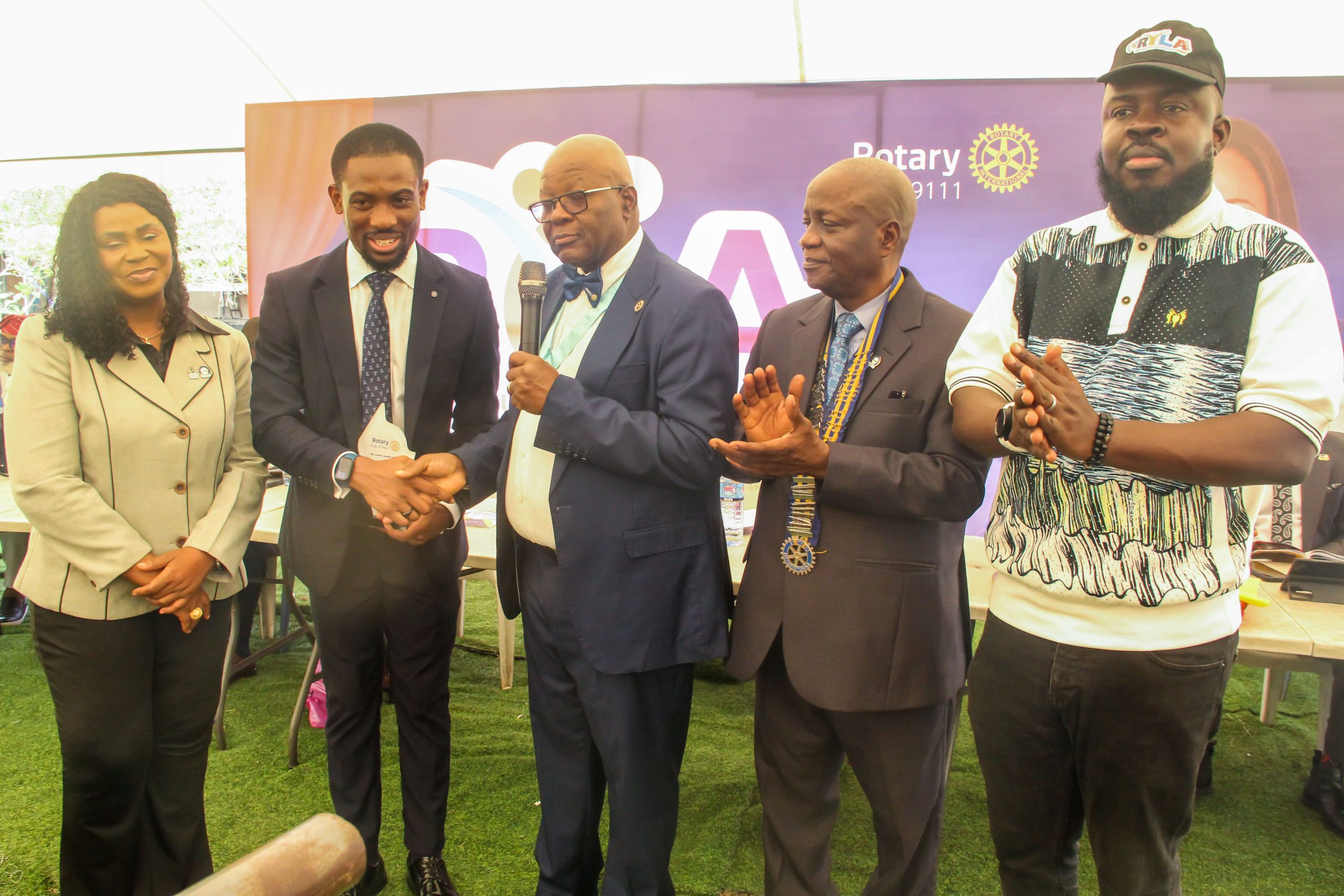
The leading club in Rotary International District 9111, Rotary Club of Ikeja, has donated N1 million to support this year’s Rotary Youth Leadership Academy, RYLA 2026.
The donation was made by the Impact President, Rotarian Kayode Osokomaiya on behalf of the club last Monday, August 3rd, 2026 during the club’s meeting at the Sea School , Apapa where the week long RYLA 2026 is taking place.
Speaking at the event as a Guest Speaker on the theme, ‘Creating Lasting Impact: Igniting Purpose Driven Leaders’, the Managing Director of Knewrow, Mr. Tomiwa Anjorin said that young people have the capacity to make as much impact as the adults.
Mr. Anjorin said: “If impact was only a conversation for adults, this event would never have been organised. The fact that we are here today is proof that you are not too young to make a difference.
“With over 50 million teenagers in Nigeria, your generation represents one of our nation’s greatest opportunities. The question is not whether you can change Nigeria, but whether you will choose to.
“Many of us have been taught to pursue success first and impact later. I believe we have the order reversed. Impact comes before success.The world’s most successful organisations, such as Google and Microsoft, became successful because they solved meaningful problems and created value for millions of people. Success is often the reward for sustained impact.
“I encourage you to shape your future through four choices: choose character over popularity, service over selfishness, growth over comfort, and responsibility over excuses. These decisions build trust, develop competence, and prepare you for lasting leadership.’’

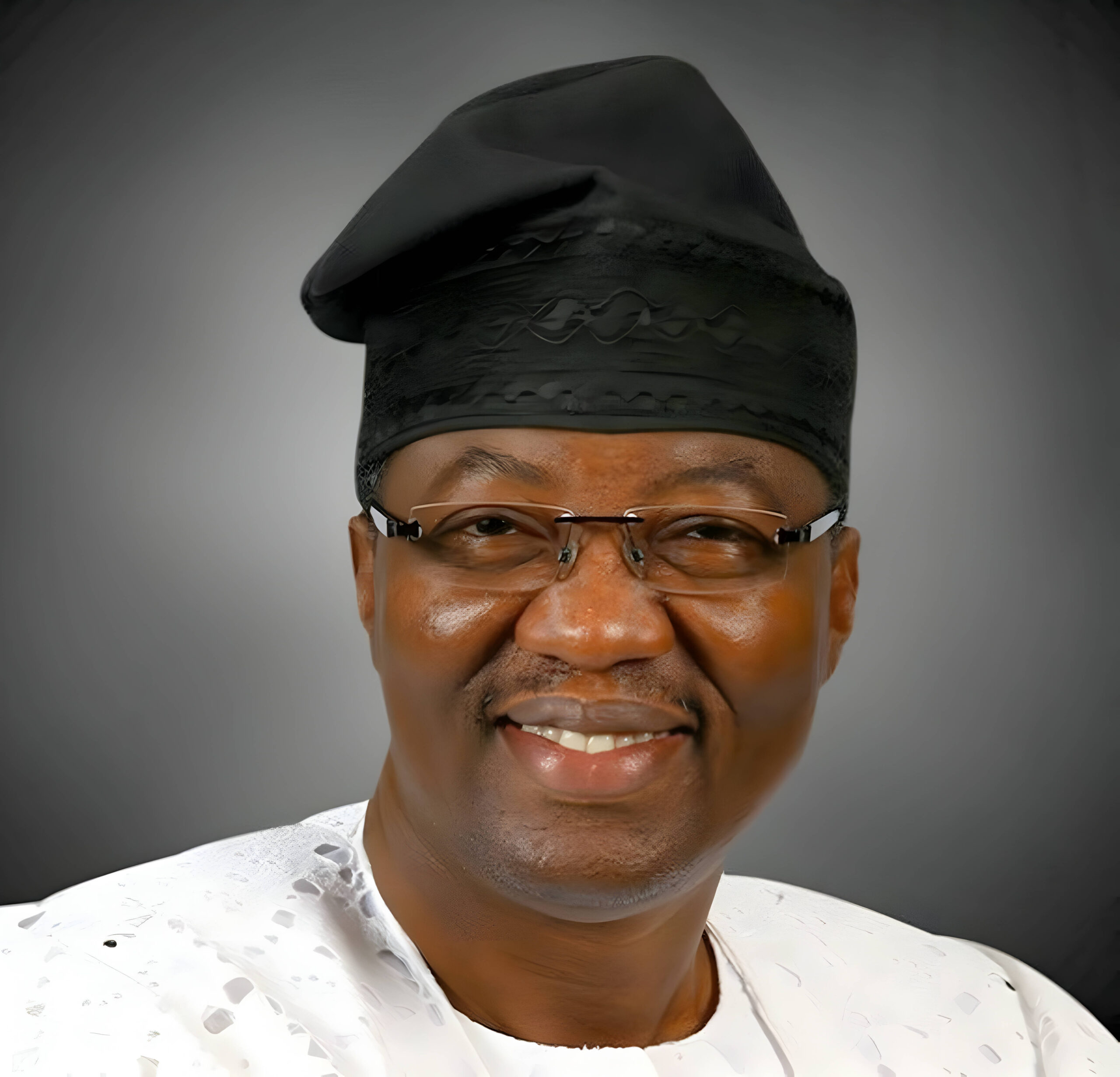
Atan General Hospital solar grid project boosts healthcare services as Senator Gbenga Daniel delivers stable power to the Ogun facility
Humanity
Leo Stan Ekeh Foundation, Zinox, TD Africa, others donate Multi-Million Naira AI-Tech Centre to Holy Ghost College

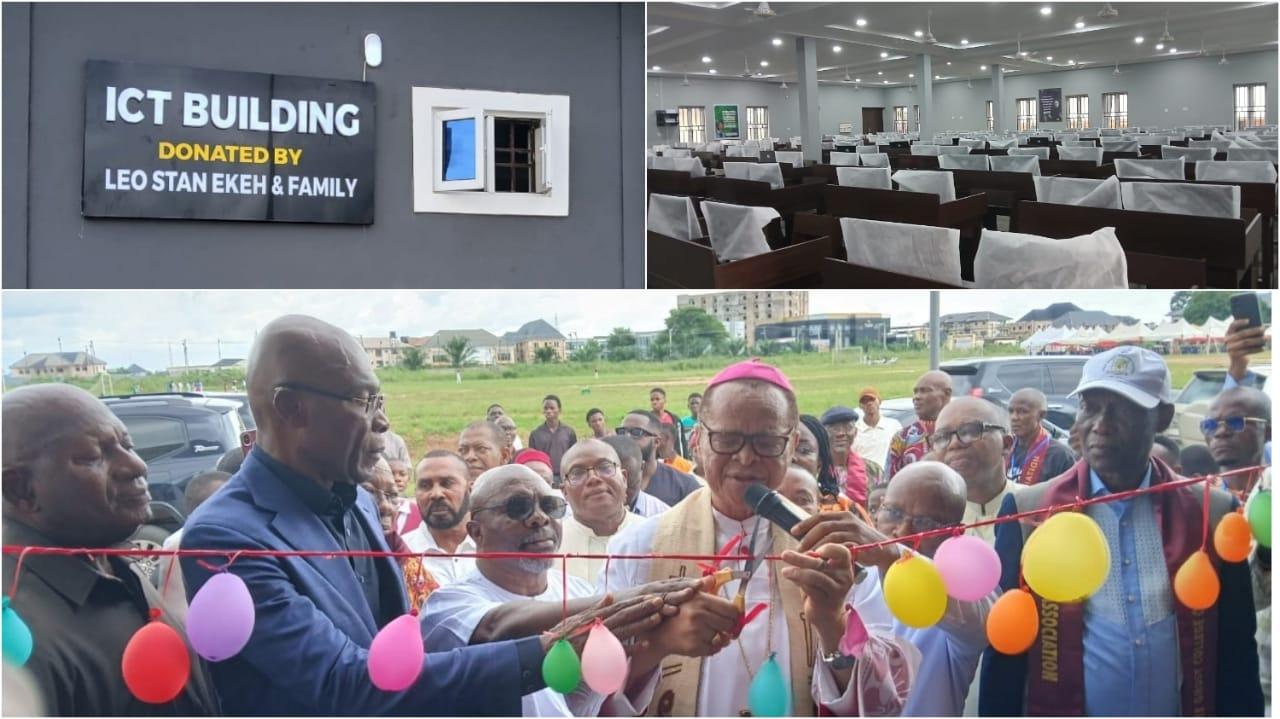
Africa’s foremost serial digital icon, Leo Stan Ekeh, last weekend donated a multi-million-Naira AI-Tech Centre to Holy Ghost College, Owerri, Imo State at a ceremony that added colour to the 77th years anniversary of the school.
The centre was built by the Leo Stan Ekeh Foundation in partnership with all the companies under the Zinox Group, namely TD Africa, Zinox Technologies, Task Systems, Konga Group, etc.
The AI -Tech centre construction supervised by Mr. Ekeh himself from block quality standard to final finishing is equipped with highly integrated All-In-One Zinox Computers, 24-hour solar-power and enabled with high speed Starlink corporate internet connectivity signed up for the college for five years. In addition to its Eco-friendly features, like the lifestyle integrated computer tables and chairs, it is fitted with two large AI-active screens for real- time online tutorials, turning the popular Catholic secondary school into one of the global smart tech colleges that will explore infinite possibilities in Africa.
Mr. Leo Stan Ekeh, an alumnus of the school, said he was inspired by the desire to turn graduates of the college into 21st Century globally-certified whizzes who can effectively compete with their mates from all over the world.
He said: “It is my prayer that this centre shall produce Nigeria’s tech driven billionaires who can defend their wealth and alter the destinies of millions of Nigerians. Few of us who are wealth creators in Nigeria are miracle kids because during our time we technically lacked everything, but God helped us to emerge as wealth creators. It is my wish that this centre shall create a tech culture for our kids and that the training on AI and certified contents which we have signed with different globally rated consultants shall make the centre a standout tech hub.
“This centre shall earn the status of Microsoft, Cisco, Oracle, Starlink certification centre very soon and a model to other colleges in the Southeastern part of Nigeria and by extension Nigeria. We are hiring a Director for the Tech Centre and few other staff to complement its leadership. We have structured trainings on finishing school, ethics, etc., including retraining the teachers on modern skills of teaching, transparent communication, and digital psychology in dealing with today’s smart kids.
R-L: Catholic Archbishop Rev. Lucius Ugorji, assisted by Mr. Cosmas Ibe, an old boy of the college to cut the tape, while Mr. Leo Stan Ekeh and Mr. Jerry Chukwueke watch in admiration. Top is the exterior and interior of the centre.
“My family and I through the Foundation and companies under the Zinox group have done similar projects including Entrepreneurial centres in over 123 Primary, Secondary, and tertiary institutions across Nigeria quietly since 1996 and when we are done with few committed projects in the next 12 months, we shall now concentrate on our 1000 tech university scholarships project. It is our way of giving back to the society and appreciating those who supported and are still supporting our companies while providing world-class tech human capital that shall drive their growth and defend the nation in future. I also hope other Nigerians can do same in educational institutions around them or their alma mater. We must consciously upgrade Nigeria by investing in tech and the youths.
“We have budgeted to do more. We shall refurbish and create an intelligent hostel with Al-amenities to celebrate wizkids in the college and encourage their mates on healthy living and competition. It will be a privilege to be accommodated in this intelligent hostel and each year, a student accommodated here shall earn a congratulatory letter from the foundation with a token gift. We need to reset the mind set of our kids to earn global citizenship if we must earn a decent future,” he told the audience which included Catholic Archbishop Lucius Ugorji, Bishop of Owerri Ecclesiastical Province, priests, principal of the college, Rev. Dr. Samuel Agu; the state commissioner for education (Primary and Secondary), Professor Bernard Ikegwuoha, old students, parents, and over 1,600 secondary school students drawn from different schools in the state.
Describing the AI-tech centre as the first in the south east, he urged the students to take full advantage of it to make a success in life, stressing that in the 21st century, ICT provides children of the poor the pathway to upset the rich. He urged the students to take advantage of the 1000 tech university scholarship instituted by his Foundation in partnership with Zinox Technologies, TD Africa, Task Systems and Konga Group for Nigerian indigent tech students in Nigerian universities and polytechnics.
The scholarship is now live on konga.com, just click the 1000 tech scholarship banner and get full information regarding the scholarship.
Ekeh promised to ensure that those manning the centre are properly skilled and remunerated. He listed no fewer than seven secondary schools across the country that will benefit from infrastructural development including building residential apartments for some teachers and knowledge workers, and mini-ICT centers to create tech culture in these institutions within the next one year.
Ekeh who shared with the audience his life’s experience, also narrated how ICT has lifted and raised global billionaires like Elon Musk, Bill Gates, among others. He told the students that they can be the next generation game-changers and billionaires if they get serious with ICT, adding that in life
“Many are called but few are chosen. You can become the chosen ones if you acquire the right ICT skills with structured mentality which is an opportunity that the tech-center offers.” He added.
-
Politics3 years ago
13 Ondo Assembly Members Disown Endorsement of Aiyedatiwa
-
Politics3 years ago
APC Group, Ondo Govt, Quarrel Over Money for Endorsement
-

 Trending News5 years ago
Stop unsavoury, inciting statements – DSS warns
-

 Others5 years ago
Adron Homes Celebrates 10 Years Of Housing Excellence
-

 Humanity5 years ago
President Buhari Commiserates With Ambassador Maureen Tamuno Over The Loss Of Her Father
-

 Others7 years ago
EX- CUSTOMS BOSS, IBRAHIM MERA’S DWINDLING FAME
-

 Business2 years ago
Bigi Carbonated Soft Drinks Treats 40 Consumers to an Epic Easter Movie Hangout
-

 Business2 years ago
Wema Bank Shines at Global SME Finance Forum Conference Awards 2024 …Awarded: • SME Financier of the Year (Africa) • Platinum Award for Best Financier for Women Entrepreneurs (Africa)