
Business
OPEC calls for $17.4 trillion investment in hydrocarbons by 2050 to meet demand
OPEC Secretary General Haitham Al Ghais urges $17.4 trillion in hydrocarbon investments by 2050 to meet rising global demand and offset declining production rates.


OPEC Secretary General Haitham Al Ghais urges $17.4 trillion in hydrocarbon investments by 2050 to meet rising global demand and offset declining production rates

OPEC Secretary General Haitham Al Ghais has underscored the critical need for substantial investment in the hydrocarbon sector, estimating a cumulative requirement of $17.4 trillion by 2050.
Also read: Oil crash hits Nigeria’s budget
This investment, according to Al Ghais, is essential to meet the continuously increasing global energy demand and to compensate for natural production declines, which necessitate an additional five million barrels per day on average each year just to maintain current overall supply levels.
Al Ghais made these remarks at the 11th Joint IEA-IEF-OPEC Workshop on the Interactions between Physical and Financial Energy Markets, held at the OPEC Secretariat in Vienna.
He emphasized OPEC’s consistent call for greater investments in the oil industry, highlighting that the organization’s actions, particularly within the framework of the Declaration of Cooperation (DoC), aim to foster an investment-enabling environment characterized by sustainable stability in the oil market.
The high-level workshop, chaired by HE Al Ghais, HE Jassim Alshirawi, Secretary General of the International Energy Forum (IEF), and Toril Bosoni, Head of the Oil Industry and Markets Division of the International Energy Agency (IEA), addressed crucial topics including recent factors influencing oil market volatility, strategies for exploring global oil trade flows, inter-regional arbitrages and their impact on crude benchmarks, and financing opportunities for oil and gas developments.
OPEC’s latest World Oil Outlook (WOO) projects a significant 24 per cent increase in global primary energy demand by 2050, driven by population growth, urbanization, an expanding middle class, and emerging energy-intensive technologies, as well as the imperative to provide energy access to billions worldwide.
Al Ghais stressed the necessity of embracing all energy sources and leveraging all available technologies to address the interconnected challenges of energy accessibility, rising demand, security, affordability, and emissions reduction.
Jassim Alshirawi of the IEF echoed this sentiment, emphasizing the need for predictable investments in both hydrocarbons and clean energy technologies, along with close collaboration on market transparency to navigate the energy trilemma and geoeconomic shifts effectively.


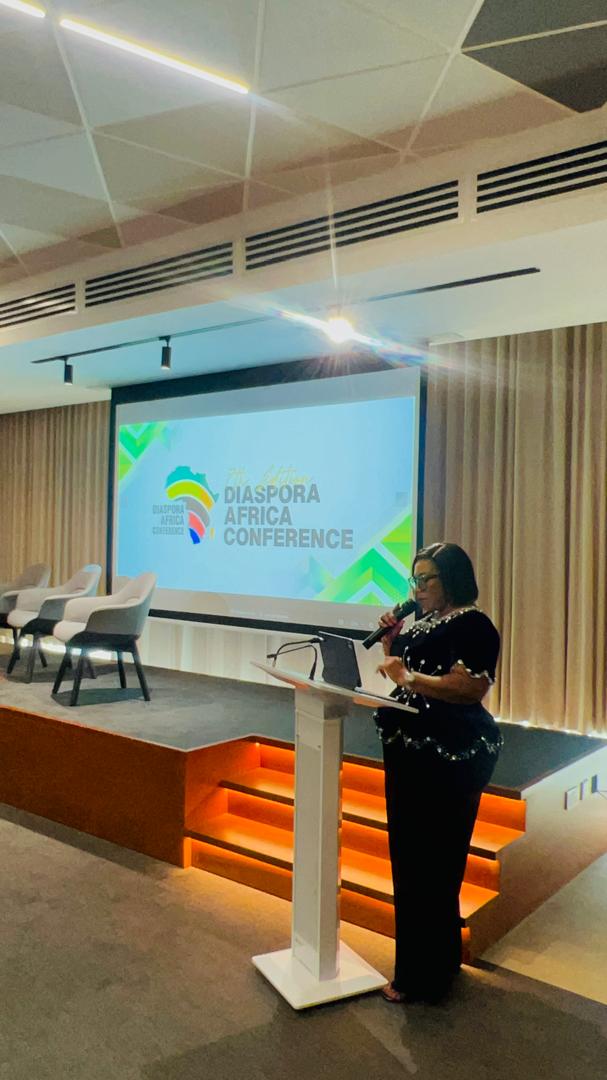
AICL GMD Maureen Tamuno calls for stronger diaspora investment in Africa through trust, transparency, skills transfer and sustainable partnerships

-
Politics3 years ago
13 Ondo Assembly Members Disown Endorsement of Aiyedatiwa
-
Politics3 years ago
APC Group, Ondo Govt, Quarrel Over Money for Endorsement
-

 Trending News5 years ago
Stop unsavoury, inciting statements – DSS warns
-

 Others5 years ago
Adron Homes Celebrates 10 Years Of Housing Excellence
-

 Humanity5 years ago
President Buhari Commiserates With Ambassador Maureen Tamuno Over The Loss Of Her Father
-

 Others7 years ago
EX- CUSTOMS BOSS, IBRAHIM MERA’S DWINDLING FAME
-

 Business2 years ago
Bigi Carbonated Soft Drinks Treats 40 Consumers to an Epic Easter Movie Hangout
-

 Business2 years ago
Wema Bank Shines at Global SME Finance Forum Conference Awards 2024 …Awarded: • SME Financier of the Year (Africa) • Platinum Award for Best Financier for Women Entrepreneurs (Africa)