
Security
Securing Nigeria from the Ground Up: Why the CJTF Deserves the Backing of Government, Corporate Nigeria, the People


Support for Civilian Joint Task Force is vital to Nigeria’s fight against insecurity. Empowering CJTF helps protect communities and curbs the rise of armed groups

In a country where insecurity has become the most persistent threat to peace and national development, no conversation about sustainable solutions is complete without acknowledging the critical role of grassroots security structures.
Also read: President Tinubu Pushes for State Police, Calls for Urgent Constitutional Reform to Tackle Insecurity
One such structure is the Civilian Joint Task Force (CJTF), a formidable group of civilian volunteers who have, for years, put their lives on the line in some of Nigeria’s most dangerous territories, often without pay, protection, or even recognition.
Despite operating under immense pressure and threat, these everyday Nigerians who are teachers, artisans, farmers, students, and retired security personnel, have taken it upon themselves to protect their communities from terrorist insurgencies, armed banditry, and kidnapping syndicates.
With over 20,000 members currently operating across at least 12 states, including Plateau, Kaduna, Rivers, Edo, and Kebbi, the CJTF is not just a vigilante group but a shadow army of patriotism and grassroots intelligence that deserves far more than mere applause.
The origin of the CJTF can be traced back to the height of Boko Haram’s terror campaign in Borno State, where communities began organizing themselves in response to the state’s inability to provide sufficient security.
Since then, the CJTF model has evolved into a national template for community-led defense, expanding its presence across the northern and central states of Nigeria.
What is most remarkable about the CJTF is not just its reach or numbers (though a 20,000-strong nationwide database is impressive) but its results.
In recent incidents in Plateau State’s Wase Local Government Area, CJTF members were at the frontline of reclaiming villages seized by bandits, rescuing kidnapped victims, and restoring order where formal security outfits were either overwhelmed or absent.
The decentralized yet disciplined nature of the CJTF is one of its greatest strengths, and this is personified in the caliber of its state leadership.
Aminu Sani, who doubles as both the National Commandant and the Kaduna State Commandant, has been at the forefront of galvanizing cross-regional coordination, promoting professionalism within ranks, and unifying CJTF’s strategic objectives across various states.
In Edo State, Commandant Ehiaghe Akhere Isua has also built an exemplary collaboration with the Nigeria Police, working hand-in-hand on a 24/7 basis. According to Isua, the state’s Commissioner of Police reaches out directly to CJTF for support during operations, appreciating the manpower and intelligence the group provides during patrols, arrests, and interventions.
Same thing is obtainable in Plateau State where according to Tanimu Shehu, Commandant of plateau State, CJTF members recently played a big role in repelling attacks and reclaiming territories seized by armed groups in Wase Local Government Area. These relationships reflect the trust CJTF has earned among formal institutions, a trust born of results, not rhetoric.
Indeed, it is commendable that the Inspector General of Police has now issued acknowledgment signals to state commands recognizing the CJTF’s legitimacy.
This is an important first step in formalizing their role in the country’s security architecture. But much more needs to be done — and urgently so.
First, the government at both federal and state levels must transition from passive acknowledgment to active engagement.
This includes integrating CJTF members into community policing frameworks, offering basic stipends, providing identity cards, and supplying minimal protective gear and logistics. These steps are necessities for people who are facing bullets and blades while defending Nigeria’s internal borders.
Secondly, the Corporate Private Sector must realize that insecurity affects business operations and investor confidence.
Whether it’s the agriculture sector suffering from farm shutdowns due to attacks, or the telecoms industry facing sabotage of infrastructure in remote areas, the private sector is directly affected by the erosion of community safety.
Supporting CJTF through corporate social responsibility (CSR) programmes, equipment donations, or even direct partnerships can be a transformative step.
Imagine a company like MTN Nigeria equipping CJTF checkpoints with solar-powered communication tools, or a company like Dangote Cement sponsoring basic healthcare insurance for CJTF volunteers in hard-hit areas like Kaduna and Zamfara.
These aren’t just philanthropic acts; they’re smart investments in the communities that businesses depend on for raw materials, human capital, and market access.
Why Nigerians Must Also Step Up
Security is not just the government’s job. As citizens, we each have a stake in the survival and stability of the Nigerian state. The same passion we use to call out injustice online should be extended to championing the cause of those who are silently, sacrificially building a safety net around us.
Supporting the CJTF could be as simple as fundraising in local communities for food supplies, volunteering to provide first aid training, or donating old uniforms and torches.
Moreover, civil society organizations, NGOs, and media outlets must make deliberate efforts to amplify the stories of CJTF’s sacrifice.
Nigeria is not short of tragic news cycles from Abuja to Zamfara but in the midst of these stories are glimmers of hope that rarely make the front pages. Let us spotlight these glimmers.
Let us share their pictures, tell their stories, and humanize the sacrifices they make. Visibility is a form of advocacy, and advocacy is a step toward justice.
The Human Cost of Neglect
The alternative to supporting the CJTF is not benign, it is dangerous. When grassroots defenders are unsupported, unprotected, and unrecognized, we create a vacuum. That vacuum is quickly filled by armed groups who promise protection in exchange for loyalty.This is how militias form.
This is how insurgencies escalate. And this is how a preventable crisis becomes a national catastrophe.
Already, we have lost several CJTF members in Plateau and Borno States in the line of duty.
These were fathers, sons, breadwinners, and community leaders. Many were buried in silence, with no pensions, no public honors, and no support to the families they left behind. If this cycle continues, we risk demoralizing an already strained force and losing a critical layer of Nigeria’s security fabric.
Supporting the CJTF is not just a matter of strategy, it is a moral imperative. It is a test of our national conscience. These are men and women who have answered the call of duty when others looked away.
They are what it means to be Nigerian, resourceful, and relentlessly hopeful. To leave them behind is to betray the very soul of our communal identity.
Let us not wait until the headlines scream “CJTF Abandoned!” before we act. Let us not bury another unsung hero before we remember their worth. Instead, let us rise… government, business, and citizenry alike to support those who are doing the hard, thankless work of keeping us safe.
In the face of Nigeria’s mounting insecurity, the solution may not come from foreign consultants, expensive drones, or political manifestos.
It may just lie in a small outpost in Wase, a checkpoint in Kebbi, or a local vigilante unit in Jos where one man, wearing no bulletproof vest and holding a rusty cutlass, refuses to let evil win.
That man is a member of the CJTF. That man is a Nigerian worth fighting for.
Also read: Our Insecurity Challenges Are Temporary – Aregbesola
Emeka Ezike is a public affairs commentator, a web3 contributor and Grand Patron of the Civilian Joint Task Force (CJTF). Ezike is a strong advocate for community-driven solutions to Nigeria’s challenges. He writes from Lagos.


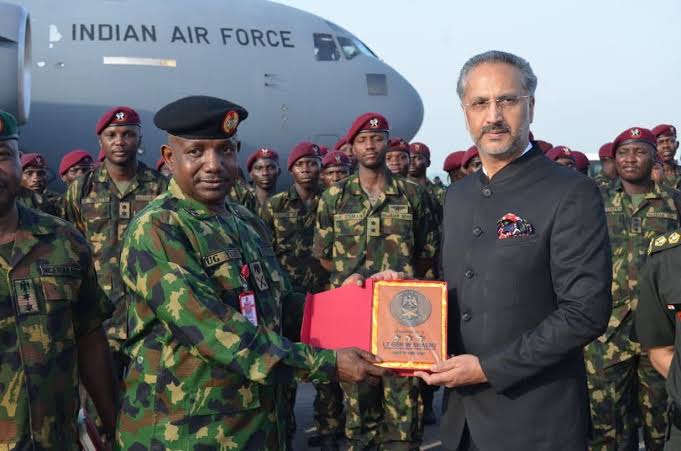
The Nigerian Army is sending 600 soldiers to India for specialised jungle and mountain warfare training to improve combat readiness
The Nigerian Army has commenced the deployment of 600 personnel to India for specialised jungle and mountain warfare training aimed at improving troops’ combat readiness and ability to operate in difficult terrain.
Also read:Umahi Predicts South-East Shift in 2027 Vote for Tinubu
The first batch of 300 soldiers departed the Nnamdi Azikiwe International Airport in Abuja on Thursday, October 22, aboard two Indian Air Force aircraft, a C-17 and an Airbus A321.
The Acting Director of Army Public Relations, Colonel Appolonia Anele, announced the deployment in a statement on Friday.
According to the statement, the training is intended to enhance troops’ operational effectiveness in challenging environments and strengthen the Army’s capacity to protect Nigeria’s territorial integrity.
“The training underscores the COAS’s commitment to building a professional, adaptable and combat-ready force capable of confronting terrorists, insurgents and other criminal elements operating in forests, mountainous areas and other challenging environments,” the statement said.
The statement said the deployment was initiated by the Chief of Army Staff, Lieutenant General Waidi Shaibu, as part of efforts to improve personnel development, realistic training and operational effectiveness.
It added that the programme aligned with Shaibu’s command philosophy, which prioritises combat readiness and the development of a resilient, mission-ready force.
The Coordinator of the Nigerian Military Training Support and Advisory Team at Army Headquarters, Department of Army Training, Major General UG Yusuf, represented the Army chief at the departure ceremony.
The Indian High Commissioner to Nigeria also witnessed the departure.
The Army said arrangements were underway to transport the remaining 300 personnel to India to complete the planned deployment.
The specialised training is expected to strengthen the soldiers’ ability to operate in forests, mountainous regions and other difficult environments where conventional military operations can pose additional challenges.
The initiative is also expected to reinforce defence cooperation between Nigeria and India.
Also read:Umahi Predicts South-East Shift in 2027 Vote for Tinubu
The Army said the deployment reflected its commitment to developing personnel capable of responding to security threats while safeguarding the country’s sovereignty and protecting lives and property.
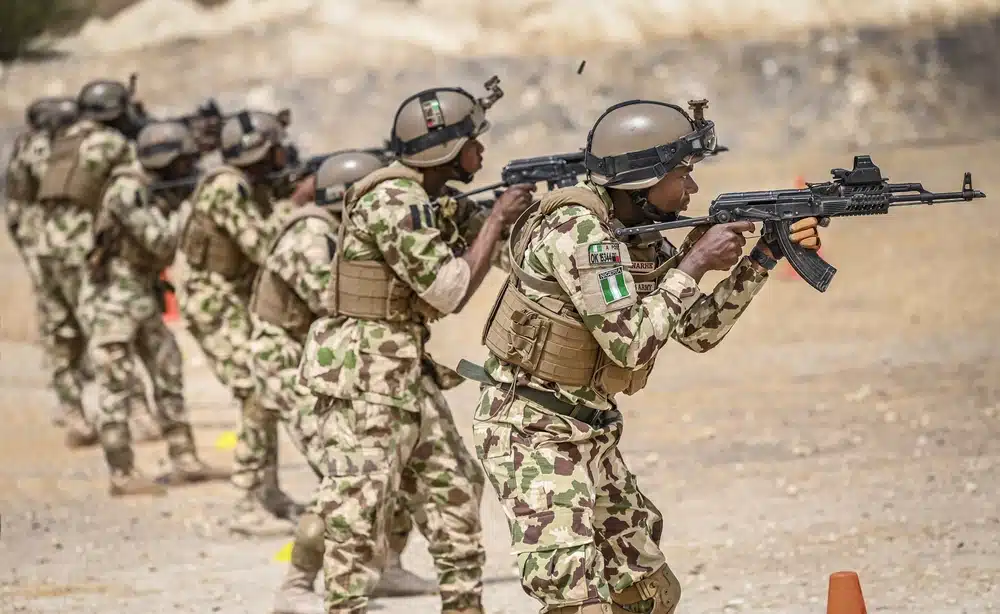
Troops rescue four kidnap victims in Zamfara and Kebbi during separate military operations targeting suspected terrorists and criminal groups


-
Politics3 years ago
13 Ondo Assembly Members Disown Endorsement of Aiyedatiwa
-
Politics3 years ago
APC Group, Ondo Govt, Quarrel Over Money for Endorsement
-

 Trending News5 years ago
Stop unsavoury, inciting statements – DSS warns
-

 Others5 years ago
Adron Homes Celebrates 10 Years Of Housing Excellence
-

 Humanity5 years ago
President Buhari Commiserates With Ambassador Maureen Tamuno Over The Loss Of Her Father
-

 Others7 years ago
EX- CUSTOMS BOSS, IBRAHIM MERA’S DWINDLING FAME
-

 Business2 years ago
Bigi Carbonated Soft Drinks Treats 40 Consumers to an Epic Easter Movie Hangout
-

 Business2 years ago
Wema Bank Shines at Global SME Finance Forum Conference Awards 2024 …Awarded: • SME Financier of the Year (Africa) • Platinum Award for Best Financier for Women Entrepreneurs (Africa)