
Politics
The Trinity of State Decay (II): Inside the Loop of Insecurity

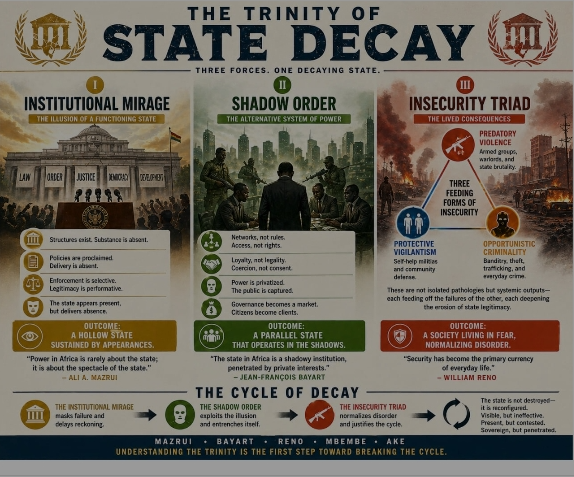
Nigeria state weakness analysis explores how insecurity, weak governance and shadow systems reshape authority and sovereignty

Nigeria’s decoupling is not random — it is engineered. The state wears the mask of authority while its rivals wield the substance of power.
Also read: The Insecurity Triad: Money, Land and Mind — The Capstone
In the vacuum, a rival order rises: taxing, renaming, and ruling with a clarity the state can no longer muster.
Part 1 named the condition. This second movement explains its mechanics.
If the Institutional Mirage performs authority and the Shadow Order exercises it, then the question is no longer whether the state is weakening, but how that weakening is organised, sustained, and reproduced.
The answer lies in the Insecurity Triad — not as a collection of crimes, but as an operational system of governance that emerges in the interstices of state withdrawal.
What appears as disorder is structure. What appears as fragmentation is system. What appears as crisis is reproduction.
At the centre of this reproduction is a loop the state does not merely fail to break — but increasingly inhabits as its own mode of survival.
The Structural Interaction: Mirage, Shadow, and the Production of Void
The Institutional Mirage and the Shadow Order are not parallel formations. They are locked in a causal circuit — a self-reinforcing loop sustained by the Insecurity Triad.
The sequence is precise, not accidental.
The Mirage creates the vacuum.
By performing governance without delivering it — convening committees instead of enforcing authority, issuing declarations instead of securing territory, maintaining symbolic centrality while withdrawing from operational peripheries — the Institutional Mirage produces spaces where sovereignty exists in form but not in force.
These are not empty spaces. They are functional voids: zones where authority is declared but not operational, where legality exists but enforceability does not, where the state is present as narrative but absent as structure.
In these voids, legitimacy becomes unanchored from enforcement.
The Shadow does not enter these spaces as disruption.
It enters as replacement infrastructure.
It fills the vacuum through the Insecurity Triad:
Money — ransom economies that convert insecurity into revenue;
Land — territorial governance through coercive taxation and control;
Mind — ideological capture that replaces civic legitimacy with alternative authority systems.
The Triad is not incidental. It is not criminal residue. It is administrative architecture without formal recognition.
Together, these three logics form a rival system of governance that requires no elections, no constitutional validation, no external recognition. It requires only the sustained absence of enforceable state presence.
Constitutional Erasure: The Shadow’s Sovereign Inscription
The functional void produced by the Mirage is not passive; it is actively inscribed by rival authority.
What Part 1 established empirically — the renaming of villages, the hoisting of rival flags, and the symbolic reordering of territory — now becomes analytically central as constitutional erasure within the Insecurity Triad loop.
Fanon’s insight is decisive here. To rename is to unmake — to dissolve one sovereign order and inscribe another in its place. The gun secures territory; the name governs it. Constitutional erasure is therefore not adjacent to governance. It is governance in its rival form — counter-constitutional inscription of authority.
Its significance lies in how it restructures perception and compliance. Once a community is renamed, the former constitutional designation becomes politically fragile.
To invoke the state’s authority is to invoke an order that cannot enforce itself; to invoke the Shadow’s authority is to invoke one that can. The choice is no longer between legality and illegality, but between enforceable and unenforceable reality.
Constitutional erasure thus converts the Mirage’s vacancy into the Shadow’s jurisdiction. It transforms spatial absence into administrative capture, making subsequent compliance transfer structurally inevitable.
The population is not simply governed differently; it is repositioned outside the state’s effective map of enforceability.
The Shadow does not request allegiance. It inscribes it through territorial naming itself.
Compliance Transfer: The Silent Relocation of Authority
As the Shadow consolidates control within functional voids, a second-order transformation occurs: compliance begins to migrate.
This is not ideological conversion. It is practical adaptation.
Populations shift allegiance along lines of enforceability rather than legality:
•taxes are paid to those who can enforce extraction;
•disputes are resolved by those who can enforce outcomes;
•rules are obeyed where consequences are immediate.
What emerges is not rebellion against the state, but rational substitution of authority under conditions of asymmetry.
Each act of compliance transferred is also an act of state erosion — not because the state disappears, but because its authority becomes non-competitive in lived reality.
At this stage, sovereignty is no longer monopolised. It is distributed according to functional capacity.
Dependency Turn: When the State Requires the Shadow
The loop reaches structural maturity when the state begins to adapt to its own displacement.
This is the most critical transition in the entire system.
The state does not confront the Shadow Order as an external adversary alone. It increasingly engages it as an informal stabiliser of governability.
This produces what can be described as Promotional Negotiation — the practice of purchasing temporary stability from a rival authority structure through ransom logic, informal settlements, or negotiated withdrawals.
This is not strategy. It is systemic dependency.
Every negotiation produces three systemic effects:
•It monetises insecurity by validating abduction economies;
•It territorialises Shadow authority by recognising de facto control;
•It legitimises the Shadow as a negotiating sovereign rather than a residual actor.
The paradox is complete: the state stabilises instability by financing its reproduction.
At this point, the Institutional Mirage is no longer merely performing sovereignty.
It is renting functional access to sovereignty from its own rival system.
Theoretical Architecture
The Trinity of State Decay is grounded in a layered theoretical architecture that explains the formation, operation, and persistence of the Institutional Mirage, the Shadow Order, and the Insecurity Triad.
At the level of structural formation, Claude Ake and Franz Fanon clarify the inherited constitution of the Institutional Mirage: a postcolonial state that operates primarily as a performative and extractive apparatus, whose authority is unevenly inscribed across territorial space and sustained through symbolic rather than fully enforceable sovereignty.
At the level of mechanism, William Reno and Achille Mbembe explain the operational logic through which the Shadow Order emerges within the functional voids produced by the Mirage.
Reno accounts for the relocation of authority to actors capable of enforcing compliance through control of resources and coercive capacity, while Mbembe extends this analysis by showing how coercion becomes a distributed regime of governance over life, survival, and exposure to insecurity.
At the level of persistence, Ali Mazrui and Jean-François Bayart explain why the interaction between Mirage and Shadow stabilises rather than resolves: Mazrui foregrounds the historical continuity of overlapping and non-synthesised authority systems, while Bayart highlights adaptive strategies through which elites and institutions reproduce governance through external linkage and internal accommodation.
Together, these perspectives converge within the Trinity as a single analytic stack in which the Institutional Mirage, the Shadow Order, and the Insecurity Triad form a self-reproducing system of fragmented but structured sovereignty.
The Loop as System: Self-Reproduction Logic
The Insecurity Triad stabilises the system through continuous feedback:
Mirage withdraws functional void emerges;
Shadow occupies—authority substitutes
Triad institutionalises—governance stabilises;
Compliance shifts —state capacity erodes further;
Negotiation increases —dependency deepens
Loop intensifies —system reproduces.
There is no external reset mechanism within this system.
It is self-referentially stabilising under fragmentation conditions.
The Trinity of State Decay does not describe collapse. It describes a stable configuration of fragmented sovereignty sustained by asymmetry in enforcement capacity.
Its resolution does not lie within the system it describes, but in the restoration of empirical sovereignty capable of reuniting legitimacy and force.
This is not the end of the argument, but the consolidation of its structure.
The next and final movement will define the conditions under which the Trinity can be reversed, and the architecture of sovereignty reassembled into a single coherent system.
Also read: Plateau Youths Protest Insecurity, Demand Urgent Action
Trust is sacred. Stay seasoned


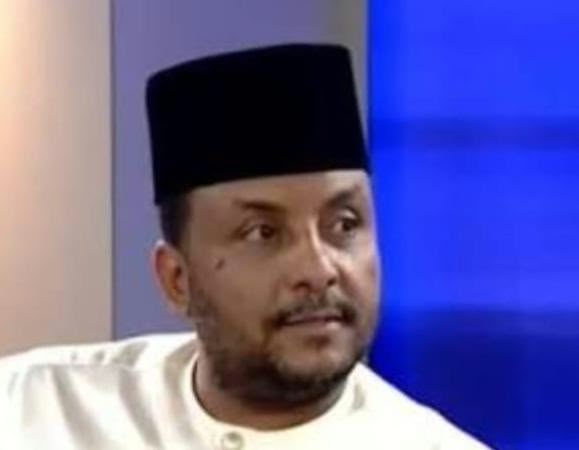
The All Progressives Congress Presidential Campaign Council has restricted the authority of its spokespersons to three officials following the controversy surrounding Alwan Hassan’s failed demonstration of Nigeria’s 112 national emergency number on live television.
The decision, announced on Wednesday, November 11, 2026, came less than 24 hours after Hassan appeared on Channels Television’s Politics Today, where he challenged the programme’s presenter, Seun Okinbaloye, to test the emergency number during the broadcast.
Under the new arrangement, only the campaign council’s Director-General, Senator Abdulaziz Yari; the Minister of Solid Minerals Development, Dele Alake; and the Minister of Information and National Orientation, Mohammed Idris, are authorised to speak officially on its behalf.
The announcement was made in a statement signed by President Bola Tinubu’s Chief of Staff and the campaign council’s Deputy Director-General (Administration), Femi Gbajabiamila.
The statement said the restructuring was intended to ensure more coordinated, disciplined and effective public engagement.
Hassan, alongside Ayobami Oyalowo, Kemi Asekun-Shittu and Adamu Fanda, was stripped of the authority to speak as an official campaign spokesperson. The four were, however, retained as members of the Directorate of Media and Strategic Communications.
Failed demonstration of emergency number
The controversy began on Tuesday, November 10, when Hassan appeared on Politics Today to discuss the Tinubu administration’s achievements ahead of the 2027 general election.
During the interview, he highlighted the 112 emergency number, describing it as a national service through which Nigerians could seek assistance during medical emergencies, road accidents, kidnappings, bandit attacks and other security situations.
To demonstrate its effectiveness, Hassan challenged Okinbaloye to dial the number during the live programme.
However, repeated attempts by the presenter and Hassan to connect to the emergency service were unsuccessful.
Hassan suggested that a network problem might have affected the calls, although the failed demonstration generated questions about the availability and reliability of the service.
The incident attracted criticism, particularly because the emergency number had been presented as one of the administration’s achievements.
Although the campaign council announced its restructuring shortly afterwards, its statement did not expressly identify Hassan’s television appearance as the reason for the changes.
112 emergency number predates Tinubu administration
The history of Nigeria’s 112 emergency number also became a subject of public discussion following Hassan’s television appearance.
The initiative predates the Tinubu administration, with the Nigerian Communications Commission (NCC) tracing its development to the Federal Government’s efforts to establish a nationwide emergency communications system.
On September 23, 2019, the Federal Government launched the 112 emergency call number alongside the first Emergency Communications Centre in Katsina State under the administration of former President Muhammadu Buhari.
The initiative followed earlier efforts to establish a coordinated emergency response framework involving telecommunications operators, security agencies and other relevant institutions.
In April 2026, the National Economic Council approved the adoption of 112 as Nigeria’s national emergency number across all levels of government and relevant agencies.
The council also approved a multi-agency implementation committee, with coordination led by the Office of the Vice-President and the NCC.
In September 2026, Vice-President Kashim Shettima directed relevant agencies to develop an operational roadmap for the nationwide rollout of the system.
Shettima said adequate funding and resources would be necessary to make the initiative effective.
The Federal Government subsequently constituted a committee involving the Nigeria Police Force, NCC, National Emergency Management Agency, Federal Road Safety Corps and other agencies to develop the implementation framework.
The distinction is that although 112 was launched in 2019, the government is still working towards a unified nationwide emergency response system.
Hassan’s earlier allegation against ministers
The latest controversy came weeks after Hassan generated another political debate over comments he made during an interview on Arise Television.
On October 22, 2026, the APC campaign spokesperson alleged that some ministers paid billions of naira to secure government appointments and subsequently sought to recover the money after assuming office.
He made the comments while defending Tinubu’s direct involvement in managing government revenue and expenditure.
Hassan argued that some ministers prioritised recovering the money allegedly spent to secure their appointments rather than delivering on their responsibilities.
His remarks attracted criticism, with questions raised about whether he was referring to ministers serving under the Tinubu administration.
The APC subsequently clarified that Hassan was referring to practices under previous administrations and not ministers appointed by Tinubu.
The party’s National Publicity Secretary, Felix Morka, maintained that appointments under the current administration were based on merit, competence and the capacity to deliver.
Hassan did not identify any minister or provide documentary evidence to substantiate the allegation.
His latest controversy has therefore placed renewed attention on the campaign council’s decision to narrow the number of officials authorised to communicate its position publicly.
The restructuring comes as political parties intensify preparations for the 2027 general election, with the APC seeking to manage its public messaging and defend the Tinubu administration’s record.
Politics
ZAMFARA STANDS STILL AS GOV. LAWAL HOSTS FIRST LADY REMI TINUBU FOR MEGA RALLY AND WOMEN’S EMPOWERMENT

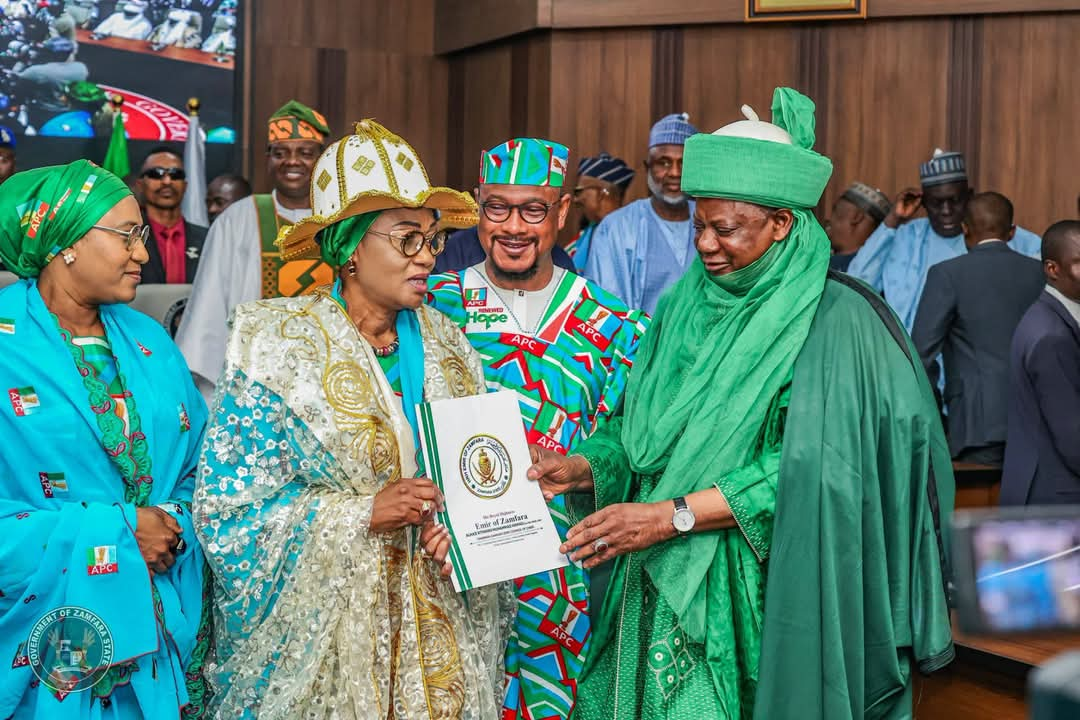
The First Lady of Nigeria, Senator Oluremi Tinubu, received a rousing welcome from thousands of residents and supporters during her visit to Zamfara State.
On Tuesday, the Zamfara State Government hosted the APC North-West Women’s Mega Rally and Empowerment Programme at the Trade Fair Complex in Gusau.
The event, led by Zamfara First Lady Hajiya Huriyya Dauda Lawal, brought together former Zamfara governors, the First Ladies of the North-West, ministers and other key All Progressives Congress stakeholders.
Before the rally, Senator Tinubu met with the Zamfara State traditional rulers to seek their blessings.
In her remarks, Tinubu described her visit as a powerful expression of solidarity and compassion, as well as a commitment to women’s welfare and advancement, especially for those facing insecurity, poverty and limited economic opportunities.
She said, “This is the happiest day of my life. Except for Zamfara, I have been in all 36 states of Nigeria, including the FCT. I have always wanted to come to Zamfara, and today I have fulfilled that. Because it is now easy to come, this is just the beginning; I am coming back again. Mr President is also coming.
“Before I start, I want to commiserate with you all for all the lives that were lost; they are very precious to us. May God forgive them, grant them Al-Jannatul Firdaus, and continue to be with us.
“Today is Juma’at; we have to be fast; we have empowerment to give to women. This is the only party that empowers during the campaign, and it is not about the campaign; we have been empowering from day one. And that is why it is not politics.
“Earlier, I was also given a title in Zamfara, the ‘Jagaban Matan Arewa’ by the Chairman of the Zamfara State Council of Chiefs and Emir of Anka, Alhaji Attahiru Muhammad Ahmad. I thanked all the Emirs.
“I love Zamfara. I am happy to be here. Mr President said I should tell you he will continue working for you. Nigeria will continue to prosper, in sha Allah.”
Earlier, Governor Dauda Lawal thanked Senator Tinubu for her continued support through the Renewed Hope Initiative, including its Food Outreach Programme.
“Your Excellency, Mother of the Nation, your presence today represents more than an official visit. You have set a record in the history of our dear Zamfara State.
“Your Excellency, Distinguished ladies and gentlemen, in Zamfara State, we firmly believe that empowering women is not only our responsibility as a government; it is a needed and bankable investment in social and societal morality, economic prosperity, family stability, and sustainable peace.
“I assure Your Excellency that Zamfara’s government and people unwaveringly support Mr President’s second term. With the women here and the men supporting them, Zamfara and the North West will deliver for Mr President come January 2027.”
Politics
Governor Dauda Lawal Appoints 282 aides to strengthen inclusive governance in Zamfara State

The Executive Governor of Zamfara State, Dr. Dauda Lawal, has approved the appointment of 282 individuals as Senior Special Assistants.
The appointees include some Technical Assistants and Special Assistants who have been upgraded to Senior Special Assistants.
Announcing the approval, the Secretary to the Zamfara State Government, Malam Abubakar Mohammad Nakwada said the appointments underscore Governor Lawal’s commitment to inclusive and participatory governance, strengthening grassroots engagement, broadening citizens’ involvement in government affairs, and enhancing effective communication of government policies, programmes, and achievements across the state.
The development further reinforces the administration’s commitment to accountability, transparency, and people-centred development under the Rescue and Rebuild Agenda.
The appointees will assist the Governor in a wide range of roles, including Community Engagement, Grassroots Mobilization, matters relating to Persons with Disabilities, Media & Publicity, and other duties as may be assigned.
Governor Lawal charges the appointees to demonstrate dedication, loyalty, professionalism, and commitment to public service, while serving as effective bridges between government and the people, ensuring that diverse community voices are heard and reflected in governance.
-
Politics3 years ago
13 Ondo Assembly Members Disown Endorsement of Aiyedatiwa
-
Politics3 years ago
APC Group, Ondo Govt, Quarrel Over Money for Endorsement
-

 Trending News6 years ago
Stop unsavoury, inciting statements – DSS warns
-

 Others5 years ago
Adron Homes Celebrates 10 Years Of Housing Excellence
-

 Humanity5 years ago
President Buhari Commiserates With Ambassador Maureen Tamuno Over The Loss Of Her Father
-

 Others7 years ago
EX- CUSTOMS BOSS, IBRAHIM MERA’S DWINDLING FAME
-

 Business3 years ago
Bigi Carbonated Soft Drinks Treats 40 Consumers to an Epic Easter Movie Hangout
-

 Business2 years ago
Wema Bank Shines at Global SME Finance Forum Conference Awards 2024 …Awarded: • SME Financier of the Year (Africa) • Platinum Award for Best Financier for Women Entrepreneurs (Africa)