
Opinion
Legacy in Continuity: How OGD’s Vision Continues to Shape Ogun’s Development Today [FEATURE]


By Lukman OMIKUNLE
Gbenga Daniel’s visionary leadership continues to shape Ogun State’s industrial, educational, and infrastructural growth more than a decade later

More than a decade after Otunba Gbenga Daniel (OGD) left office as the Governor of Ogun State, the imprints of his leadership remain deeply woven into the fabric of the Gateway State.
Also read: Otunba Gbenga Daniel inspires hope with development plans in Ogun East
His legacy — a blend of visionary industrialization, infrastructural expansion, and human development — continues to shape the trajectory of Ogun’s growth under successive administrations.
Today, Ogun State is one of Nigeria’s most industrialized regions, a hub for manufacturing, logistics, and innovation.
But this transformation did not happen by accident — it was the outcome of deliberate groundwork laid between 2003 and 2011, when OGD redefined governance through a fusion of foresight and pragmatism.
The OGD Blueprint: From Vision to Institution
When OGD branded Ogun as “The Gateway State,” it was more than a slogan — it was a development philosophy. He envisioned a state that would serve as Nigeria’s industrial bridge, connecting Lagos’ economic intensity with the heartland’s vast potential.
His administration initiated and completed major infrastructure projects — roads, industrial estates, free trade zones, power plants, and educational institutions — that provided the structural backbone for future growth.
The Olokola Free Trade Zone (OKFTZ) and Kajola Industrial Park, two projects conceptualized under his leadership, became magnets for both local and international investors.
His government’s Memoranda of Understanding with foreign partners, including the Chinese and Shell Nigeria Gas, created the foundation for industrial clusters that still power Ogun’s economy today.
“OGD laid the blocks of modern Ogun — he built the vision that others are now expanding,” said a senior Ogun bureaucrat who served under multiple administrations.
Infrastructure That Endured — Roads, Power, and Access
Many of the state’s major arterial roads — linking Abeokuta, Sagamu, Ifo, Ota, and Ijebu-Ode — were initiated or rehabilitated during Daniel’s tenure. These routes became the logistics lifelines that attracted industries and improved mobility for millions of residents.
His power initiatives, including independent power projects (IPPs) and transformer installations across rural communities, prefigured the state’s later push toward energy sustainability.
The strategic location of industrial estates near expressways and gas pipelines was not coincidental — it was a calculated decision to give Ogun an edge in logistics and cost efficiency.
That same advantage today underpins the Agbara Industrial Corridor, now home to giants like Nestlé, Lafarge, and Unilever.
Economic Transformation: From Vision to Vanguard
The eightfold increase in Internally Generated Revenue (IGR) during OGD’s era — from ₦100 million to ₦800 million monthly — was a turning point. It repositioned Ogun as a self-sustaining state capable of financing its development.
Subsequent administrations, including those of Senator Ibikunle Amosun and Prince Dapo Abiodun, have built upon this fiscal foundation.
The ease of doing business reforms, land processing systems, and digital tax administration that Ogun now boasts of are all evolutions of policies that began under OGD’s pro-business government.
From the Ogun-Guangdong Free Trade Zone to Asero and Agbara Industrial Estates, the state continues to attract investors who cite OGD’s business-friendly policies and infrastructure planning as the original catalyst.
“OGD made Ogun the alternative to Lagos — and today, that vision is our greatest advantage,” a senior official at the Ogun State Investment Promotion Agency told Newsheadline247.
Education and Human Capital: The Continuum of a People-First Policy
No true legacy endures without human capital. OGD’s comprehensive education reforms, vocational programmes, and ICT initiatives laid the groundwork for today’s renewed focus on technical education and youth employability.
The Gateway ICT Institute, technical colleges, and Ogun State Polytechnic upgrades birthed under Daniel’s watch are now producing the skilled manpower sustaining the state’s industrial ecosystem.
Successive administrations have continued his tradition of linking education to industry — a policy alignment that ensures Ogun’s youth are not left behind in the new economy.
Social Infrastructure and Urban Renewal
In cities like Abeokuta, Sagamu, and Ijebu-Ode, one can still trace the architectural and community projects that began under OGD.
The Gateway City Gates, Oke-Mosan Secretariat expansions, and rural electrification projects remain visible testaments to his belief that infrastructure is the language of progress.
In the health sector, the modernized hospitals and community health centres introduced during his era continue to serve as the foundation upon which newer health initiatives are being launched.
Governance Philosophy That Outlived Tenure
OGD’s governance style — pragmatic, inclusive, and human-centred — created a political and administrative culture that emphasized results over rhetoric. His focus on public-private partnerships (PPP) became a model now institutionalized in Ogun’s economic planning.
He promoted merit-based appointments, encouraged civic engagement, and fostered a sense of ownership among the state’s civil service — habits that have survived long after he left office.
“Daniel didn’t just govern; he institutionalized excellence,” remarked a political historian. “That is why Ogun still benefits from his template today.”
Legacy in Motion: The OGD Footprint Today
From the industrial corridors of Sagamu and Ota to the education-driven hubs of Abeokuta and Ijebu, OGD’s legacy continues to breathe life into Ogun’s development story.
Governor Dapo Abiodun’s infrastructural renewal drive, digital economy expansion, and industrial incentives are direct continuations of the Gateway Vision crafted two decades ago.
OGD’s blueprint was not just about roads and factories — it was about people, productivity, and prosperity. Today, that legacy endures in the confidence of investors, the resilience of youth, and the continued evolution of a state that stands tall as the economic pride of the Southwest.
“The foundation of our progress rests on the vision of leaders who saw tomorrow before it arrived,” an Ogun elder statesman said. “Gbenga Daniel was one of them.”
A Legacy That Still Works
Two decades on, Otunba Gbenga Daniel’s vision remains the silent architect behind Ogun’s economic strength. His blend of foresight, discipline, and compassion ensured that progress was not episodic — it became systemic.
The Gateway State is still growing — and at its heart lies the blueprint of a leader who dared to dream and delivered.
Also read: Otunba Gbenga Daniel inspires hope with development plans in Ogun East
OGD’s story is not just history — it is continuity in motion.



Writer Ehi Braimah has called on Rotary clubs across West Africa to prioritise lasting partnerships over short-term projects as the region prepares for the 2026 West Africa Project Fair.
The Fair, hosted by Rotary International Districts 9111 and 9112, is scheduled to hold from November 10 to 17 at the Balmoral Convention Centre, Sheraton Hotel, Ikeja, Lagos.
It will be flagged off by Rotary International President Olayinka Babalola and is expected to draw clubs, Rotarians, Rotaractors and international partners from nine districts across the region.
Braimah noted that the theme, “Partnerships for Lasting Impact,” reflects a shift from simply launching projects to ensuring that interventions continue to serve communities long after commissioning.
He argued that many development challenges in West Africa — including healthcare, education, water, sanitation, food security and environmental issues — transcend national borders and require collaborative solutions.
According to him, a common weakness in development work is the “project mentality,” where attention focuses on starting and completing initiatives rather than guaranteeing their long-term usefulness.
Braimah stressed that true partnerships go beyond sponsorship. They involve shared responsibility, technical expertise, institutional support, monitoring and local ownership.
He said the Project Fair offers a marketplace for clubs seeking funding or technical help to connect with partners who can provide resources, knowledge or institutional backing.
The column concluded that lasting impact is achieved when Rotary’s community presence is combined with the strengths of governments, businesses and development organisations, creating solutions that communities can sustain.
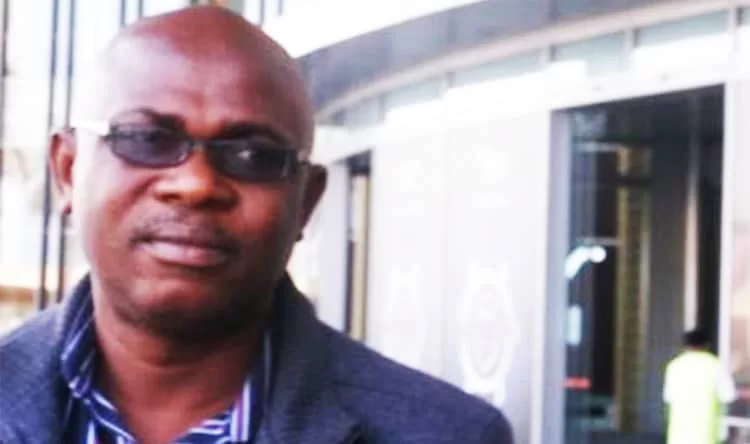
Columnist Ikeddy Isiguzo has raised fresh questions about the Lagos-Calabar Coastal Highway project and President Bola Tinubu’s second-term campaign strategy.
In his latest piece, Isiguzo criticised what he described as inconsistencies in explanations offered by Works Minister David Umahi regarding changes to the multi-billion-dollar highway.
He argued that the project, originally presented as a flagship infrastructure plan, has faced technical and financial challenges that were not adequately addressed at the outset.
Isiguzo recalled earlier concerns he raised in 2024 about the absence of detailed technical designs, environmental assessments and competitive bidding processes.
He also commented on the political dimensions of the project, noting recent statements by the minister linking adjustments to the route with presidential directives.
Turning to the 2027 elections, the columnist suggested that President Tinubu appears reluctant to campaign extensively across the country, preferring to rely on party structures and selected regional appearances.
Isiguzo listed proposed campaign locations and questioned the exclusion of certain states, interpreting the itinerary as a sign of limited political confidence.
He further criticised the ruling party’s internal dynamics, including competition among senior figures for future positions.
The column concluded with a brief reference to recent comments by the Edo State APC chairman on Peter Obi, describing them as extreme.
Isiguzo’s article continues his pattern of sharp commentary on governance and infrastructure under the current administration.
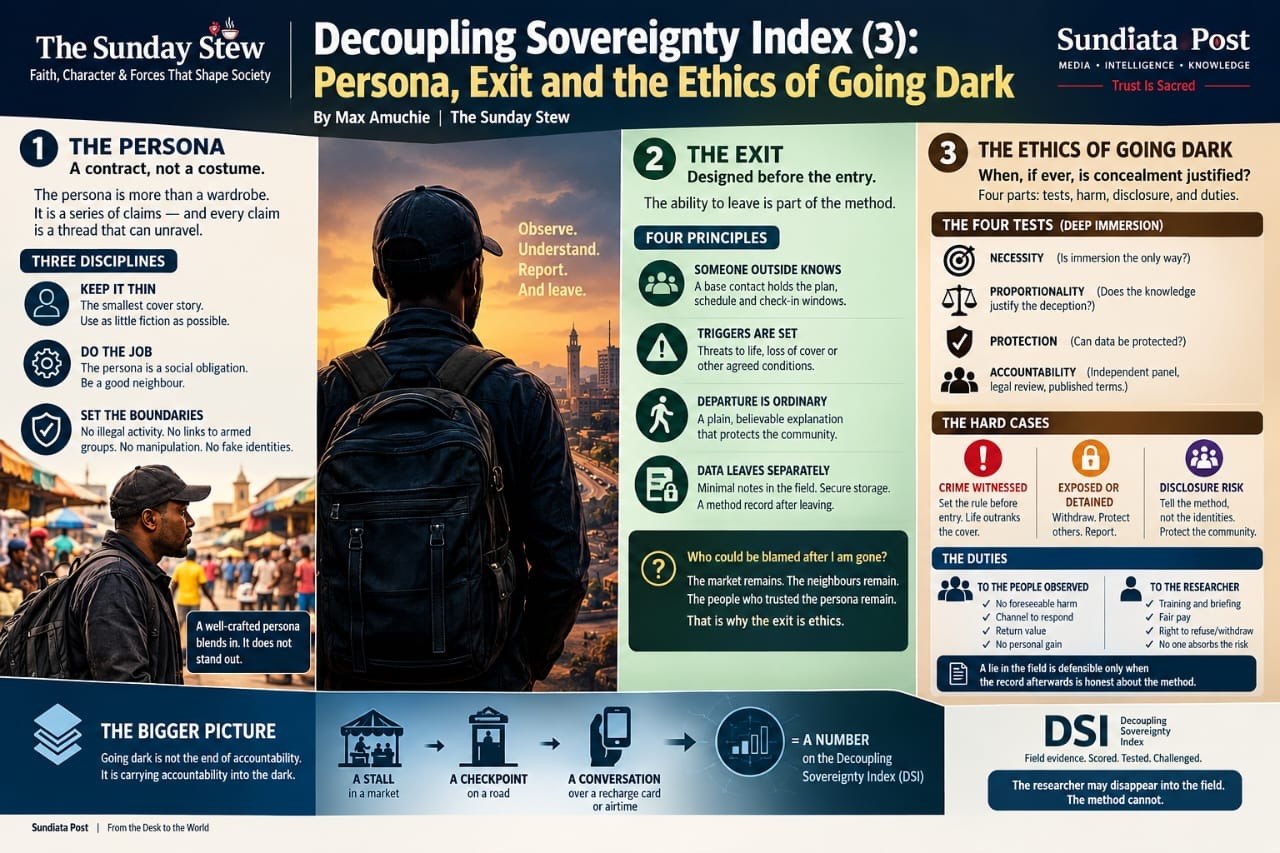
In the latest instalment of his Decoupling Sovereignty Index series, Max Amuchie examines the ethical obligations that arise when researchers adopt temporary identities to study decoupled zones.
Writing in The Sunday Stew, the Sundiata Post CEO and theorist argues that any methodology requiring a researcher to live under a borrowed role creates three unavoidable duties: the role must be disciplined, the researcher must be able to leave, and the deception must be ethically justified.
Amuchie treats the persona as a contract rather than a costume. He advises keeping the cover story thin, performing the assumed job properly, and setting clear boundaries before entering the field. These boundaries include never participating in illegal activity, never passing information to armed groups, never manipulating relationships solely to extract information, and never assuming the identity of a real person.
He stresses that the exit must be designed before entry. At the Sundiata Post Knowledge Lab, no researcher enters a zone until the exit plan is written down. This includes external check-ins, pre-agreed triggers for withdrawal, an ordinary departure story, and separating data from the person so that the community is not exposed after the researcher leaves.
On the ethics of “going dark,” Amuchie applies four tests: necessity, proportionality, protection and accountability. Immersion is justified only when remote or rapid methods cannot answer the research question.
The knowledge gained must outweigh the deception, and no observed person should face foreseeable harm. An independent panel must review and can veto any covert plan.
He addresses three hard cases: what to do if the researcher witnesses a crime, what happens if the persona is exposed, and how to disclose the method without endangering people. Life outranks the cover. Where imminent danger exists, the researcher must warn or withdraw even if it ends the assignment.
Amuchie insists that the duty runs both ways. The people observed must not pay a price for the findings, and the researcher must be trained, fairly paid and free to refuse or withdraw without penalty.
The column concludes that a lie in the field is defensible only when the later account is fully honest about the method. The people may be protected; the method may not.
Part 4 of the series will examine how field evidence is translated into scores on the Decoupling Sovereignty Index.
-
Politics3 years ago
13 Ondo Assembly Members Disown Endorsement of Aiyedatiwa
-
Politics3 years ago
APC Group, Ondo Govt, Quarrel Over Money for Endorsement
-

 Trending News5 years ago
Stop unsavoury, inciting statements – DSS warns
-

 Others5 years ago
Adron Homes Celebrates 10 Years Of Housing Excellence
-

 Humanity5 years ago
President Buhari Commiserates With Ambassador Maureen Tamuno Over The Loss Of Her Father
-

 Others7 years ago
EX- CUSTOMS BOSS, IBRAHIM MERA’S DWINDLING FAME
-

 Business2 years ago
Bigi Carbonated Soft Drinks Treats 40 Consumers to an Epic Easter Movie Hangout
-

 Business2 years ago
Wema Bank Shines at Global SME Finance Forum Conference Awards 2024 …Awarded: • SME Financier of the Year (Africa) • Platinum Award for Best Financier for Women Entrepreneurs (Africa)