
Opinion
Ogun @ 50: The Daniel Era — Policies, Progress and Political Legacy


By Wale Onifade
Gbenga Daniel’s Ogun legacy shines as the state marks 50 years, highlighting infrastructure, education, and economic transformation

As Ogun State marks its 50th year since inception on February 3, 2026, retrospectives of political leadership in the Gateway State have cast renewed light on the pivotal role of Otunba Engr. Gbenga Daniel — both as the state’s transformative governor from 2003 to 2011 and as a current federal lawmaker shaping national policy from the Senate.
Also read: WEMA BANK LAUNCHES “EVOLUTION OF LOVE” CAMPAIGN FOR VALENTINE’S DAY
A Visionary Takeover: Governance Philosophy and Policy Framework
When Gbenga Daniel assumed office on May 29, 2003, he brought a blueprint that married infrastructure-led development with human capital expansion, prioritising the twin goals of economic competitiveness and social inclusion.
His governance philosophy rested on three pillars: physical infrastructure, educational empowerment, and industrial growth — each backed by institutional reform and private sector engagement.
Daniel’s administration pursued proactive Public–Private Partnerships (PPPs), institutionalised state agencies to improve service delivery, and implemented youth-focused empowerment strategies that sought to reduce unemployment and stimulate grassroots entrepreneurship.
Infrastructure as a Development Engine
Under his stewardship, Ogun State witnessed infrastructure expansion rarely seen before:
Transport Networks: The dual-carriage upgrade of the Sagamu–Abeokuta expressway became symbolic of Daniel’s commitment to linking people, places, and markets.
Across the state, more than 2,000 kilometres of roads were rehabilitated or constructed, improving mobility and enhancing trade flows.
Stadia and Sports Facilities: Daniel’s administration constructed world-class stadia in Ijebu-Ode, Sagamu and Ilaro.
Notably, the Gateway International Stadium in Ijebu-Ode hosted the 2009 FIFA U-17 World Cup, showcasing Ogun on the global stage.
Cargo and Trade Infrastructure: Visionary planning led to the construction of the Gateway Agro-Cargo International Airport to link Nigerian agribusiness to export markets, while free trade zones — notably the Ogun-Guangdong Free Trade Zone, Kajola Transportation Free Trade Zone, and the proposed Olokola Free Trade Zone/Deep Sea Port — aimed to position Ogun as a logistics and manufacturing hub.
Tourism and Urban Redevelopment: Historic sites such as Olumo Rock were refurbished with modern amenities, enhancing their appeal and adding to the state’s tourism offerings.
Public urban housing schemes reshaped cityscapes in Abeokuta and beyond.
Education: A Legacy of Access and Specialisation
Daniel’s investment in education remains one of the most defining aspects of his governance:
Established the Tai Solarin University of Education (TASUED) — the first specialised university of its kind in Nigeria dedicated to teacher training.
Spearheaded the relocation of Olabisi Onabanjo University (OOU) to its permanent campus at Ago-Iwoye, and expanded its multi-campus footprint with specialised faculties.
Founded multiple polytechnics and ICT centres, including Gateway ICT Polytechnic (Sapade / Igbesa) and Abraham Adesanya Polytechnic (Ijebu Igbo) — strengthening vocational and technical education across the state.
Built the NYSC Orientation Camp in Sagamu, widely regarded as one of the country’s best.
These educational investments not only broadened access, but also aligned with the state’s economic priorities by equipping students with skills tailored to industry demands.
Economic Growth: Industrialisation and Investment Attraction
Under Daniel’s watch, Ogun cemented its reputation as an investment destination of choice:
His administration’s strategic positioning of the state’s industrial corridors attracted multiple industrial giants and foreign direct investment, catalysing job creation and economic diversification.
The Gateway Industrial & Petro-Gas Institute (GIPI) and other sectoral institutes aimed to develop talent pipelines for emerging sectors including oil, gas, and petrochemicals.
An active Ogun State Employment Generation Programme (OGEGEP) and targeted SME empowerment accelerated economic participation among youths and artisans.
People-Oriented Policies and Social Investment
Beyond hard infrastructure, Daniel’s administration rolled out initiatives that directly impacted social welfare:
Youth empowerment and entrepreneurship programmes proliferated, supporting young Nigerians into careers and business formation.
Subsidies, training grants, and social intervention initiatives aimed to reduce education and healthcare barriers.
Creation of state agencies such as the Ogun State Rural Medical Scheme (OGRUMED) improved access to primary and secondary healthcare services in underserved communities.
From Statehouse to Senate: A Continuum of Public Service
After concluding two terms as governor, Daniel briefly stepped back from frontline politics, focusing on leadership development through his Political Leadership Academy (POLA).
His return to elective office came in 2023, when he won the Senatorial seat for Ogun East representing the region at the National Assembly.
In the Senate, Daniel’s influence has extended to national security, economic planning, and regional development priorities:
As Chairman of the Senate Committee on Navy, he played a central role in securing federal approval for the Abigi-Makun-Omi Naval Base project — a strategic infrastructure expected to fortify maritime security and local economic activity.
He has championed legislative initiatives to establish specialised federal institutions in Ogun East — including a Federal College of Aviation Technology — strengthening the state’s role in national human capacity development.
His chairmanship of the Nigerian-Finnish Business Council drew international recognition for fostering bilateral economic partnerships.
Commemorating a Half-Century: Legacy and Lessons
As Ogun State celebrates 50 years since its creation, the imprint of Otunba Gbenga Daniel’s leadership endures — from highways and higher education to maritime strategy and federal engagement.
While public discourse on governance outcomes may vary, the infrastructure, institutional foundations, and policy initiatives Daniel advanced remain central to conversations about the state’s development trajectory.
Also read: Otunba Gbenga Daniel and the Economics of Sporting Excellence in Ogun State
At the crossroads of history and aspirations yet unmet, Ogun stands as both testament and challenge: a state shaped by pioneering governance and propelled by citizens eager for innovation, inclusion, and sustained progress. In that narrative, the Daniel era is indisputably a defining chapter.



Writer Ehi Braimah has called on Rotary clubs across West Africa to prioritise lasting partnerships over short-term projects as the region prepares for the 2026 West Africa Project Fair.
The Fair, hosted by Rotary International Districts 9111 and 9112, is scheduled to hold from November 10 to 17 at the Balmoral Convention Centre, Sheraton Hotel, Ikeja, Lagos.
It will be flagged off by Rotary International President Olayinka Babalola and is expected to draw clubs, Rotarians, Rotaractors and international partners from nine districts across the region.
Braimah noted that the theme, “Partnerships for Lasting Impact,” reflects a shift from simply launching projects to ensuring that interventions continue to serve communities long after commissioning.
He argued that many development challenges in West Africa — including healthcare, education, water, sanitation, food security and environmental issues — transcend national borders and require collaborative solutions.
According to him, a common weakness in development work is the “project mentality,” where attention focuses on starting and completing initiatives rather than guaranteeing their long-term usefulness.
Braimah stressed that true partnerships go beyond sponsorship. They involve shared responsibility, technical expertise, institutional support, monitoring and local ownership.
He said the Project Fair offers a marketplace for clubs seeking funding or technical help to connect with partners who can provide resources, knowledge or institutional backing.
The column concluded that lasting impact is achieved when Rotary’s community presence is combined with the strengths of governments, businesses and development organisations, creating solutions that communities can sustain.
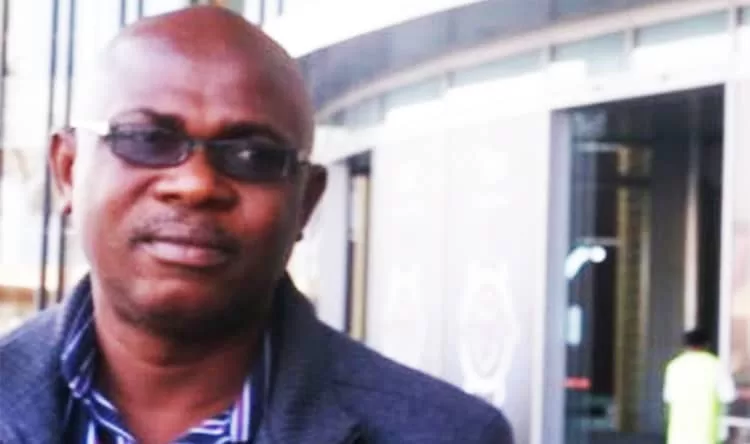
Columnist Ikeddy Isiguzo has raised fresh questions about the Lagos-Calabar Coastal Highway project and President Bola Tinubu’s second-term campaign strategy.
In his latest piece, Isiguzo criticised what he described as inconsistencies in explanations offered by Works Minister David Umahi regarding changes to the multi-billion-dollar highway.
He argued that the project, originally presented as a flagship infrastructure plan, has faced technical and financial challenges that were not adequately addressed at the outset.
Isiguzo recalled earlier concerns he raised in 2024 about the absence of detailed technical designs, environmental assessments and competitive bidding processes.
He also commented on the political dimensions of the project, noting recent statements by the minister linking adjustments to the route with presidential directives.
Turning to the 2027 elections, the columnist suggested that President Tinubu appears reluctant to campaign extensively across the country, preferring to rely on party structures and selected regional appearances.
Isiguzo listed proposed campaign locations and questioned the exclusion of certain states, interpreting the itinerary as a sign of limited political confidence.
He further criticised the ruling party’s internal dynamics, including competition among senior figures for future positions.
The column concluded with a brief reference to recent comments by the Edo State APC chairman on Peter Obi, describing them as extreme.
Isiguzo’s article continues his pattern of sharp commentary on governance and infrastructure under the current administration.
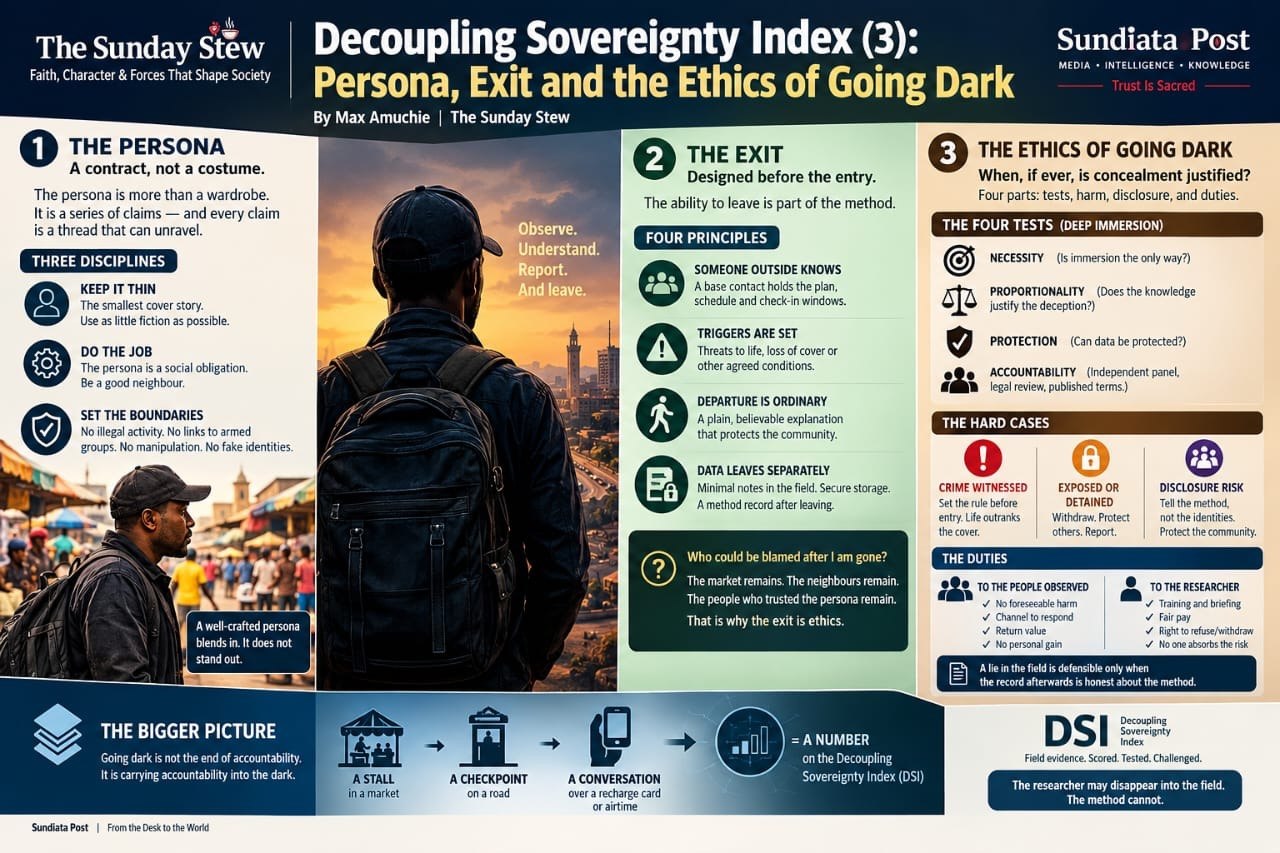
In the latest instalment of his Decoupling Sovereignty Index series, Max Amuchie examines the ethical obligations that arise when researchers adopt temporary identities to study decoupled zones.
Writing in The Sunday Stew, the Sundiata Post CEO and theorist argues that any methodology requiring a researcher to live under a borrowed role creates three unavoidable duties: the role must be disciplined, the researcher must be able to leave, and the deception must be ethically justified.
Amuchie treats the persona as a contract rather than a costume. He advises keeping the cover story thin, performing the assumed job properly, and setting clear boundaries before entering the field. These boundaries include never participating in illegal activity, never passing information to armed groups, never manipulating relationships solely to extract information, and never assuming the identity of a real person.
He stresses that the exit must be designed before entry. At the Sundiata Post Knowledge Lab, no researcher enters a zone until the exit plan is written down. This includes external check-ins, pre-agreed triggers for withdrawal, an ordinary departure story, and separating data from the person so that the community is not exposed after the researcher leaves.
On the ethics of “going dark,” Amuchie applies four tests: necessity, proportionality, protection and accountability. Immersion is justified only when remote or rapid methods cannot answer the research question.
The knowledge gained must outweigh the deception, and no observed person should face foreseeable harm. An independent panel must review and can veto any covert plan.
He addresses three hard cases: what to do if the researcher witnesses a crime, what happens if the persona is exposed, and how to disclose the method without endangering people. Life outranks the cover. Where imminent danger exists, the researcher must warn or withdraw even if it ends the assignment.
Amuchie insists that the duty runs both ways. The people observed must not pay a price for the findings, and the researcher must be trained, fairly paid and free to refuse or withdraw without penalty.
The column concludes that a lie in the field is defensible only when the later account is fully honest about the method. The people may be protected; the method may not.
Part 4 of the series will examine how field evidence is translated into scores on the Decoupling Sovereignty Index.
-
Politics3 years ago
13 Ondo Assembly Members Disown Endorsement of Aiyedatiwa
-
Politics3 years ago
APC Group, Ondo Govt, Quarrel Over Money for Endorsement
-

 Trending News5 years ago
Stop unsavoury, inciting statements – DSS warns
-

 Others5 years ago
Adron Homes Celebrates 10 Years Of Housing Excellence
-

 Humanity5 years ago
President Buhari Commiserates With Ambassador Maureen Tamuno Over The Loss Of Her Father
-

 Others7 years ago
EX- CUSTOMS BOSS, IBRAHIM MERA’S DWINDLING FAME
-

 Business2 years ago
Bigi Carbonated Soft Drinks Treats 40 Consumers to an Epic Easter Movie Hangout
-

 Business2 years ago
Wema Bank Shines at Global SME Finance Forum Conference Awards 2024 …Awarded: • SME Financier of the Year (Africa) • Platinum Award for Best Financier for Women Entrepreneurs (Africa)