Connect with us

Opinion

Parliamentary oversight or coordinated smear? The unprocedural attack on NNPCL’s Dr. Mumuni Dagazau

Published

on

Parliamentary
 By Jibrin Ateba — The oversight responsibilities of the National Assembly are vital to constitutional governance, as firmly anchored in Section 88 of the 1999 Constitution of the Federal Republic of Nigeria (as amended).

Also read: Rotary Urged To Prioritise Lasting Partnerships In West Africa

This provision empowers each chamber of the National Assembly to order investigations into any matter within its legislative competence, as well as the conduct of any person, authority, ministry, or government department entrusted with executing laws or administering public funds.

adron lemon friday

Furthermore, Section 62 provides the explicit constitutional foundation for establishing specialized committees, most notably the Committee on Public Petitions, to systematically receive, review, and investigate genuine citizen grievances.

To ensure these powers are exercised with order, discipline, and fairness, the legislature operates under clear Standing Orders formulated pursuant to Sections 60 and 101 of the Constitution.

While derived broadly from the investigative powers in Sections 88 and 128, the specific mechanisms, rules, and mandatory steps for receiving, vetting, hearing, and acting upon public petitions are meticulously detailed within these Standing Orders.

Having established this statutory background, it is essential to emphasize a fundamental principle: the constitutional mandate to receive and investigate petitions is an instrument of public accountability, not a weapon for personal vendettas, political witch-hunts, or legislative leverage.

It is within this context that the recent actions of the House of Representatives Committee on Petroleum Resources (Downstream) must be critically examined.

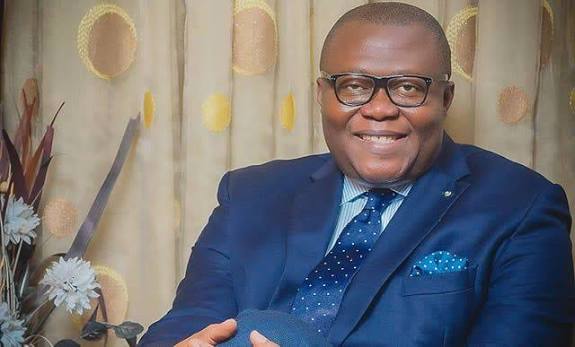
Its Chairman, Hon. Ikenga Ugochinyere Imo, disclosed at the House Committee Downstream Week that his committee had received a petition alleging money laundering and abuse of office against the Executive Vice President of the Nigerian National Petroleum Company Limited, Dr. Mumuni Dagazau.

A rigorous examination of this public disclosure reveals a glaring departure from standard parliamentary practice.

This entire affair bears all the hallmarks of a orchestrated campaign driven by deep-seated malice; a desperate attempt to smear the character of public officers who have steadfastly refused to cow to covert blackmail or compromise their official responsibilities.

If this petition possesses any legitimate substance, why did the Committee Chairman fail to reveal the identity of the petitioner? Going public with an unverified, anonymous document without first conducting a preliminary administrative inquiry, establishing a prima facie case, or according Dr. Dagazau his fundamental constitutional right to a fair hearing is deeply troubling.

By disclosing to the press with unbacked claims, the committee has bypassed established legislative protocol and effectively subjected an officer to a trial by media.

In doing so, the committee risks allowing itself to be used as a proxy for disgruntled elements seeking to undermine ongoing reforms in Nigeria’s downstream petroleum sector.

These interested parties appear unable to accept that the NNPC Limited of today operates under an entirely different paradigm from the NNPC Limited of the past. Under the Petroleum Industry Act (PIA), NNPC Limited is driven by financial prudence, corporate accountability, and strict integrity.

The days when public institutions could be coerced into handing out unearned benefits are over. Those who believe they can resort to character assassination to extract personal gain or force compliance will find that their blackmail falls on deaf ears.

Furthermore, the backdrop against which these remarks were made renders the Chairman’s comment even more disappointing.

At a major legislative gathering such as the “House Committee Downstream Week” a platform designed specifically to evaluate the health, security, and growth of Nigeria’s energy sector; the clear expectation of stakeholders, industry experts, and the general public was a forward-looking, substantive engagement.

National interest demanded that the committee focus its spotlight on critical industry dynamics: tracking progress made in local refining capacity, addressing persistent supply and bottlenecks, tackling crude oil theft, and formulating actionable legislative solutions to lower energy costs for everyday Nigerians.

Instead of seizing this vital platform to offer strategic direction and policy support, Hon. Ugochinyere Ikenga chose to reduce a high-level public gathering to a arena for personal attacks and unverified slurs against an executive officer.

Diverting public focus away from pressingly urgent structural challenges in the downstream sector to launch an unprovoked, uninvestigated attack on Dr. Mumuni Dagazau represents a severe misplacement of priorities.

It undermines the very essence of parliamentary responsibility, substituting constructive legislative leadership with sensationalism and targeted distraction at a time when the nation desperately needs solutions, not political theater.

While Dr. Dagazau reserves all legal rights to protect his hard-earned reputation against defamatory attacks and coordinated character assassination, the leadership of the House of Representatives should be urged to step in.

Also read: Rotary Urged To Prioritise Lasting Partnerships In West Africa

The National Assembly must protect the dignity of the parliament by ensuring that committee oversight remains grounded in fairness, thoroughness, and due process, rather than public spectacles driven by unverified petitions.

61 / 100 SEO Score
Continue Reading
Click to comment

Leave a Reply

Your email address will not be published. Required fields are marked *

Opinion

Rotary Urged To Prioritise Lasting Partnerships In West Africa

Published

on

Writer Ehi Braimah has called on Rotary clubs across West Africa to prioritise lasting partnerships over short-term projects as the region prepares for the 2026 West Africa Project Fair.

adron lemon friday

The Fair, hosted by Rotary International Districts 9111 and 9112, is scheduled to hold from November 10 to 17 at the Balmoral Convention Centre, Sheraton Hotel, Ikeja, Lagos.

It will be flagged off by Rotary International President Olayinka Babalola and is expected to draw clubs, Rotarians, Rotaractors and international partners from nine districts across the region.

Braimah noted that the theme, “Partnerships for Lasting Impact,” reflects a shift from simply launching projects to ensuring that interventions continue to serve communities long after commissioning.

He argued that many development challenges in West Africa — including healthcare, education, water, sanitation, food security and environmental issues — transcend national borders and require collaborative solutions.

According to him, a common weakness in development work is the “project mentality,” where attention focuses on starting and completing initiatives rather than guaranteeing their long-term usefulness.

Braimah stressed that true partnerships go beyond sponsorship. They involve shared responsibility, technical expertise, institutional support, monitoring and local ownership.

He said the Project Fair offers a marketplace for clubs seeking funding or technical help to connect with partners who can provide resources, knowledge or institutional backing.

The column concluded that lasting impact is achieved when Rotary’s community presence is combined with the strengths of governments, businesses and development organisations, creating solutions that communities can sustain.

61 / 100 SEO Score
Continue Reading

Opinion

Columnist Questions Future Of Tinubu Coastal Highway

Published

on

Columnist Ikeddy Isiguzo has raised fresh questions about the Lagos-Calabar Coastal Highway project and President Bola Tinubu’s second-term campaign strategy.

adron lemon friday

In his latest piece, Isiguzo criticised what he described as inconsistencies in explanations offered by Works Minister David Umahi regarding changes to the multi-billion-dollar highway.

He argued that the project, originally presented as a flagship infrastructure plan, has faced technical and financial challenges that were not adequately addressed at the outset.

Isiguzo recalled earlier concerns he raised in 2024 about the absence of detailed technical designs, environmental assessments and competitive bidding processes.

He also commented on the political dimensions of the project, noting recent statements by the minister linking adjustments to the route with presidential directives.

Turning to the 2027 elections, the columnist suggested that President Tinubu appears reluctant to campaign extensively across the country, preferring to rely on party structures and selected regional appearances.

Isiguzo listed proposed campaign locations and questioned the exclusion of certain states, interpreting the itinerary as a sign of limited political confidence.

He further criticised the ruling party’s internal dynamics, including competition among senior figures for future positions.

The column concluded with a brief reference to recent comments by the Edo State APC chairman on Peter Obi, describing them as extreme.

Isiguzo’s article continues his pattern of sharp commentary on governance and infrastructure under the current administration.

51 / 100 SEO Score
Continue Reading

Opinion

Researcher Outlines Ethics Of Covert Fieldwork In Decoupled Zones

Published

on

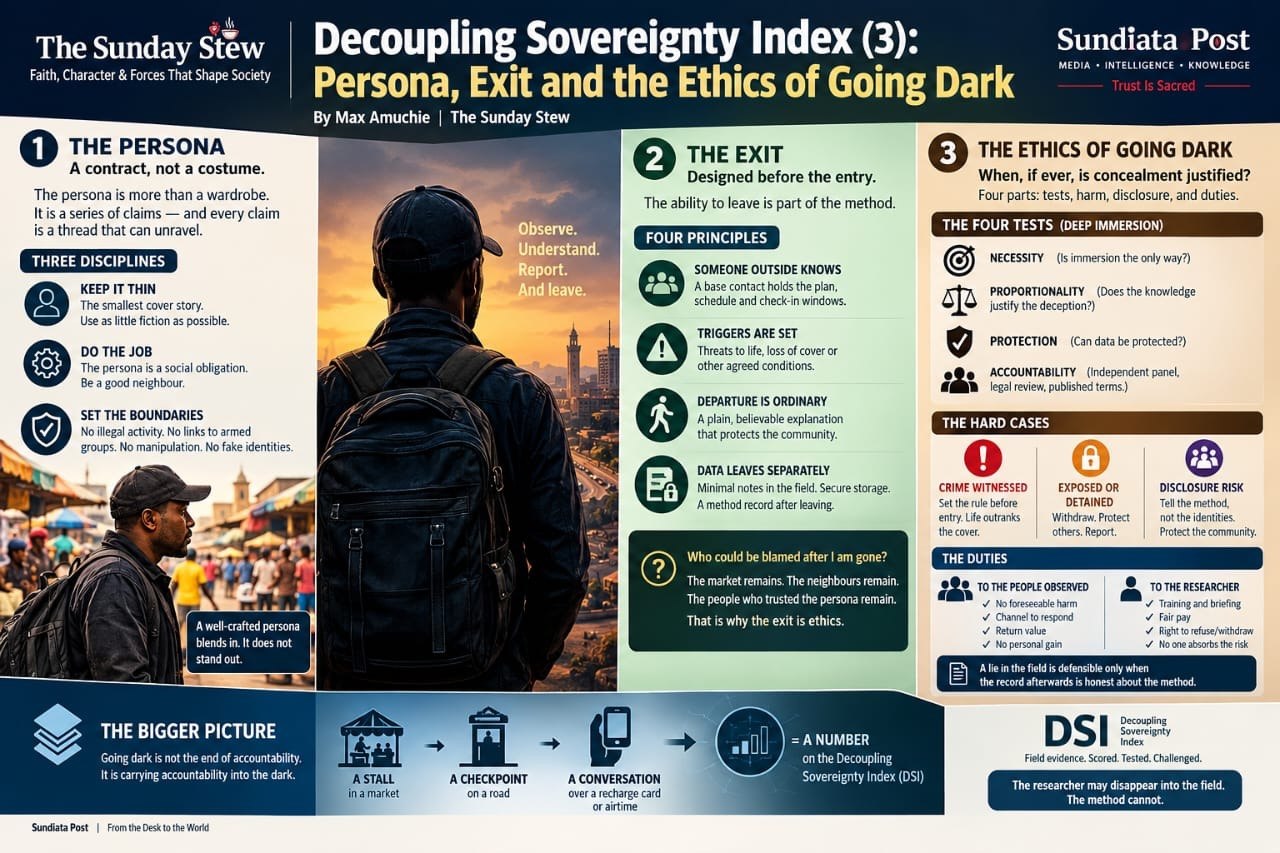
In the latest instalment of his Decoupling Sovereignty Index series, Max Amuchie examines the ethical obligations that arise when researchers adopt temporary identities to study decoupled zones.

adron lemon friday

Writing in The Sunday Stew, the Sundiata Post CEO and theorist argues that any methodology requiring a researcher to live under a borrowed role creates three unavoidable duties: the role must be disciplined, the researcher must be able to leave, and the deception must be ethically justified.

Amuchie treats the persona as a contract rather than a costume. He advises keeping the cover story thin, performing the assumed job properly, and setting clear boundaries before entering the field. These boundaries include never participating in illegal activity, never passing information to armed groups, never manipulating relationships solely to extract information, and never assuming the identity of a real person.

He stresses that the exit must be designed before entry. At the Sundiata Post Knowledge Lab, no researcher enters a zone until the exit plan is written down. This includes external check-ins, pre-agreed triggers for withdrawal, an ordinary departure story, and separating data from the person so that the community is not exposed after the researcher leaves.

On the ethics of “going dark,” Amuchie applies four tests: necessity, proportionality, protection and accountability. Immersion is justified only when remote or rapid methods cannot answer the research question.

The knowledge gained must outweigh the deception, and no observed person should face foreseeable harm. An independent panel must review and can veto any covert plan.

He addresses three hard cases: what to do if the researcher witnesses a crime, what happens if the persona is exposed, and how to disclose the method without endangering people. Life outranks the cover. Where imminent danger exists, the researcher must warn or withdraw even if it ends the assignment.

Amuchie insists that the duty runs both ways. The people observed must not pay a price for the findings, and the researcher must be trained, fairly paid and free to refuse or withdraw without penalty.

The column concludes that a lie in the field is defensible only when the later account is fully honest about the method. The people may be protected; the method may not.

Part 4 of the series will examine how field evidence is translated into scores on the Decoupling Sovereignty Index.

65 / 100 SEO Score
Continue Reading

Trending News