
Opinion
Is Iran’s second liberation afoot?


By Bola BOLAWOLE
Iran protests crisis deepens as economic hardship and repression threaten the grip of the Ayatollah-led government

“No army can withstand the strength of an idea whose time has come”- Victor Hugo.
Also read: Chelsea and PSG Compete for Alvarez Transfer
Could Hugo’s assertion be what is happening in Iran as we speak? Has the time come for the Iranian people to liberate themselves a second time within a generation? Having moved from the Shah’s oppression to the Ayatollahs’ repression, are the Iranian people now ready – and, indeed, are on the move – to truly liberate themselves and be free?
Iran’s streets rage with protests in a classic demonstration of the often-stated but hardly-heeded saying that there is a limit to human endurance.
Leaders everywhere think little of the saying by the iconic United States leader, Abraham Lincoln, that “You can fool all the people some of the time, and some of the people all the time, but you cannot fool all the people all the time.”
Even if you hide under the toga of religion, you cannot fool all the people all the time. The veil, at some point, will be parted! After 47 years of Ayatollah rule, the scales are falling off the eyes of the Iranian people.
Nothing incites us better than our pocket. So, when our pocket speaks, no one needs anyone to urge us into action!
Hundreds, if not thousands, of protesting Iranians have been mowed down by the repressive Islamic regime; yet, the rage of the people is not abated, as they keep pouring into the streets of major Iranian cities protesting the parlous state of the economy and the repression that the regime has employed for decades to keep the population in bondage.
The cage of religion is broken and the people in their multitudes are escaped from the snares of the fowlers. When will the same cage of religion – employed by both Islamic mullahs and Christian religion preneurs – be similarly broken in Nigeria?
Even if the Ayatollahs escape the ongoing rage of the people, their end may not be far from sight. For one, President Donald Trump has promised the protesters that help is on its way, even as he urged them to keep the pressure on the regime. A panicky Iranian regime is begging for negotiations.
Besides, no kingdom and no empire lasts forever: Every despot has an expiry date. Like the Shah’s oppressive reign came crashing in 1978/79, despite US support, the reign of the Ayatollahs is also bound to come crashing someday, despite the deceit of religion woven around it.
Why do leaders fail to learn from history, thereby condemning their nations to move in cycles? The same factors that led to the fall of the Shah, propelling the Ayatollahs to victory, are similar to those leading to the collapse of the Islamic Revolution of 1979.
Consider this report, “The Shah of Iran, Mohammad Reza Pahlavi, was overthrown in the 1978–79 Iranian Revolution due to widespread opposition to his autocratic rule, social injustice, economic mismanagement, and perceived subservience to Western powers.
Mass protests and strikes paralyzed the country in 1978, leading to his departure in January 1979.
“Key reasons for the Shah’s fall include: Political and social repression (and) authoritarian rule: The Shah’s government was highly autocratic, violating the Iranian constitution and repressing dissent through a powerful and feared secret police, SAVAK. Political parties, trade unions, and independent media were all suppressed.
“Western alignment and perceived puppet status: Many Iranians, from the secular left to the religious right, viewed the Shah as a “puppet” of non-Muslim Western powers, especially the United States and the United Kingdom, due in part to the 1953 CIA-backed coup that had reinstalled (the Shah) as an absolute monarch after he fled the country. His close ties with Israel further fueled this anti-Western sentiment.
“Disregard for Islamic tradition: The Shah’s aggressive modernization and Westernization programs, known as the “White Revolution”, clashed with Iran’s Shi’a Muslim identity and traditional conservative values, alienating many, especially the clergy. A controversial decision in 1976 to change the Islamic calendar to an imperial one was seen as a major insult to religious identity.
“Corruption and elitism: There was a widespread perception of extravagance and corruption within the royal court and ruling elite, which grew resentment among the general populace, including the poor and middle classes.
“Economic difficulties: Unequal distribution of wealth: Despite a rapidly-expanding economy and a windfall in oil revenues after 1973, many Iranians felt that the wealth primarily benefited the elite.
“Economic instability: The overly ambitious economic programs and a subsequent sharp economic contraction in 1977-1978, along with bottlenecks, inflation, and austerity measures, caused widespread disappointment and anger.
“Strikes: By late 1978, mass strikes by government and oil workers brought the economy to a halt, a critical turning point that paralyzed the country and weakened the regime.
“Rise of Ayatollah Khomeini and opposition unity: Khomeini’s leadership: The exiled cleric Ayatollah Ruhollah Khomeini emerged as a charismatic and unifying figure for the diverse opposition movements, which included left-wing, nationalist, and intellectual allies.
His messages, smuggled into Iran on thousands of cassette tapes, resonated with a broad spectrum of the population.
“Martyrdom cycle: A Shi’a tradition of commemorating the dead 40 days after their death led to a cycle of escalating protests and mass mobilization throughout 1978, strengthening the anti-Shah movement.
“Military’s neutrality: In the revolution’s final days, the Iranian armed forces declared their ‘neutrality’ on February 11, 1979, effectively removing the last pillar of support for the Shah’s regime and allowing the revolutionaries to take control.
“Ultimately, a combination of these deep-seated grievances, the Shah’s terminal illness (a secret at the time) which contributed to his indecision, the withdrawal of Western support under the (US President Jimmy) Carter administration’s human rights policy, and the organized, unified opposition under Khomeini created a ‘perfect storm’ that led to the collapse of the monarchy.”
Repression, religion and anti-American sentiments played pivotal roles in the Shah’s collapse. Riding on the crest of both to power, the Ayatollahs appear to have unduly overplayed their cards. Now, let us listen to a report of the factors leading to the Ayatollahs own collapse:
“Iran’s economy has been primarily damaged by a combination of international sanctions, chronic economic mismanagement and corruption, and an over-reliance on oil revenues.
“Key factors include international sanctions: Decades of strict sanctions imposed by the U.S. and other nations over Iran’s nuclear program, regional activities, and human rights record have been a major cause of the economic crisis.
These sanctions have severely restricted Iran’s access to global financial markets and crippled its ability to export oil, historically the cornerstone of government revenue.
“Economic mismanagement and corruption: Internal issues such as persistent government budget deficits, a lack of productivity, and widespread corruption have undermined the economy.
Government-controlled corporations, including those linked to the Islamic Revolutionary Guard Corps (IRGC), often operate inefficiently, crowd out the private sector, and benefit from preferential access to resources.
“Oil dependence: Iran has been heavily dependent on oil revenues for its annual budget, making its economy highly vulnerable to fluctuations in market prices and international pressure. The inability to consistently export oil has led to severe revenue losses and fiscal instability.
“Currency devaluation and inflation: The rial (Iran’s official currency) has lost significant value over the years, leading to hyperinflation and eroding the purchasing power of Iranian citizens.
This makes basic goods and services unaffordable for many and has pushed a large segment of the middle class into poverty.
“Energy crisis: Poor maintenance, aging equipment, and energy price subsidies that encourage waste have resulted in a systemic energy crisis, including frequent power outages and a bottleneck on industrial production capability.
“Foreign military involvement: Significant financial resources are allocated to regional interventions and supporting allies abroad, which critics argue compete with domestic social welfare and infrastructure development needs.
“Brain drain: The lack of economic opportunities, political instability, and human rights issues have led to the emigration of millions of highly educated professionals, resulting in a substantial loss of human capital and potential for innovation and growth.”
From the above, it can be deduced that a major problem of the Ayatollahs was their foreign policy or national interest decisions.
They moved from an extreme pro-West position to a truculent anti-West posturing, unable to find a lasting accommodation with the West since 1979. They vow the destruction of the Jewish state of Israel.
They seek nuclear weapons at all costs. They support radical Islam all over the place, even antagonising moderate Islamic states to the bargain.
Iran and Iraq fought a gruelling eight-year war that drained both nations and served the interests of their collective enemies while setting the two combatants back by many decades.
Crippling sanctions imposed by the US-led Western coalition have dealt crippling damage on Iran’s economy, denying it of resources needed for national development.
Of course, there is the scourge of corruption and mismanagement. In the midst of all of these, iron-hand rule soon replaced the support freely given by the people.
Most, if not all, of the above factors must sound familiar to Nigerians. Every politics, as they say, is local.
Whatever politics a nation plays at the international level must not be allowed to have a telling effect on the local population.
Unmitigated corruption, insensitivity of leaders, undue dependence on oil revenues, incessant power outages leading to declining productivity and high unemployment rate, unbearable cost of living engineered in the main by a steeply devalued currency – all these are no citizen’s friends. Patriotism cannot be successfully preached to an empty stomach.
Also read: Chelsea and PSG Compete for Alvarez Transfer
Therefore, Nigerian leaders – and people – have a lot to learn from what is unravelling in Iran.



Writer Ehi Braimah has called on Rotary clubs across West Africa to prioritise lasting partnerships over short-term projects as the region prepares for the 2026 West Africa Project Fair.
The Fair, hosted by Rotary International Districts 9111 and 9112, is scheduled to hold from November 10 to 17 at the Balmoral Convention Centre, Sheraton Hotel, Ikeja, Lagos.
It will be flagged off by Rotary International President Olayinka Babalola and is expected to draw clubs, Rotarians, Rotaractors and international partners from nine districts across the region.
Braimah noted that the theme, “Partnerships for Lasting Impact,” reflects a shift from simply launching projects to ensuring that interventions continue to serve communities long after commissioning.
He argued that many development challenges in West Africa — including healthcare, education, water, sanitation, food security and environmental issues — transcend national borders and require collaborative solutions.
According to him, a common weakness in development work is the “project mentality,” where attention focuses on starting and completing initiatives rather than guaranteeing their long-term usefulness.
Braimah stressed that true partnerships go beyond sponsorship. They involve shared responsibility, technical expertise, institutional support, monitoring and local ownership.
He said the Project Fair offers a marketplace for clubs seeking funding or technical help to connect with partners who can provide resources, knowledge or institutional backing.
The column concluded that lasting impact is achieved when Rotary’s community presence is combined with the strengths of governments, businesses and development organisations, creating solutions that communities can sustain.
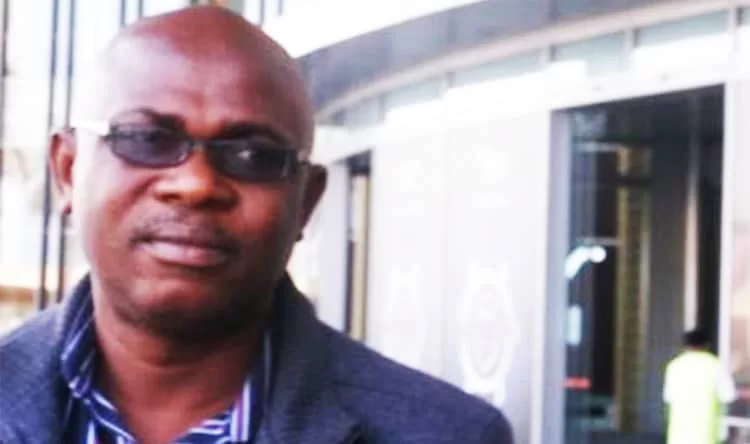
Columnist Ikeddy Isiguzo has raised fresh questions about the Lagos-Calabar Coastal Highway project and President Bola Tinubu’s second-term campaign strategy.
In his latest piece, Isiguzo criticised what he described as inconsistencies in explanations offered by Works Minister David Umahi regarding changes to the multi-billion-dollar highway.
He argued that the project, originally presented as a flagship infrastructure plan, has faced technical and financial challenges that were not adequately addressed at the outset.
Isiguzo recalled earlier concerns he raised in 2024 about the absence of detailed technical designs, environmental assessments and competitive bidding processes.
He also commented on the political dimensions of the project, noting recent statements by the minister linking adjustments to the route with presidential directives.
Turning to the 2027 elections, the columnist suggested that President Tinubu appears reluctant to campaign extensively across the country, preferring to rely on party structures and selected regional appearances.
Isiguzo listed proposed campaign locations and questioned the exclusion of certain states, interpreting the itinerary as a sign of limited political confidence.
He further criticised the ruling party’s internal dynamics, including competition among senior figures for future positions.
The column concluded with a brief reference to recent comments by the Edo State APC chairman on Peter Obi, describing them as extreme.
Isiguzo’s article continues his pattern of sharp commentary on governance and infrastructure under the current administration.
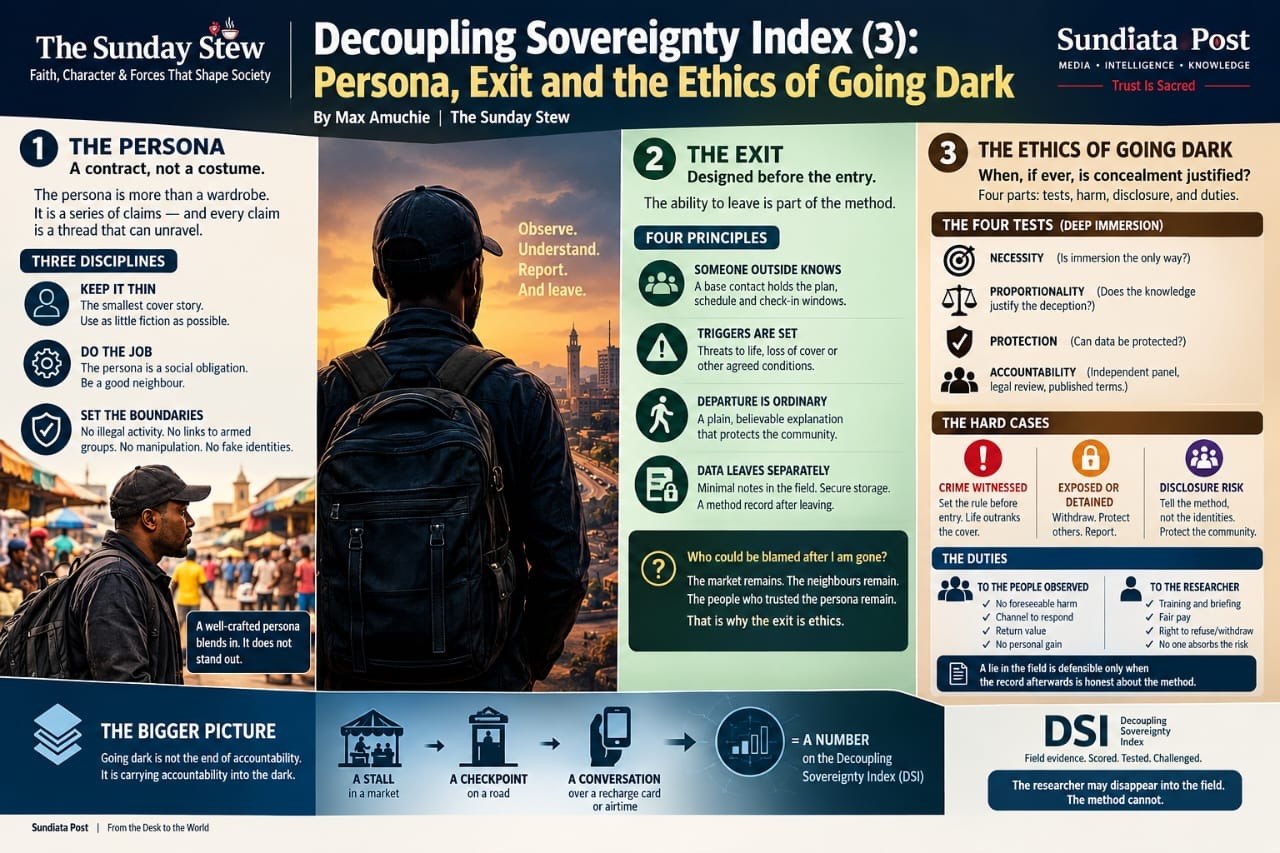
In the latest instalment of his Decoupling Sovereignty Index series, Max Amuchie examines the ethical obligations that arise when researchers adopt temporary identities to study decoupled zones.
Writing in The Sunday Stew, the Sundiata Post CEO and theorist argues that any methodology requiring a researcher to live under a borrowed role creates three unavoidable duties: the role must be disciplined, the researcher must be able to leave, and the deception must be ethically justified.
Amuchie treats the persona as a contract rather than a costume. He advises keeping the cover story thin, performing the assumed job properly, and setting clear boundaries before entering the field. These boundaries include never participating in illegal activity, never passing information to armed groups, never manipulating relationships solely to extract information, and never assuming the identity of a real person.
He stresses that the exit must be designed before entry. At the Sundiata Post Knowledge Lab, no researcher enters a zone until the exit plan is written down. This includes external check-ins, pre-agreed triggers for withdrawal, an ordinary departure story, and separating data from the person so that the community is not exposed after the researcher leaves.
On the ethics of “going dark,” Amuchie applies four tests: necessity, proportionality, protection and accountability. Immersion is justified only when remote or rapid methods cannot answer the research question.
The knowledge gained must outweigh the deception, and no observed person should face foreseeable harm. An independent panel must review and can veto any covert plan.
He addresses three hard cases: what to do if the researcher witnesses a crime, what happens if the persona is exposed, and how to disclose the method without endangering people. Life outranks the cover. Where imminent danger exists, the researcher must warn or withdraw even if it ends the assignment.
Amuchie insists that the duty runs both ways. The people observed must not pay a price for the findings, and the researcher must be trained, fairly paid and free to refuse or withdraw without penalty.
The column concludes that a lie in the field is defensible only when the later account is fully honest about the method. The people may be protected; the method may not.
Part 4 of the series will examine how field evidence is translated into scores on the Decoupling Sovereignty Index.
-
Politics3 years ago
13 Ondo Assembly Members Disown Endorsement of Aiyedatiwa
-
Politics3 years ago
APC Group, Ondo Govt, Quarrel Over Money for Endorsement
-

 Trending News5 years ago
Stop unsavoury, inciting statements – DSS warns
-

 Others5 years ago
Adron Homes Celebrates 10 Years Of Housing Excellence
-

 Humanity5 years ago
President Buhari Commiserates With Ambassador Maureen Tamuno Over The Loss Of Her Father
-

 Others7 years ago
EX- CUSTOMS BOSS, IBRAHIM MERA’S DWINDLING FAME
-

 Business2 years ago
Bigi Carbonated Soft Drinks Treats 40 Consumers to an Epic Easter Movie Hangout
-

 Business2 years ago
Wema Bank Shines at Global SME Finance Forum Conference Awards 2024 …Awarded: • SME Financier of the Year (Africa) • Platinum Award for Best Financier for Women Entrepreneurs (Africa)