Business
Nigeria Leads Regional Fight Against Illegal Fishing


Nigeria illegal fishing initiative launches pilot vessel register to curb IUU fishing and strengthen transparency in West African waters

Nigeria has stepped forward to lead a major regional effort to curb illegal fishing in the Gulf of Guinea by piloting the long-awaited Regional Record of Authorised Fishing Vessels for West Africa.
Also read: Anti-Corruption fight requires strong collaboration, says house committee chairman
The announcement was made in Abuja by Dr. Adegboyega Oyetola, Minister of Marine and Blue Economy and Chairman of the Conference of Ministers of the Fisheries Committee for the West Central Gulf of Guinea (FCWC), during a high-level meeting with the FCWC Secretary-General and officials.
Oyetola emphasised that Nigeria’s decision reflects a shift from declarations to action in combating illegal, unreported, and unregulated (IUU) fishing, which costs West African economies billions of dollars annually.
“Nigeria’s decision to serve as the pilot country demonstrates our resolve to translate regional leadership into measurable outcomes for sustainable fisheries management,” he said.
At the heart of the initiative is the creation of a verified regional database of industrial fishing vessels authorised to operate within the maritime jurisdictions of FCWC member states.
The register will cover both national and foreign fleets, enhancing transparency, accountability, and information-sharing among coastal nations.
The vessel register builds on the Monrovia Declaration, under which FCWC member states endorsed the system as a shared governance tool to combat IUU fishing across West and Central Africa.
The pilot phase will allow Nigeria and the FCWC to test the system, identify operational gaps, and generate lessons for a wider regional rollout.
Oyetola stressed that collective action and harmonised systems are essential to protecting shared fish stocks.
Complementary measures already underway include joint patrols and enforcement operations under the West Africa Sustainable Ocean Programme, implemented by the FCWC in partnership with the European Fisheries Control Agency.
The minister also highlighted updates to Nigeria’s draft National Plan of Action on IUU fishing following the transfer of fisheries oversight to the Federal Ministry of Marine and Blue Economy, signalling renewed policy focus on curbing illicit activity in Nigerian waters.
Plans for closer institutional collaboration on harmonising food safety and fisheries standards across the region were also proposed.
FCWC Secretary-General Antoine Gaston Djihinto praised Nigeria’s leadership, commending Oyetola’s commitment to boosting fish production and tackling illegal fishing.
He described the Lagos-hosted FCWC Conference in November 2025 as “outstanding and highly commendable.”
Established in 2007, the FCWC comprises Benin, Côte d’Ivoire, Ghana, Liberia, Nigeria, and Togo.
Also read: EFCC Pushes for Stronger Collaboration with Taraba Judiciary to Fight Financial Crimes
Headquartered in Tema, Ghana, it promotes regional cooperation in fisheries management, legislative harmonisation, enhanced monitoring, and the development of a sustainable blue economy across the West Central Gulf of Guinea.


Tinubu Niger Delta summit opens in Port Harcourt as investors and policymakers gather to drive investment, innovation and industrial growth

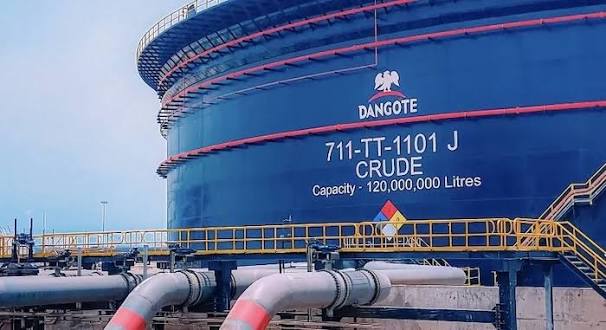
Dangote Petroleum Refinery has set its initial public offering price at ₦525 per share, with the company seeking to raise about ₦2.15 trillion as it prepares to enter Nigeria’s public equities market.
The Securities and Exchange Commission has approved the offer for 4.1 billion ordinary shares at ₦525 each. If fully subscribed, the offer would generate approximately ₦2.15 trillion, equivalent to about $1.6 billion at current exchange rates.
The offering is expected to open on 14 September 2026, according to Aliko Dangote, the president of Dangote Industries. The planned sale is positioned to become one of the largest equity offerings in Africa.
The IPO marks a significant step in Dangote Group’s plans to broaden ownership of the refinery and raise additional capital for expansion.
The refinery currently has a stated processing capacity of 650,000 barrels of crude oil per day. Dangote has said the company plans to increase that capacity to 1.4 million barrels per day as part of its longer-term expansion strategy.
The planned share sale follows a $1 billion underwriting programme completed in August, providing additional financial backing ahead of the public offering.
The refinery, located in the Lekki area of Lagos State, is one of Africa’s largest industrial projects and has become an increasingly important player in Nigeria’s fuel supply market since beginning operations.
The public offering will give Nigerian investors an opportunity to acquire shares in the refinery directly, while providing Dangote Petroleum Refinery with fresh capital to support its next phase of growth.
The company has also indicated ambitions to expand beyond its current Nigerian operations, with Dangote recently announcing plans for another refinery project in Kenya.
-
Politics2 years ago
13 Ondo Assembly Members Disown Endorsement of Aiyedatiwa
-
Politics2 years ago
APC Group, Ondo Govt, Quarrel Over Money for Endorsement
-

 Trending News5 years ago
Stop unsavoury, inciting statements – DSS warns
-

 Others5 years ago
Adron Homes Celebrates 10 Years Of Housing Excellence
-

 Humanity5 years ago
President Buhari Commiserates With Ambassador Maureen Tamuno Over The Loss Of Her Father
-

 Others7 years ago
EX- CUSTOMS BOSS, IBRAHIM MERA’S DWINDLING FAME
-

 Business2 years ago
Bigi Carbonated Soft Drinks Treats 40 Consumers to an Epic Easter Movie Hangout
-

 Business2 years ago
Wema Bank Shines at Global SME Finance Forum Conference Awards 2024 …Awarded: • SME Financier of the Year (Africa) • Platinum Award for Best Financier for Women Entrepreneurs (Africa)