
Business
Nigeria Non-Oil Exports Hit Historic $6.1bn in 2025


Nigeria non-oil exports rose to a record $6.1bn in 2025, led by cocoa and fertilisers, reflecting stronger trade, diversification, and market reach

Nigeria’s non-oil export sector reached a historic high of $6.1bn in 2025, marking the strongest performance since the establishment of the Nigerian Export Promotion Council (NEPC) nearly five decades ago.
Also read: NCC to Launch Satellite-to-Phone Services for 23.3 Million Nigerians
The figure represents an 11.5 per cent year-on-year increase from $5.4bn in 2024, reflecting renewed momentum in the country’s push to diversify its economy away from crude oil dependence.
Executive Director and Chief Executive Officer of NEPC, Nonye Ayeni, disclosed the figures on Monday in Abuja during the council’s annual progress report and 2026 non-oil export outlook briefing.
She noted that data from pre-shipment inspection agencies confirmed the milestone, describing the achievement as a testament to improved market access, compliance, and product diversification.
Cocoa beans dominated Nigeria’s export basket in 2025, generating $1.99bn and accounting for nearly 33 per cent of total non-oil export earnings.
Urea fertiliser followed with $1.29bn in value, while cashew nuts, sesame seeds, and gold dore contributed $457m, $300m, and $229m respectively.
Processed products such as cocoa liquor and cashew kernels highlighted the sector’s gradual shift towards value addition.
Total export volumes rose to 8.02 million metric tonnes, up from 7.29 million in 2024, with products reaching 120 countries worldwide.
The Netherlands was the largest destination by value at $1.07bn, followed by Brazil and India with $630m and $464m respectively.
Ayeni highlighted that exports to the Netherlands grew by 32.46 per cent, driven largely by cocoa beans, cocoa butter, and sesame seeds.
Despite the strong performance, Ayeni cautioned that significant trade still occurs informally across Nigeria’s land borders, and the council is working to incorporate such activity into official records to better support exporters.
Top export companies included Indorama Eleme Fertiliser & Chemical Limited, Dangote Fertiliser Limited, and Starlink Global and Ideal Ltd, which accounted for 13.13 per cent, 8.41 per cent, and 8.06 per cent of total non-oil exports.
Banks actively facilitating export transactions included Zenith Bank, Guaranty Trust Bank, and First Bank of Nigeria.
Ayeni further highlighted NEPC’s capacity-building efforts, noting that 728 training programmes reached over 96,000 participants across 36 states in 2025.
The council also funded international certifications for 210 SMEs, bringing the total certified exporters close to 700, while another 567 are undergoing certification.
Looking ahead, NEPC projects sustained growth in 2026, driven by enhanced capacity building, value addition, market diversification, and the mainstreaming of informal trade.
Also read: CBN Forecasts Stronger Growth as Nigeria Stabilises Economy
Strategic trade agreements, such as the Nigeria United Arab Emirates Comprehensive Economic Partnership, are expected to further boost non-oil export revenues.


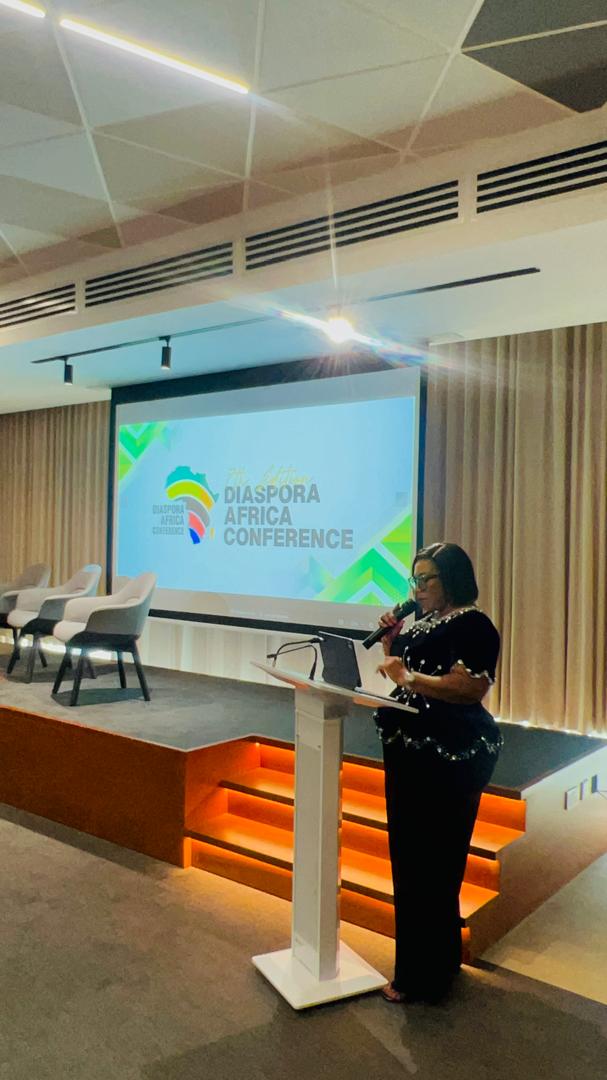
AICL GMD Maureen Tamuno calls for stronger diaspora investment in Africa through trust, transparency, skills transfer and sustainable partnerships

-
Politics3 years ago
13 Ondo Assembly Members Disown Endorsement of Aiyedatiwa
-
Politics3 years ago
APC Group, Ondo Govt, Quarrel Over Money for Endorsement
-

 Trending News5 years ago
Stop unsavoury, inciting statements – DSS warns
-

 Others5 years ago
Adron Homes Celebrates 10 Years Of Housing Excellence
-

 Humanity5 years ago
President Buhari Commiserates With Ambassador Maureen Tamuno Over The Loss Of Her Father
-

 Others7 years ago
EX- CUSTOMS BOSS, IBRAHIM MERA’S DWINDLING FAME
-

 Business2 years ago
Bigi Carbonated Soft Drinks Treats 40 Consumers to an Epic Easter Movie Hangout
-

 Business2 years ago
Wema Bank Shines at Global SME Finance Forum Conference Awards 2024 …Awarded: • SME Financier of the Year (Africa) • Platinum Award for Best Financier for Women Entrepreneurs (Africa)