
Nation
Nigeria’s Job-Creation Strategy Anchored on Macroeconomic Reform and Private-Sector Growth — Foreign Affairs Minister


Nigeria’s Honourable Minister of Foreign Affairs, Amb. Yusuf Maitama Tuggar, has outlined the country’s job-creation strategy, emphasising that sustainable employment growth is being driven by far-reaching macroeconomic reforms under the Tinubu Administration.
Speaking at the Africa Jobs Engine Panel on the margins of the World Economic Forum, the Minister explained that Nigeria’s approach is focused on restoring macroeconomic stability and creating clear, investable pathways for the private sector.
He highlighted recent reforms, including the stabilisation of the foreign exchange regime, the removal of fuel subsidies, and ongoing power-sector restructuring that separates generation, transmission, and distribution. According to the Minister, these measures are designed to improve transparency, reduce distortions, and attract long-term private investment, particularly in energy-intensive and job-rich sectors.
According to a statement signed by Alkasim Abdulkadir SA Media to the minister , he also noted that comprehensive tax reforms are underway to improve efficiency, enhance predictability, and strengthen Nigeria’s competitiveness as a destination for business and investment.
Referencing Nigeria’s hosting of the West Africa Economic Summit (WAES), he stated that the summit was conceived to bridge information gaps by equipping the private sector across the region with practical knowledge of regional frameworks and opportunities, including the West African Power Pool and other enabling regulatory instruments.
He stressed that while government’s responsibility is to provide stable and enabling conditions, the private sector remains the primary engine of job creation. In this context, the Minister pointed to the emergence of local production ecosystems that are increasingly converting raw materials into finished goods, supported by stronger linkages between labour, finance, and markets. These developments, he noted, are already expanding opportunities for women and young people.
The Honourable Minister further cautioned that the African Continental Free Trade Area should remain firmly focused on its core mandate of economic integration. He underscored that deepening intra-African trade, industrial linkages, and value chains is essential to sustaining long-term growth and employment across the continent.
He concluded by reaffirming Nigeria’s commitment to reforms that strengthen confidence, unlock private capital, and position the economy as a platform for inclusive growth and job creation in Africa.





The Federal Government says it plans to lift
five million young Nigerians out of poverty through its skills acquisition and empowerment programmes aimed at promoting sustainable livelihoods.
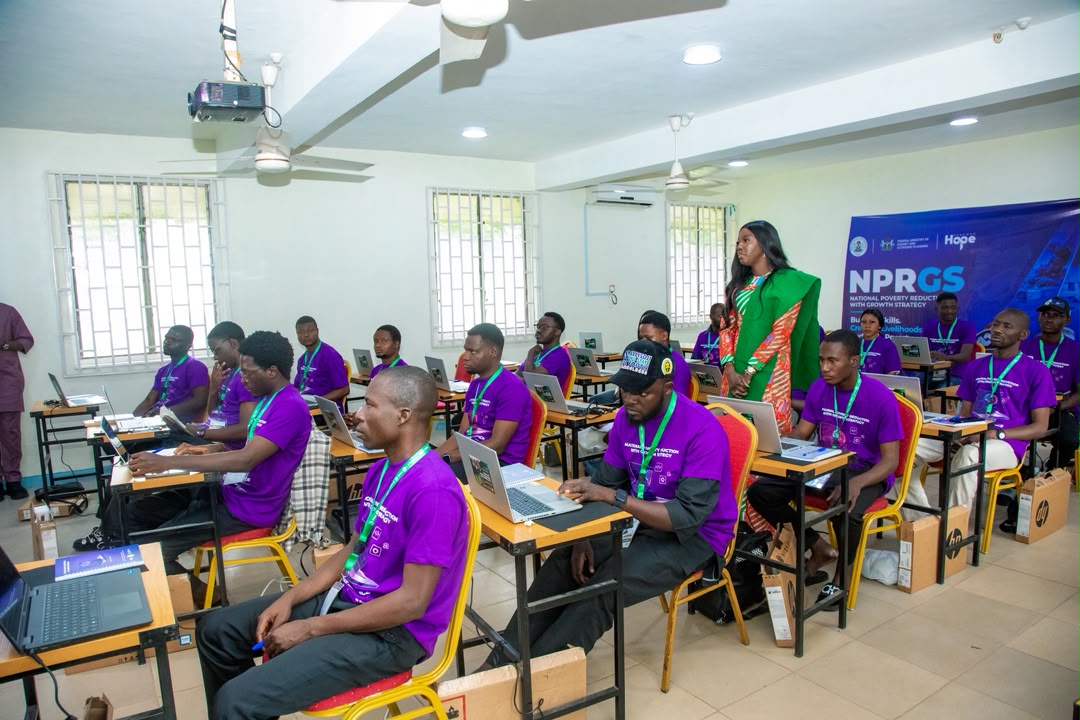
The initiative, being implemented under the National Poverty Reduction with Growth Strategy (NPRGS), is designed to equip young Nigerians with practical, market-relevant skills to enhance their economic independence and employability.
Dr Abiola Arogundade, Senior Assistant to the President on Technical, Vocational and Entrepreneurship Education (OSSAP-TVEE), coordinator of the programme, disclosed this on Monday in Ibadan at the commencement of the programme’s Oyo State phase which will run from September 28 to October 9.
She said the training is part of President Bola Tinubu’s commitment to empowering Nigerians through technical, vocational and entrepreneurial education.
Arogundade said the programme, which commenced in the Federal Capital Territory (FCT), had moved to Oyo State and would be extended to other states and geopolitical zones across the country.
Under the Oyo State phase, 200 young Nigerians are being trained in Graphics and Artificial Intelligence (AI), makeup artistry and fashion designing.
Of the beneficiaries, 30 participants are undergoing training in Graphics/AI, while 85 each are receiving training in makeup artistry and fashion designing.
Arogundade said the initiative went beyond skills acquisition, adding that beneficiaries would be connected to organisations and business opportunities to support their transition into sustainable livelihoods.
“So with this programme, we are training 200 people. We will also be distributing 500 tablets during the grand finale of the programme as part of the Federal Government’s digital empowerment drive.
“We are directly empowering 700 people in this programme and there will be multiplier effect.
“We are not just training them for themselves but we are training them for their communities, for the population, and for all the states in Nigeria,” she said.
She urged participants to take the training seriously, maximise the opportunity and use their newly acquired skills to empower others within their communities.
“I want to just encourage them to do their best.
“I want to encourage them to know that President Bola Tinubu is thinking about all Nigerians, all young Nigerians in the country and ready to address their plights,” she said.
The presidential aide reiterated the Federal Government’s commitment to creating opportunities for young Nigerians to become economically self-reliant through practical training and entrepreneurship development.
Earlier, the keynote speaker for the Graphics/AI training, Mrs Oluronke Shonubi, said the growing adoption of artificial intelligence presented Nigeria with opportunities to accelerate development, improve employability and prepare young people for emerging jobs.
One of the beneficiaries, Idowu Olalere, a 400-level student of the Federal University Oye-Ekiti (FUOYE), expressed appreciation to the Federal Government for providing young Nigerians with opportunities to acquire emerging digital skills.
Olalere said the training would help bridge the gap between existing skills and evolving labour market requirements.
Two other beneficiaries, Mrs Iyabo Ajayi, a makeup trainee, and Fatunbi Joshua, a fashion designing trainee, also expressed gratitude to the Federal Government for the opportunity.
They expressed optimism that the initiative would contribute to reducing unemployment by equipping participants with practical skills and opportunities for self-employment.
At the conclusion of the training, participants will receive laptops, sewing machines and fully equipped makeup kits to support their entrepreneurial pursuits and facilitate the establishment of sustainable businesses.
The programme forms part of the Federal Government’s broader efforts to promote inclusive economic growth, reduce poverty and expand opportunities for young Nigerians through technical and vocational education.
-
Politics3 years ago
13 Ondo Assembly Members Disown Endorsement of Aiyedatiwa
-
Politics3 years ago
APC Group, Ondo Govt, Quarrel Over Money for Endorsement
-

 Trending News5 years ago
Stop unsavoury, inciting statements – DSS warns
-

 Others5 years ago
Adron Homes Celebrates 10 Years Of Housing Excellence
-

 Humanity5 years ago
President Buhari Commiserates With Ambassador Maureen Tamuno Over The Loss Of Her Father
-

 Others7 years ago
EX- CUSTOMS BOSS, IBRAHIM MERA’S DWINDLING FAME
-

 Business3 years ago
Bigi Carbonated Soft Drinks Treats 40 Consumers to an Epic Easter Movie Hangout
-

 Business2 years ago
Wema Bank Shines at Global SME Finance Forum Conference Awards 2024 …Awarded: • SME Financier of the Year (Africa) • Platinum Award for Best Financier for Women Entrepreneurs (Africa)