Opinion
Renewed Hope @3: How Prof. Audi Abubakar’s NSCDC is Forging Nigeria’s Economic Defence
Published
2 months agoon
NSCDC Economic Defence Reform under Audi strengthens Nigeria’s critical infrastructure protection and boosts Renewed Hope economic security strategy
By Oladapo Sofowora
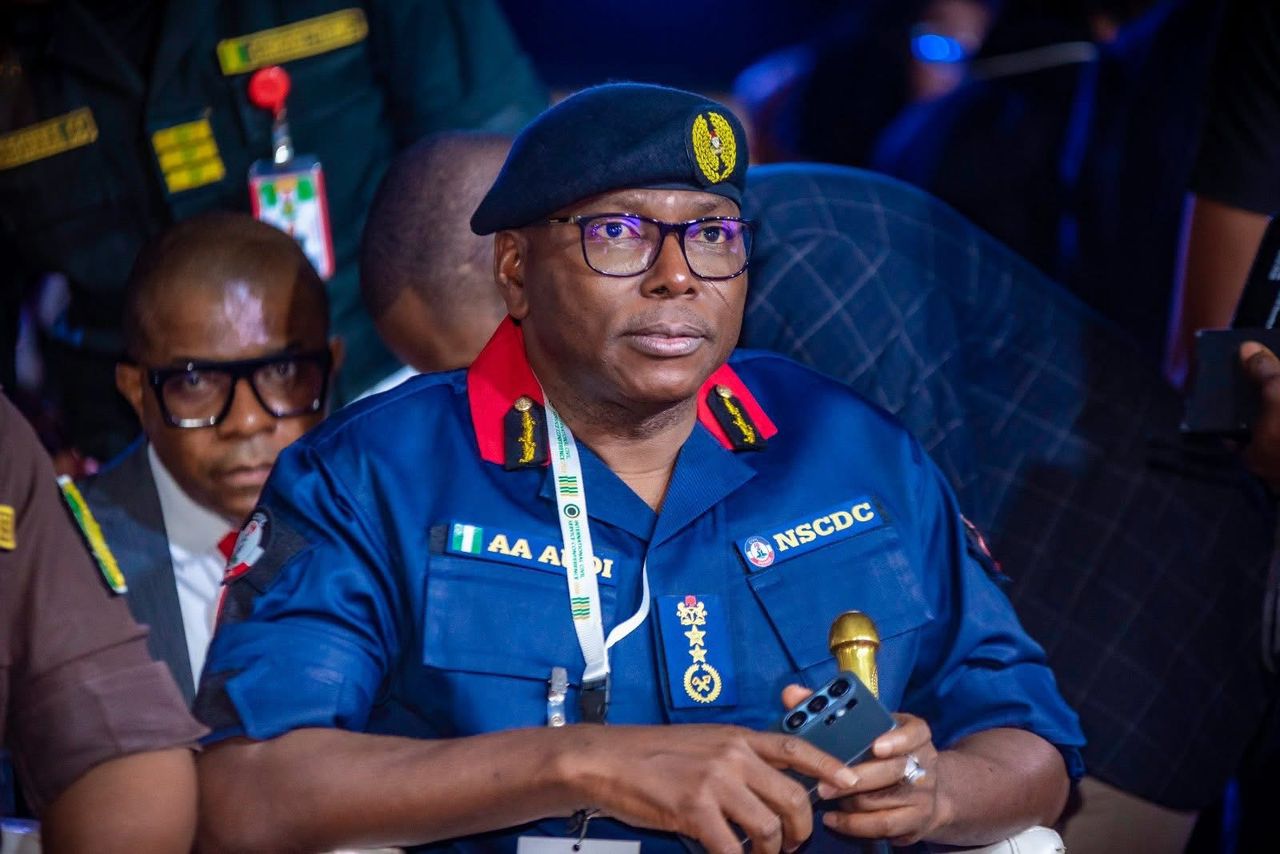
As President Bola Ahmed Tinubu marks three years at the nation’s helm as President of the Federal Republic of Nigeria; the “Renewed Hope” agenda has found one of its most reliable engines in the most unexpected of places, not in the marbled halls of policy think-tanks nor in the headline-grabbing press releases of the Presidency media team, but in the methodical, grinding and increasingly sophisticated operations of the Nigeria Security and Civil Defence Corps (NSCDC), under the quiet but relentless command of Professor Ahmed Abubakar Audi mni OFR.
Also read: Renewed Hope Projects Transform Kano, Jigawa Communities
NSCDC has undergone a transformation so radical, so structural and so deeply embedded in the logic of modern security models that it has effectively redefined what it means to protect a nation in the 21st century with technology driven innovation.
Where the average citizen once saw a uniformed auxiliary force guarding public buildings, there now stands a technology-driven, intelligence-led and globally-aligned economic shield working assiduously in protecting critical infrastructure, combating economic saboteurs and also protecting our collective economic resources.
Audi has not merely reformed a government security agency; he has built a blueprint for how Nigeria can secure its commonwealth against the vandals, saboteurs and shadow economies that have, for decades, bled the nation dry.
The architecture of this transformation rests on three unshakable pillars: technological revolution, institutional specialization and grassroots intelligence integration.
Each has been executed with a focused precision that suggests Audi, an erudite scholar by training and a strategist by instinct.
The NSCDC head honcho understood from his first day in office that the old methods of analog patrols and reactive responses were doomed to fail against the sophisticated networks of oil thieves, illegal miners and infrastructure vandals.
His answer has been to digitize the Corps from the ground up and the evidence of this shift arrived in dramatic fashion in March 2026, when he unveiled and distributed what stands as the largest consignment of high-tech operational equipment in the Corps’ history.
All 36 state command including the FCT, received three aerial surveillance drones, night vision goggles that turn darkness into daylight and the true game-changer: operational backpacks fitted with mini-tablets, solar chargers, GPS trackers and situation room connectivity packs that allow commanders in Abuja to track the real-time movements of every patrol officer in the field .
For the first time in history, the vandal who digs up an armoured cable in a remote village at 2 a.m. is no longer anonymous; his location is triangulated, his movements logged and the nearest response unit is alerted before he can cart his haul onto a waiting truck.
This technological leap is not a vanity project.
It is a direct response to the brutal arithmetic of economic sabotage that has, for years, undermined the Renewed Hope mandate.
When President Tinubu spoke of revitalizing the solid minerals sector as a cornerstone of non-oil revenue, he was speaking into a vacuum of enforcement.
Illegal miners operated with impunity across the North-Central and North-Western belts, extracting gold, lithium, lead without licenses, without royalties and without any regard for environmental or labour laws .
The revenue from this sector languished at a meager N6 billion annually, a fraction of its true potential.
Audi’s answer was the creation of the Mining Marshals, a specialized unit within the NSCDC trained specifically for the unique challenges of securing extractive sites across the country.
The results have been nothing short of transformative. In the span of two years, the Marshals dismantled over 1,000 illegal mining sites, chased out the foreign-backed cartels that controlled them and restored order to a sector in chaos.
The Marshalls have secured legal convictions and have jailed those found culpable of economic sabotage.
The revenue from solid minerals royalties exploded from N6 billion to N38 billion, a sixfold increase that speaks directly to the economic logic of the Renewed Hope agenda under President Tinubu.
This is not security for its own sake; it is security as wealth creation, security as fiscal policy, security as the invisible hand that clears the path for legitimate commerce to flourish.
Yet the mining sector is only one theater in a multi-front war.
The oil and gas industry, the historic jugular of the Nigerian economy, has long been hemorrhaged by illegal refining and crude theft on an industrial scale.
Under Audi, the NSCDC has taken the fight into the creeks alongside with the NAVY and other relevant security agency with a ferocity that has surprised even seasoned observers.
The destruction of over 400 illegal refineries has been accompanied by the arrest of 4,677 suspected economic saboteurs and the securing of 638 convictions.
The NSCDC has become a nightmare for oil thieves.
They have become dreaded because of their intellegence gathering finesse and their sophisticated weapons and technology driven information gathering gadgets.
These are not the statistics of a passive agency waiting for crimes to be reported; they are the product of aggressive, intelligence-driven operations that combine the Corps’ own assets with strategic partnerships, including the controversial but effective collaboration with Tantita Security Services in the Niger Delta.
Where previous administrations debated the legality of private security involvement, Audi simply focused on the outcome which is to drastically reduced theft, increased crude production and a slow but steady reclamation of the nation’s stolen wealth.
But perhaps the most innovative aspect of Audi’s strategy and the one that will have the longest-lasting impact, is his understanding that no amount of drones or night vision goggles can succeed without the active participation of the Nigerian people.
Security, he has argued repeatedly, is not a monopoly of the state; it is a shared responsibility that begins in the village square and the market stall.
This philosophy has found concrete expression in the Corps’ grassroots engagement framework, launched first in Lagos State across all 50 divisions and now being replicated in other states.
The model is deceptively simple but operationally profound. Galvanizing traditional rulers, market leaders, youth groups, religious bodies and owners of critical infrastructure into a structured intelligence-sharing network.
By formalizing channels through which grassroots intelligence flows to the NSCDC, Audi has effectively multiplied the Corps’ eyes and ears by millions, turning ordinary citizens into active intels of the nation’s critical assets.
This community-driven approach has been further strengthened by the institutionalization of specialized units designed to address specific security gaps in the national architecture.
The Agro Rangers, for instance, have emerged as a critical force in the battle for food security, one of the most urgent priorities of the Renewed Hope mandate.
In Gombe State, the Corps recently commissioned a fully equipped Agro Rangers base at the Kanawa Forest Reserve, complete with residential facilities, solar power, and a motorised borehole, built in collaboration with the state government and the Agro-Climatic Resilience in Semi-Arid Landscapes (ACRESAL) project.
This is not a temporary outpost; it is a permanent statement of intent.
The Rangers stationed there have a clear mandate which is to effect zero encroachment, zero illegal logging and the mediation of farmer-herder conflicts before they escalate into a full blown communal violence.
By embedding security directly into the agricultural value chain, Audi has positioned the NSCDC as a guarantor of the nation’s food supply, protecting not just silos and ranches but the very livelihoods of millions of smallholder farmers.
None of this institutional muscle would be possible, however, without a parallel commitment to the welfare and professionalism of the personnel who wear the uniform.
Audi, drawing on his academic background in public administration, understood early that a demoralized force is an ineffective force.
He moved aggressively to clear backlogs of unpaid salary arrears and stagnated promotions, addressing grievances that had festered for years and sapped the Corps of its fighting spirit.
Simultaneously, he launched a sweeping ethical crackdown, warning that the new equipment and elevated status would be accompanied by zero tolerance for indiscipline, misconduct or the diversion of operational assets for personal gain.
The message has been consistent and unmistakable; the NSCDC has transitioning from a volunteer paramilitary organization to a professional security service bound by a clear code of conduct, standard operating procedures and a performance management framework that rewards results and punishes deviance.
The ambition, however, extends far beyond Nigeria’s borders. Audi has positioned the NSCDC as a regional leader in security sector reform and the recent validation of the Corps’ revised Gender Policy II, supported by the UK Commonwealth and Development Office through the SPRiNG Programme, underscores this global orientation.
The policy, scheduled for launch in 2026, mainstreams gender-responsive leadership, strengthens disability inclusion, and aligns the Corps with Nigeria’s Third National Action Plan on Women, Peace and Security.
The deployment of Female Special Squads to vulnerable schools, which has already thwarted 48 planned kidnap attempts, is a direct operational outcome of this policy orientation.
It reflects a sophisticated understanding that security in the modern era is not merely about firepower but about inclusivity, about bringing all segments of society into the protective embrace of the state.
The most recent manifestation of Audi’s digital transformation agenda came in June 2026, just days ago, when the Corps launched a strategic capacity-building programme focused on research methodology and operational excellence.
For two days in Abuja, officers from all 36 state commands and the Federal Capital Territory gathered to be trained not in weapons handling or riot control, but in data analysis, strategic communication and evidence-based threat assessment.
The message from the Commandant General was unambiguous; the future of security belongs to those who can analyze trends, interpret intelligence and develop research-driven solutions to emerging threats.
The induction of Critical Thinking, Research and Innovation desk officers across all commands signals a permanent institutional shift toward a knowledge-driven security culture, one where the officer with a laptop and a hypothesis is as valuable as the officer with a rifle and a patrol vehicle.
As President Tinubu’s administration looks toward the horizon, the transformation of the NSCDC under Professor Audi Abubakar offers a powerful template for how Nigeria can secure its economic future.
The Corps has moved from the periphery to the center, from a reactive guard force to a proactive intelligence-led enforcer, from an analog relic to a digital vanguard.
It has demonstrated, through verifiable results, that protecting critical infrastructure is not a cost to be managed but an investment to be optimized.
Every illegal refinery destroyed, every illegal mining site dismantled, every kilometer of pipeline secured and every agro-ranger base commissioned represents a brick in the wall of Nigeria’s economic sovereignty.
The commonwealth of the nation, long treated as a common quarry for thieves and saboteurs, is finally being defended with the seriousness it deserves.
Professor Audi has not just restructured a security agency; he has redefined the very meaning of national security, proving that in the struggle for Nigeria’s soul, the battle for its pipelines, its mines, its farms and its cables is the battle to ensure that Renewed Hope becomes a reality.
The vandals are on notice.
The era of impunity is ending and the NSCDC, under the steady hand of its scholar-commander, stands ready to enforce the peace that Nigeria’s prosperity demands.
From all Indication, Prof Audi’s approach has helped highlight and turned a beam light to the President Bola Ahmed Tinubu’s Renewed Hope mandate inline with the security of lives and property which the NSCDC is not taking the back seat on.
Also read: Eid-el-Fitr: Obasa Makes Strong Appeal for Tinubu’s Renewed Hope Plan
The Corp is working round the clock to ensure the presidential mandate is upheld at the highest professional level and also ensuring that the force is leading in its core mandate and also contributing to the economic development of Nigeria on a larger scale.
You may like
-
Oyo Assembly Clears Makinde’s Leave Request, Deputy Takes Over
-
Security Forces Rescue Kwara Businessman, Kill 3 terrorists
-
Collapse After a Landslide: Starmer’s Fall May Not be The Last
-
Governor Dauda Lawal Signs Landmark Education Reform Orders, Rolls Out National Curriculum in Schools
-
AICL Expands Youth Enterprise Drive, Awards N9.75m to Startups
-
How Nigerians Can Apply for FG’s C.L.I.C.K.D. Loan for Laptops, Phones
Opinion
Collapse After a Landslide: Starmer’s Fall May Not be The Last
Published
12 hours agoon
July 23, 2026
By Azu Ishiekwene
It was painful to watch him outside No.10 on Monday. Despite his immaculate suit and well-groomed hair, British Prime Minister Sir Keir Starmer looked like he was facing a public execution.
Also read: Governor Dauda Lawal Signs Landmark Education Reform Orders, Rolls Out National Curriculum in Schools
The bespoke podium, which had been in use since David Cameron’s tenure, looked more like a stake, and Starmer’s valedictory like a miserere before the bullets would be discharged.
The carnage that British politics has become has just claimed its sixth prime minister in a decade. Britain is not doing as badly as Italy – yet – which had 50 governments and 15 prime ministers between 1946 and 1994, but at the current rate, it’s not doing badly at becoming Europe’s next Britaly, as The Economist once described it.
Which is all difficult to understand, given that for the two-and-a-half years of his premiership, Starmer never failed to remind voters that he came to power in one of the largest electoral landslides in recent British history.
Not entirely untrue. Labour won 411 of the 650 seats in the House of Commons, a majority of 174 seats over all other parties combined. Starmer’s Labour was the largest party in England, Scotland and Wales, and the first government since 2010 to end 14 years of Conservative rule.
Landslide, backslide
So, what happened? Boris Johnson, who had a chaotic and scandal-ridden premiership, has suggested that Starmer won because the Conservatives collapsed rather than due to voter enthusiasm for Labour.
He told Sky News that Starmer lost because he was a stumbling block who stood in the way instead of providing vision and leadership, virtues that I’m not sure Johnson would recognise, even in plain sight.
He was being half-clear. He conveniently forgot that his wrong-headed decision to remove Britain from the European Union is part of the price his successors, including Starmer, have had to pay. Starmer’s successor, Andy Burnham, will also be paying for it.
A study by researchers affiliated with institutions including the National Bureau of Economic Research and the Bank of England estimated that by 2025, Brexit had reduced UK GDP by between six and eight per cent relative to a non-Brexit scenario.
Business investment was down nearly 18 per cent, while productivity and employment also went down.
Post-Brexit, the British economy has been fragile, and the cost-of-living crisis has taken a toll on the middle class and pensioners. Young British adults are poorer than their parents were.
Complications, complications
Yet, none of this should have come as a surprise to Starmer. He knew that the economy was fragile, that the cost of living was rising, and public services were stretched when he campaigned to provide economic stability, fiscal discipline and a competent government.
When he positioned himself as everything to everyone, that strategic ambivalence helped him to win; it couldn’t keep him in power.
He not only knew the mess that Brexit had left the country in, but he also knew that the country was yet to fully recover from the COVID-19 supply chain disruptions and massive payouts, which added billions of pounds to the national debt, apart from the losses to fraud, estimated by a Reuters report at £10.9 billion.
The US-Israel war on Iran has piled on the chaotic fallouts of the Russia-Ukraine war, raising food prices and energy costs around the world and forcing many UK households to deal with levels of inflation that they had not experienced for years.
Every UK prime minister after Johnson – from Liz Truss to Rishi Sunak and Starmer – has had to contend with the economic legacy of three successive shocks: Brexit, the pandemic, the war in Ukraine, and now, the Middle East crisis.
Politics, poetry and prose
Yet, when politicians campaign, their poetry distorts our common sense, and we’re seduced by the hope that perhaps, just perhaps, it might be different this time.
But Starmer knew there was not much he could do. When he said before the election that Labour would not increase taxes, for example, he knew he would not find the money to plug the hole. So, he was forced to make a U-turn.
When he promised welfare reforms and fiscal discipline, he knew he was speaking with both sides of his mouth. But that was what his voters, especially his base and the campaign groups, wanted to hear.
And when he promised a clean, competent government – a departure from the sleaze years – Peter Mandelson was smiling, waiting to snooker him. The outcome was a shambles for the government’s reputation.
And when Starmer was boasting about a landslide, he knew that the result of the election that brought him to power was more nuanced. It was a victory by default.
While Tony Blair, for example, won 43.2 per cent of the popular vote share in 1997, Starmer won only 33.7 per cent, reflecting a far narrower popular mandate than he cared to admit publicly.
According to a YouGov Poll, among the people who voted Labour in 2024 and then participated in the 2026 local elections, only 46 per cent remained with Labour.
About 22 per cent moved to the Greens, 16 per cent to the Liberal Democrats, while 6 per cent moved to Reform UK.
With a drastic decline in public trust of politicians and public institutions, it’s not surprising that Starmer’s landslide fizzled before he could fully milk it.
The palace coup that forced out the Prime Minister was not because Labour MPs loved him less, but because they love themselves more.
Wheeling in Burnham from the shadows to No.10 was a move by the Backbenchers to buy time and fend off the lunacy of Nigel Farage’s Reform UK Party.
Talking big
Burnham has started by announcing big, obviously more left-wing Labour policies, from removing VAT on domestic electricity bills for six months to restoring the £2 cap on single bus fares across England, and from expanded housebuilding to greater public investment outside London.
He has also talked about increasing defence spending, while whispers of “nationalisation” have even been heard.
But it won’t be long before he might stumble on the question that has snagged his six predecessors: where will the money come from? Once upon a United Kingdom, when the country was at the peak of its powers, it controlled nearly 20 per cent of the world’s manufacturing output, which, of course, was after it robbed India, among others, of its pre-industrial manufacturing dominance and converted it into a primary producing country.
At the height of Britain’s influence, one-quarter of the earth’s surface was its farmland. Those days are gone.
Copying Italy?
The world has changed since Britannia ruled the waves. While Britain remains one of the world’s leading economies, its current sunset phase has taken a heavy toll on its prosperity.
Strong alignment with NATO and the European Community, which later became the EU, helped Italy navigate its turbulent years. Unfortunately, Britain chose to leave the EU when it needed it most.
The last thing the country needs is a premier who sells hope at a high price. Burnham positioned himself as a beacon for his stranded Labour Party.
Also read: Governor Dauda Lawal Signs Landmark Education Reform Orders, Rolls Out National Curriculum in Schools
Yet his record in Manchester urges caution. Already, he is making expensive, even extravagant promises that may come back to bite him. At this rate, he may well not be the last prime minister before the general election in 2029.
Opinion
Facebook vs ARCON: Presidential Aide O’tega Ogra Got It Wrong And Should Not Drag Presidency Into Murky Waters
Published
14 hours agoon
July 23, 2026
By Ewa Izuchukwu
It was barely weeks after my honest review that raised questions about Justice Bogoro’s judgment setting aside ARCON’s ₦60 billion notice against Facebook Nigeria, when I got a rejoinder from a surprising and an unexpected source.
Also read: Facebook Nigeria vs ARCON’s judgment: Not about fine but consumer protection at risk of vulnerability
It’s not from Facebook Nigeria, not from Meta’s regional or global policy office, but from our own O’tega Ogra, the Senior Special Assistant to the President on Digital Communications, Engagement and New Media Strategy. His piece, “The Facebook Nigeria Judgment Is Not a Defeat for Consumers. It Is a Victory for the Rule of Law,” summarily argues that the ruling strengthens institutional discipline rather than weaken consumer protection.
Ordinarily, public debate is healthy. Counter-arguments strengthen democratic discourse. But before engaging the substance of Ogra’s arguments, there is an important question that deserve serious considerations, answers: why has a presidential aide become the most visible public defender of a judgment obtained by Meta when the company itself has chosen silence?
Ogra’s writer profile at the end of the rejoinder discloses that he is also Vice President of the Association of Advertisers in Nigeria (ADVAN) and a member of the governing council of the World Federation of Advertisers.
Those are legitimate affiliations. But again, is he speaking as the President’s communications adviser? As an ADVAN executive? Or simply as a private citizen exercising his right to free expression?
The distinction matters because each role carries different responsibilities. When a senior presidential spokesman publicly champions a position that substantially aligns with the interests of a multinational technology company in litigation against a regulatory agency, perceptions matter as much as intentions.
Whatever he intended, the impression created is that the Presidency through its Ogra its spokesman has entered a dispute against a federal government agency. That is an impression no presidential aide should willingly create.
Interestingly, while ADVAN has maintained its longstanding disagreements with ARCON over ongoing advertising industry reforms, its President, Osamede Uwubanmwen, and its Board of Trustees Chairman, Aare Fatai Odeshile have appeared to be relatively restrained in publicly prosecuting this latest chapter of that disagreement. Instead, Ogra has emerged as the new ADVAN spokesman on industry matters.
Whether by design or circumstance, he now appears to be carrying the public argument that others within the association have largely avoided. That should concern him.
A presidential spokesman should be careful not to blur the distinction between public office and negative industry issues, particularly on matters where government itself has a direct stake through one of its regulatory agency.
The Office of the President should not be perceived as attacking a regulatory agency in the media or championing foreign interests ahead of national and consumer interests.
Is this really something to celebrate?
Setting personalities and motives aside and examining Ogra’s main claim, the court did not shield Meta from the law, only that ARCON failed to prove Facebook Nigeria’s relationship to Meta with admissible evidence rather than commercial assumption. But look at what proving that relationship “properly” actually requires in practice.
In the earlier related Abuja suit FHC/ABJ/CS/1701/2022, filed in September 2022, ARCON had gone the route Ogra says the law demands. It sued Meta Platforms Incorporated directly, and on 30 March 2023 the court granted leave to issue and serve the originating summons on Meta in the United States!
If that is what “doing it properly” looks like, then the rule of law Ogra is celebrating is one that only a well-resourced regulator, or a well-resourced litigant, can actually afford to invoke.
An ordinary Nigerian consumer deceived through advertising on Facebook cannot realistically litigate against Meta in California or Delaware. So while lawyers may applaud procedural purity, consumers are left asking a simpler question: who protects us?
Consumer protection is not exclusive to one regulator
It is disappointing that as a senior presidential aide, Ogra does not know that all government agencies have overlapping functions and all government regulatory agencies have consumer protection as their primary mandate, and that is why he would argue that ARCON is not Nigeria’s consumer protection regulator and that this responsibility belongs to the Federal Competition and Consumer Protection Commission (FCCPC).
Government agencies routinely enforce laws within their respective sectors where consumer welfare is implicated. NAFDAC prosecutes misleading advertisements relating to regulated products.
The Central Bank intervenes where financial promotions breach banking regulations. The Securities and Exchange Commission acts against unlawful investment promotions.
The Nigerian Communications Commission protects telecommunications subscribers. None of these agencies declines responsibility simply because the FCCPC also has consumer protection powers.
In fact, quite recently, the National Drug Law Enforcement Agency (NDLEA) recently secured the conviction of a social media content creator for promoting cannabis online.
The court sentenced him to seven years’ imprisonment after finding him guilty under the NDLEA Act for using social media to advertise cannabis products.
The NDLEA did not conclude that because the offending conduct involved advertising, it should wait for ARCON to act. Nor did it argue that advertising regulation fell exclusively within another regulator’s jurisdiction.
It acted because the offence touched directly on its statutory mandate. That is how sectoral regulation works. Government agencies exercise powers within their enabling laws, even where those powers intersect with advertising, consumer welfare or public safety.
The evidentiary bar Ogra defends is not the one Nigerian courts actually apply
Ogra insists that “commercial reality and legal proof are not always the same thing,” and that courts cannot repair a regulator’s evidentiary gaps. That would be a stronger argument if our courts had, in fact, been applying that standard consistently. They have not.
In January, a Lagos High Court in Femi Falana, SAN v. Meta Platforms Inc. held Meta liable as a joint data controller for content on Facebook without requiring Falana to first construct an elaborate paper trail proving Meta’s ownership and control of the platform; the relationship was treated as established fact, because it plainly is.
The Competition and Consumer Protection Tribunal reached a $220 million judgment against “Meta Platforms Incorporated (Facebook) and WhatsApp LLC” jointly on the same basis.
Our law also already possesses a doctrine built for exactly this situation, which is piercing the corporate veil, applied by the Supreme Court in Marina Nominees Ltd v. Federal Board of Inland Revenue to look behind a company shown to be acting as another’s agent, and invoked whenever, per Oyebanji v. State, a corporate form is used to dupe or evade.
None of these courts demanded that a claimant first litigate Meta’s corporate structure from scratch. Only Justice Bogoro’s court did. If Otegra’s “rule of law” means anything, it should mean consistency… the same platform, the same country, should not be a proven data controller in one courtroom and a legal stranger to its own product in another.
As referenced in my earlier piece, Nigeria is not the first place Meta has reached for corporate separateness as a shield, and Ogra’s “burden of proof” framing collapses when set against how other courts have treated the identical argument.
In Kenya, Meta spent years insisting it could not be held responsible for Facebook content moderators because they were technically employed by an outsourcing contractor, Sama; Kenya’s employment court rejected that, and the Court of Appeal upheld the rejection, holding that Meta was the real employer because the moderators did Meta’s work under Meta’s control.
In Australia, Facebook Inc argued in litigation brought by the country’s privacy regulator that only its Irish affiliate, not Facebook Inc itself, conducted business in Australia; the Full Federal Court rejected that, and separately refused Facebook Inc’s own attempt to escape service of the very kind of cross-border process Ogra treats as an unavoidable technicality here.
Ireland’s Data Protection Commission, dealing with the very corporate architecture Meta uses to route around accountability, fined the Irish subsidiary itself €1.2 billion rather than accepting that the structure shielded anyone.
In each of these markets, courts and regulators found a way to hold the platform to account without first demanding a documentary trail that, in practice, only Meta’s own internal filings could ever fully. Indeed, Nigeria’s outcome is the outlier, not the norm.
Mr. Ogra ends his article by urging ADVAN to help foster reconciliation between advertisers and regulators.
That would have been commendable had ADVAN not spent years engaged in legal confrontation with ARCON over issues bordering on regulatory authority.
Let me stop here by emphasizing that the larger issue is no longer whether the presidential aide is entitled to his opinion. Every Nigerian enjoys that right.
The real issue is whether he should be the one leading what increasingly appears to be an industry campaign against a statutory agency of the same Federal Government he has been appointed to serve.
If Mr. Ogra wishes to be the public face of ADVAN’s long-running disagreements with ARCON, that is entirely his prerogative. But public office comes with obligations that demand restraint, neutrality and an acute awareness of perception.
The Office of the President should never be seen, rightly or wrongly, as taking sides in a dispute involving one of its own regulatory agencies and a multinational corporation.
That is why Mr. Ogra should reflect carefully on the implications of his intervention. If he believes so strongly in ADVAN’s cause that he intends to become one of its principal public advocates in its continuing contest with ARCON, then the honourable course would be to first relinquish his role as Senior Special Assistant to the President.
He cannot effectively wear the hat of a presidential spokesman while simultaneously projecting himself as a leading voice in a battle that pits an industry association against an agency of the Federal Government.
This is more so as every response directed at him in this matter inevitably risks being interpreted as a response to the Presidency itself.
That serves neither President Bola Tinubu, whose office ought to remain above such industry disputes, nor the integrity of government institutions.
Also read: Facebook Nigeria vs ARCON’s judgment: Not about fine but consumer protection at risk of vulnerability
Public confidence is not strengthened when a presidential aide appears to be publicly undermining one regulator while defending the legal victory of a private multinational company.
Opinion
Wole Soyinka at 92: Nigeria’s literary titan, Africa’s conscience and global intellectual powerhouse
Published
1 week agoon
July 15, 2026
By Ehi Braimah
There are writers, there are intellectuals, and there are moral giants whose influence transcends literature to shape the conscience of nations.
Recent Post
- Oyo Assembly Clears Makinde’s Leave Request, Deputy Takes Over
- Security Forces Rescue Kwara Businessman, Kill 3 terrorists
- Ijebu-Remo State Creation Bid Secures Backing of 75 Senators
- Collapse After a Landslide: Starmer’s Fall May Not be The Last
- Facebook vs ARCON: Presidential Aide O’tega Ogra Got It Wrong And Should Not Drag Presidency Into Murky Waters
Trending News
-
Politics2 years ago
13 Ondo Assembly Members Disown Endorsement of Aiyedatiwa
-
Politics2 years ago
APC Group, Ondo Govt, Quarrel Over Money for Endorsement
-
Trending News5 years agoStop unsavoury, inciting statements – DSS warns
-
Others4 years agoAdron Homes Celebrates 10 Years Of Housing Excellence
-
Humanity4 years agoPresident Buhari Commiserates With Ambassador Maureen Tamuno Over The Loss Of Her Father
-
Others7 years agoEX- CUSTOMS BOSS, IBRAHIM MERA’S DWINDLING FAME
-
Business2 years agoBigi Carbonated Soft Drinks Treats 40 Consumers to an Epic Easter Movie Hangout
-
Business2 years agoWema Bank Shines at Global SME Finance Forum Conference Awards 2024 …Awarded: • SME Financier of the Year (Africa) • Platinum Award for Best Financier for Women Entrepreneurs (Africa)