
News
Oshiomhole Blames Naira Collapse on Buhari-Era Money Printing
Senator Oshiomhole says Buhari’s excessive money printing under CBN’s Ways and Means policy crippled the naira, creating Tinubu’s debt repayment burden.


Senator Oshiomhole says Buhari’s excessive money printing under CBN’s Ways and Means policy crippled the naira, creating Tinubu’s debt repayment burden

Buhari money printing policy was directly responsible for the collapse of the naira, according to Senator Adams Oshiomhole, who criticised the Central Bank’s use of the controversial Ways and Means provision during the former president’s tenure.
Also read: Tinubu hails Nigerian Governors over Supreme Court ruling on CBN Naira Swap policy
Speaking at the Progressive Governors Forum’s meeting and interactive session held in Benin City on Saturday, Oshiomhole said the Central Bank of Nigeria (CBN), under former President Muhammadu Buhari, printed money excessively under the guise of emergency funding. This, he said, weakened the local currency and fuelled the current economic crisis.
“We are coming from a country that was almost like Zimbabwe or Idi Amin’s Uganda, where he asked the Central Bank Governor to ‘go and print more money for us to share to the people’. And the Governor said, if we print more money, Uganda currency will be like a sheet of paper,” Oshiomhole remarked.
The senator, who represents Edo North and is a former governor of the state, traced the current cost-of-living crisis and the volatile exchange rate back to what he described as reckless monetary practices under Buhari’s leadership.
He said that the Ways and Means facility, which permits the Federal Government to borrow from the CBN to meet urgent funding needs, was abused and turned into an unsustainable financial lifeline.
This, he argued, forced the naira into free fall and left the Tinubu administration grappling with the consequences.
“To understand the root cause of the current exchange rate and inflation crisis, we must trace it to the excessive amount of banknotes printed through the so-called Ways and Means,” Oshiomhole said.
He added that Nigeria had been borrowing daily under Buhari “the way fish drinks water,” resulting in a massive debt burden that now rests on President Bola Tinubu’s shoulders. The senator stressed that servicing this debt is vital for preserving Nigeria’s financial sovereignty.
In 2024, the Senate set up an ad hoc committee to investigate both the Ways and Means facility and the CBN’s Anchor Borrowers Programme, amid growing concerns about the lack of transparency and the economic risks involved.
Under the existing law, the Central Bank may lend to the Federal Government for short-term funding gaps, but analysts say the Buhari-era administration bypassed limits and accountability checks.
Also read: Buhari Finally Signs Electoral Act Amendment Bill Into Law
Oshiomhole’s comments have reignited debate over the long-term consequences of unchecked monetary expansion and the urgent need for reform within Nigeria’s fiscal and monetary frameworks.


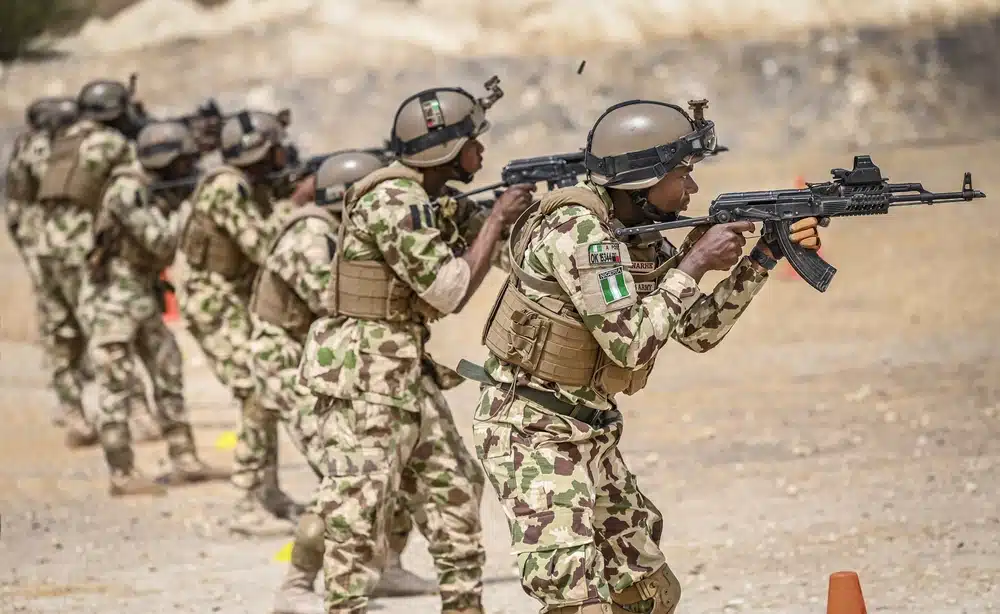
Troops rescue four kidnap victims in Zamfara and Kebbi during separate military operations targeting suspected terrorists and criminal groups

Ann Izuegbu has been arraigned in Abuja over alleged cybercrime and remanded at Suleja Correctional Centre until her next court date.
Anthonet Ngozi Izuegbu, popularly known as Ann and described as a friend of Nollywood actress Regina Daniels, has been arraigned before the Federal High Court in Abuja over alleged cybercrime.
Also read: UCL: Osimhen Scores as Galatasaray Beat Lille 4-2
According to a report by National Waves, Izuegbu was rearrested on Monday following a petition reportedly filed by Daniels and arraigned on Wednesday.
After taking her plea, the court ordered that she be remanded at the Suleja Correctional Centre. The case was adjourned until December 10, 2026.
The allegations against Izuegbu reportedly include claims of theft and blackmail raised in Daniels’ petition. However, the precise charges before the court and the defendant’s plea were not detailed in the report.
The police are also reportedly expected to file additional charges, although no further charges had been confirmed in the account provided.
The latest court proceedings follow earlier allegations involving Izuegbu and Senator Ned Nwoko, Daniels’ estranged husband.
A statement previously issued by Nwoko’s media team claimed that Izuegbu’s earlier arrest was connected to alleged criminal defamation over statements concerning the lawmaker and his wife, Laila Nwoko.
The statement disputed allegations that Nwoko had physically assaulted Laila, resulting in a miscarriage, describing the claims as false and unsupported.
It also accused Izuegbu of involvement in other alleged misconduct, including claims relating to controlled substances and an abortion involving Daniels during her marriage to Nwoko.
These claims were allegations contained in the media team’s statement and should not be treated as established facts or findings by a court.
The statement further referred to a witness statement allegedly submitted to the Maitama Area Command on October 29, 2025, concerning activities attributed to Izuegbu and other individuals.
Nwoko’s media team maintained that the matter was a law-enforcement issue rather than merely a dispute on social media.
Izuegbu’s previous court appearance was reportedly stalled on July 16, 2026, when the matter came before Justice Ekerete Akpan of the Federal High Court in Abuja.
According to the report, she collapsed and was absent from the proceedings, prompting the court to adjourn the matter to September 15, 2026.
The latest arraignment marks a further development in the case, which has attracted public attention because of the individuals involved and the allegations circulated in the media.
Also read: UCL: Osimhen Scores as Galatasaray Beat Lille 4-2
Izuegbu’s remand does not amount to a conviction. The allegations against her remain subject to the court process, and she is presumed innocent unless proven guilty.
Police have arrested a 19-year-old suspect over a stolen phone in Anambra, following an intelligence-led operation in Awka
The Anambra State Police Command has arrested a 19-year-old suspect over an allegedly stolen Infinix Android phone linked to Adamawa State.
Also read: Kano Governor Praises Tinubu Over Abuja-Kano Road Project
The suspect, identified as Mustapha Sani, was arrested on October 19, 2026, by operatives of the State Intelligence Department in Awka following an intelligence-led operation, the police said.
The command’s spokesperson, SP Tochukwu Ikenga, disclosed the arrest in a statement on Thursday, adding that preliminary findings suggested the suspect had allegedly stolen mobile phones from unsuspecting victims in Adamawa before travelling to Anambra.
According to the police, the devices were reportedly intended for sale or personal use after the suspect fled the state.
“The recovered phone is currently being investigated to establish the full circumstances surrounding the alleged offence,” Ikenga said.
He added that investigators were working to determine the suspect’s alleged involvement and facilitate the return of the recovered device to its rightful owner.
The command said investigations were ongoing to establish the circumstances surrounding the alleged theft and determine whether the suspect was involved in other offences.
The Commissioner of Police in Anambra State, CP Nnanna Ama, reaffirmed the command’s commitment to combating crime, recovering stolen property and ensuring that suspects were dealt with in accordance with the law.
Ama also assured residents and visitors that the police would continue intelligence-led operations and proactive patrols to protect lives and property and maintain public order across the state.
The arrest comes amid other reported cases involving mobile phone theft and alleged financial fraud in the region.
In a separate incident, the Borno State Police Command reportedly arrested six suspects over the alleged theft of a mobile phone and the unlawful withdrawal of N5.65m from the owner’s bank account.
The victim, identified as Abba K., reportedly told police that his Infinix Smart 8 phone went missing from his pocket after he alighted from a commercial tricycle on October 13, 2026, along Damboa Road in Maiduguri.
The Borno case remains separate from the Anambra investigation.
The Anambra police have not disclosed whether the 19-year-old suspect has been charged in court.
Also read: Kano Governor Praises Tinubu Over Abuja-Kano Road Project
He remains presumed innocent unless proven guilty.
-
Politics3 years ago
13 Ondo Assembly Members Disown Endorsement of Aiyedatiwa
-
Politics3 years ago
APC Group, Ondo Govt, Quarrel Over Money for Endorsement
-

 Trending News5 years ago
Stop unsavoury, inciting statements – DSS warns
-

 Others5 years ago
Adron Homes Celebrates 10 Years Of Housing Excellence
-

 Humanity5 years ago
President Buhari Commiserates With Ambassador Maureen Tamuno Over The Loss Of Her Father
-

 Others7 years ago
EX- CUSTOMS BOSS, IBRAHIM MERA’S DWINDLING FAME
-

 Business2 years ago
Bigi Carbonated Soft Drinks Treats 40 Consumers to an Epic Easter Movie Hangout
-

 Business2 years ago
Wema Bank Shines at Global SME Finance Forum Conference Awards 2024 …Awarded: • SME Financier of the Year (Africa) • Platinum Award for Best Financier for Women Entrepreneurs (Africa)