
Opinion
Impeachment: Will prayers save Fubara?


By Bola BOLAWOLE
Ex-governor Fayose warns Rivers Governor Fubara may need prayers to survive impeachment amid political clashes with Nyesom Wike

Erstwhile governor of Ekiti state, Peter Ayodele Fayose, has said only prayers will save Gov. Siminalayi Fubara from impeachment.
Also read: Georgina Onuoha Warns May Edochie Fans Over Toxic Threats
The Rivers State House of Assembly is making the third attempt to impeach the governor, the first two attempts having floundered on the altar of efforts at political resolution of the rofo-rofo fight between the governor and his estranged godfather, Nyesom Wike, who is the immediate past governor of the state and now Minister, Federal Capital Territory, Abuja.
Fayose is on record as having warned Fubara before his election as governor never to cross godfather-Wike’s path once he mounts the saddle.
“I know Wike o!” he repeatedly told Fubura at a public function, but it would appear, with unfolding events, that Fubara chose to turn deaf ears to Fayose’s admonitions. Possibly, he must have felt he knew Wike more than Fayose! Now, he knows better!
But why is it only prayers that Fayose thinks can save Fubara? Does that emanate from Fayose’s deep “knowledge” of Wike or a function of Fayose’s own experience as governor, having suffered a kangaroo impeachment during the Olusegun Obasanjo presidency? Did Fayose not pray enough, his wife being a widely-recognised prayer warrior? Should Fubura, then, turn to prophets, seers, soothsayers and prayer warriors to escape the Sword of Damocles hanging over his head?
I think Fayose was just trying to express the seriousness of the problem that Fubara faces. The Wike camp will stop at nothing to remove Fubara if he continues to insist on asserting himself.
The only alternative is for Fubara to allow himself to be crippled and crushed politically, and then exit the political space of Rivers state after serving out first his term as governor. No second term! Will Fubara accept that? Will Wike settle for less?
The Rivers state imbroglio reminds me of the saying of my people, to wit: the man who climbs the rafter to pilfer a pot of oil is not as much a thief as the man (accomplice) that helps him to lower the pot of oil to the ground.
The morals of that saying is this: without the accomplice, the task will be impossible to accomplish.
To flesh up this saying, let us assume that Wike (sitting governor/godfather) was the one who climbed up to the rafter where the pot of oil was located while Fubara (godson/governorship aspirant) was the one who agreed to help him lower the pot of oil to the ground.
Mission accomplished, and as Wike made his way down the rafter, already savouring the joy of settling down to enjoy the fruits of his labour, Fubara suddenly decided to bolt with the pot of oil!
An alarmed Wike quickly jumped down from the rafter and ran after Fubara. Maybe because Fubara was not fleet-footed enough or Wike was faster and more street-wise, he caught up with Fubara and seized him by the collar! I leave you to figure that out!
What do you think informed Fubara’s volte-face? Greed? Did the spirit of betrayal suddenly seize him? Or he suddenly regained consciousness and began to loathe playing second fiddle to Wike? Or was it Wike who gave Fubara a cap but asked for his head in return? Sometimes politicians struggle to get into a position only to regret their action when reality dawns on them. One such politician was a one-time Vice-President of the United States of America.
John Nance “Cactus Jack” Garner, VP to President Franklin Delano Roosevelt from 1933 – 1941, so much regretted his decision to vacate the No. 3 position of speaker of Congress (which wielded more power than the VP’s No. 2 position) that he was quoted as saying: “The Vice-Presidency isn’t worth a pitcher (or bucket) of warm spit (or piss); that “the worst damnfool mistake I ever made was letting myself be elected Vice President of the United States”, a post, he said, “didn’t amount to a hill of beans!” Not done yet, he was also quoted as regretting that “he spent eight long years as Mr. Roosevelt ‘s spare tyre!” Now you know where the “spare tyre” figure of speech came from! Could it be the Garner spirit that got hold of Fubara?
Like Garner, many are they who hate playing secondle fiddle or occupying a position just for the sake of it. I, too, hate all vices, including the vices of godfathers and godsons. But we should not condemn one without condemning the other since both are two sides of the same coin.
In the Nigerian political system of today, it is a kind of willing seller and willing buyer market. In a similar fashion, when we condemn vote-buying, we must also not forget to condemn vote-selling.
There can be no vote-buying if there are no willing vote-sellers. It fits perfectly what economists call the law of demand and supply. Both legs must stand before the law can apply.
I am not unmindful, though, of the argument that one can be a victim of the other, but victimhood should not totally absolve anyone of blame if we admit that everyone has a responsibility, and duty, to act as agent of change if we are to stand any chance of building a just and egalitarian society.
Nothing exists that does not serve a function or purpose; otherwise, it would not exist. Look around and see if you can find one such thing not serving this or that purpose and for this or that person.
What you abhor or adjure is what someone else embraces and enjoys. When governments were pulling no stops at wiping out marijuana use was when Peter Tosh sang “Legalize it, and I will advertise it!”
P
Political theorists posit that even corruption exists to perform some (inescapable) functions; otherwise, there would be no corruption.
How many traffic offenders in Lagos state, for instance, will choose to go the way of the law and have their vehicle impounded, go for psychiatric test, and then pay a whopping some of money when they can easily part with a paltry sum as bribe and go their way?
So, when prescribed penalties for minor offences are stiff, we inadvertently create loopholes for law enforcement agents to exploit for their own selfish benefits.
I have heard people quote Jesus Christ (specifically in Matthew 5:25 – 26 and Luke 12:58) to kind of support this; akin to how Antonio, William Shakespeare’s character in The Merchant of Venice (Act 1, Scene 3), described Shylock as “an evil soul producing holy witness”
And Jesus said: “Agree with thine adversary quickly, whiles thou art in the way with him; lest at any time the adversary deliver thee to the judge, and the judge deliver thee to the officer, and thou be cast into prison. Verily I say unto thee, Thou shalt by no means come out thence, till thou has paid the uttermost farthing.” (Matthew 5: 25 – 26, King James Version).
Most godfathers are taken in by the deceit of their godsons; it is impossible to believe that anyone will back another person for high office if he knew he would be stabbed in the back afterwards.
Many godsons are like Shylock, in Shakespeare’s work quoted above, who use “piety for deceitful purposes”. And like Anthonio warned his friend Bassanio concerning Shylock, they are “much like rotten apples with a goodly outside.”
I doubt if Nyesom Wike would have supported Siminalayi Fubara if he knew that what he has turned out to be is the kind of person the Rivers state governor is!
Godfatherism is a practice not limited or restricted to politics; even in the private sector, it is widely practised. Ditto in social clubs, alma mater organisations, etc.
Successors are selected well before time and are groomed to take office to ensure continuity and also that the right hands are those allowed to take over.
Sometimes if you allow for so-called level-playing ground, the best candidate may not emerge. Ask the Chinese why they closely monitor their succession process! It has worked beautifully for them.
As Jesus Christ again said in Luke 16: 8: “And the lord commended the unjust steward, because he had done wisely: for the children of this world are in their generation wiser than the children of light.” (King James Version). Why is this so?
According to a preacher, it is because the children of this world “are most times more intentional.” While the children of light are still prevaricating and counting the cost, their wordly counterparts would have quickly made up their mind and seized the initiative.
Before anyone could say “Jack Robinson”, they would have grabbed it, snatched it, and run with it! Does that sound familiar?
So, if the purpose of godfatherism is to ensure continuity, prevent the unworthy from grabbing, snatching, and running with it, so as to ensure that good governance and the dividends of democracy percolate the polity, then, it can be looked upon favourably.
But even at that, a pool of the best candidates must be allowed to contest and contend.
And the process must be transparent, fair and just. Let it not be a one-man decision or an imposition. Worse, it must not be the imposition of someone who cannot emerge as one of the best in a free and fair contest.
And the purpose must not be for godson to cover the odious tracts of godfather or pander to his vainglorious wishes in such a way that the very purpose of good governance itself is defeated.
In other words, godfatherism becomes an aberration and an anathema where the best candidate does not emerge; where it is an imposition; where the objective or goal is not continuity for good governance but pandering to the wishes of the godfather, good or bad; and where the interests of the governed take back seat, if any at all.
The problem of most godfather-godson relationships in Nigeria is that it fails most or all of the litmus tests stated above.
Some actions of Fubara (like demolishing the State House of Assembly complex and governing with just a handful of legislators) cannot be defended at all.
Wike’s own actions, obviously, suggest he made a very bad choice of a horse to back and should have himself to blame. Some have said this is Karma knocking on Wike’s door!
To conclude, prayers are good but political strategy is also necessary. By now Fubara ought to have split the ranks of the Rivers state legislators down the middle. He has two on his side now, but why is he starting too little, so late?
NB: Two more legislators lately joined the anti-impeachment movement, raising the number to four out of the 32 members of the Rivers State House of Assembly. That is some effort but Fubara still has a long way to go.
Also read: Georgina Onuoha Warns May Edochie Fans Over Toxic Threats
Wike also must by now be tightening his belt as he casts anxious glances over his shoulders! When the horses are bolting, the manager needs to crosscheck and refasten the doors of the stable!


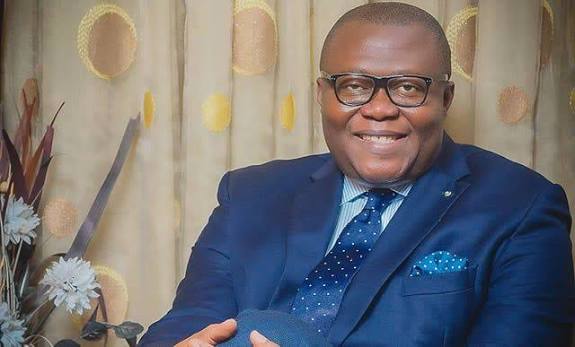
Writer Ehi Braimah has called on Rotary clubs across West Africa to prioritise lasting partnerships over short-term projects as the region prepares for the 2026 West Africa Project Fair.
The Fair, hosted by Rotary International Districts 9111 and 9112, is scheduled to hold from November 10 to 17 at the Balmoral Convention Centre, Sheraton Hotel, Ikeja, Lagos.
It will be flagged off by Rotary International President Olayinka Babalola and is expected to draw clubs, Rotarians, Rotaractors and international partners from nine districts across the region.
Braimah noted that the theme, “Partnerships for Lasting Impact,” reflects a shift from simply launching projects to ensuring that interventions continue to serve communities long after commissioning.
He argued that many development challenges in West Africa — including healthcare, education, water, sanitation, food security and environmental issues — transcend national borders and require collaborative solutions.
According to him, a common weakness in development work is the “project mentality,” where attention focuses on starting and completing initiatives rather than guaranteeing their long-term usefulness.
Braimah stressed that true partnerships go beyond sponsorship. They involve shared responsibility, technical expertise, institutional support, monitoring and local ownership.
He said the Project Fair offers a marketplace for clubs seeking funding or technical help to connect with partners who can provide resources, knowledge or institutional backing.
The column concluded that lasting impact is achieved when Rotary’s community presence is combined with the strengths of governments, businesses and development organisations, creating solutions that communities can sustain.
Columnist Ikeddy Isiguzo has raised fresh questions about the Lagos-Calabar Coastal Highway project and President Bola Tinubu’s second-term campaign strategy.
In his latest piece, Isiguzo criticised what he described as inconsistencies in explanations offered by Works Minister David Umahi regarding changes to the multi-billion-dollar highway.
He argued that the project, originally presented as a flagship infrastructure plan, has faced technical and financial challenges that were not adequately addressed at the outset.
Isiguzo recalled earlier concerns he raised in 2024 about the absence of detailed technical designs, environmental assessments and competitive bidding processes.
He also commented on the political dimensions of the project, noting recent statements by the minister linking adjustments to the route with presidential directives.
Turning to the 2027 elections, the columnist suggested that President Tinubu appears reluctant to campaign extensively across the country, preferring to rely on party structures and selected regional appearances.
Isiguzo listed proposed campaign locations and questioned the exclusion of certain states, interpreting the itinerary as a sign of limited political confidence.
He further criticised the ruling party’s internal dynamics, including competition among senior figures for future positions.
The column concluded with a brief reference to recent comments by the Edo State APC chairman on Peter Obi, describing them as extreme.
Isiguzo’s article continues his pattern of sharp commentary on governance and infrastructure under the current administration.
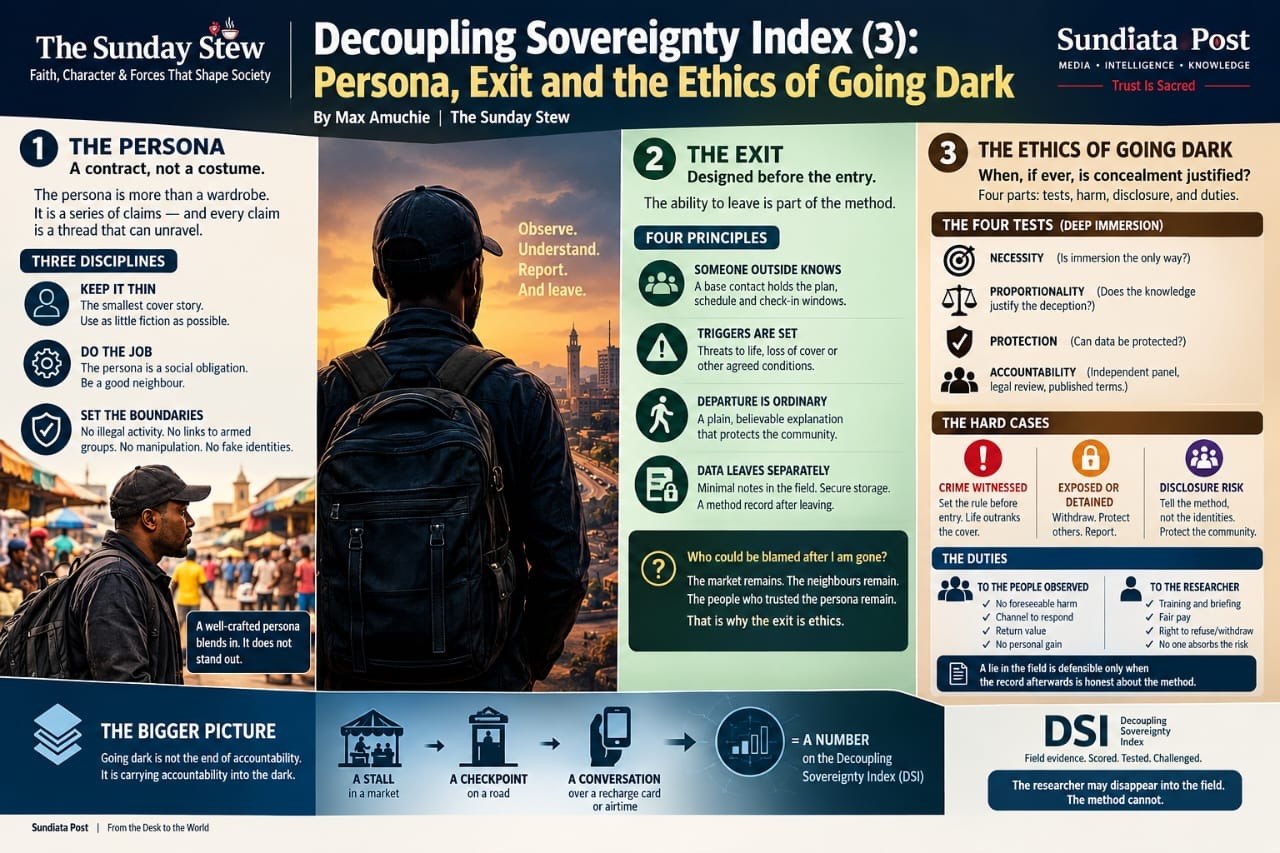
In the latest instalment of his Decoupling Sovereignty Index series, Max Amuchie examines the ethical obligations that arise when researchers adopt temporary identities to study decoupled zones.
Writing in The Sunday Stew, the Sundiata Post CEO and theorist argues that any methodology requiring a researcher to live under a borrowed role creates three unavoidable duties: the role must be disciplined, the researcher must be able to leave, and the deception must be ethically justified.
Amuchie treats the persona as a contract rather than a costume. He advises keeping the cover story thin, performing the assumed job properly, and setting clear boundaries before entering the field. These boundaries include never participating in illegal activity, never passing information to armed groups, never manipulating relationships solely to extract information, and never assuming the identity of a real person.
He stresses that the exit must be designed before entry. At the Sundiata Post Knowledge Lab, no researcher enters a zone until the exit plan is written down. This includes external check-ins, pre-agreed triggers for withdrawal, an ordinary departure story, and separating data from the person so that the community is not exposed after the researcher leaves.
On the ethics of “going dark,” Amuchie applies four tests: necessity, proportionality, protection and accountability. Immersion is justified only when remote or rapid methods cannot answer the research question.
The knowledge gained must outweigh the deception, and no observed person should face foreseeable harm. An independent panel must review and can veto any covert plan.
He addresses three hard cases: what to do if the researcher witnesses a crime, what happens if the persona is exposed, and how to disclose the method without endangering people. Life outranks the cover. Where imminent danger exists, the researcher must warn or withdraw even if it ends the assignment.
Amuchie insists that the duty runs both ways. The people observed must not pay a price for the findings, and the researcher must be trained, fairly paid and free to refuse or withdraw without penalty.
The column concludes that a lie in the field is defensible only when the later account is fully honest about the method. The people may be protected; the method may not.
Part 4 of the series will examine how field evidence is translated into scores on the Decoupling Sovereignty Index.
-
Politics3 years ago
13 Ondo Assembly Members Disown Endorsement of Aiyedatiwa
-
Politics3 years ago
APC Group, Ondo Govt, Quarrel Over Money for Endorsement
-

 Trending News5 years ago
Stop unsavoury, inciting statements – DSS warns
-

 Others5 years ago
Adron Homes Celebrates 10 Years Of Housing Excellence
-

 Humanity5 years ago
President Buhari Commiserates With Ambassador Maureen Tamuno Over The Loss Of Her Father
-

 Others7 years ago
EX- CUSTOMS BOSS, IBRAHIM MERA’S DWINDLING FAME
-

 Business2 years ago
Bigi Carbonated Soft Drinks Treats 40 Consumers to an Epic Easter Movie Hangout
-

 Business2 years ago
Wema Bank Shines at Global SME Finance Forum Conference Awards 2024 …Awarded: • SME Financier of the Year (Africa) • Platinum Award for Best Financier for Women Entrepreneurs (Africa)