
Banking
Wema Bank Retains National Licence After Recapitalisation

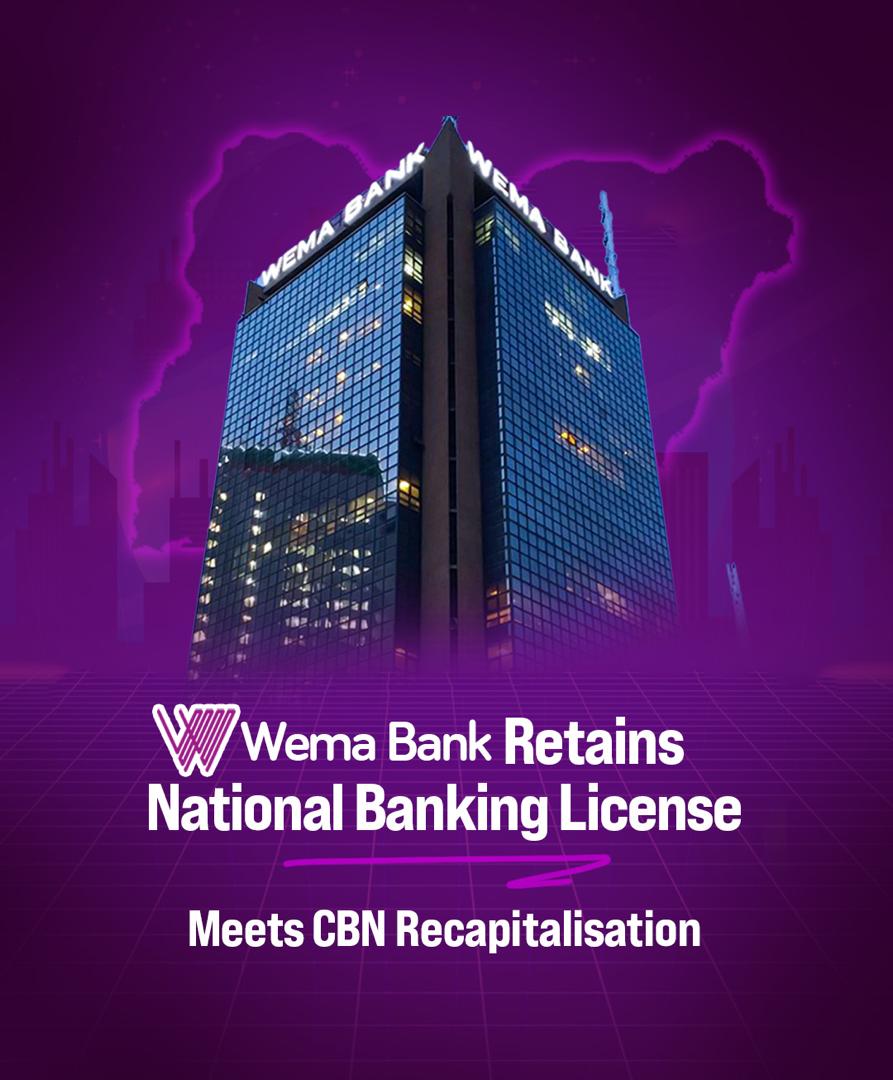
Wema Bank has successfully met the Central Bank of Nigeria’s recapitalisation requirements with Total Qualifying Capital of ₦264.7 billion, retaining its national banking licence
Wema Bank has successfully met and surpassed the Central Bank of Nigeria’s (CBN) recapitalisation requirements, reaffirming its position as a national bank with a strengthened capital base.
Also read: Adron Homes Deepens Cultural Footprint at Ibadan Festival

The bank’s Total Qualifying Capital now stands at ₦264.7 billion, well above the ₦200 billion minimum threshold for national banks.
This milestone was achieved through a ₦150 billion Rights Issue and an additional ₦50 billion special placement completed in 2025, six months ahead of the CBN’s March 31, 2026 deadline.
In early April 2026, the Central Bank formally confirmed that Wema Bank, alongside 32 other financial institutions, had successfully concluded the recapitalisation exercise.
Wema is among only ten national banks that met and exceeded the required capital threshold, thereby retaining its national banking licence.
The achievement underscores the bank’s robust financial position, strong shareholder confidence, and strategic focus on sustainable growth.
It also enhances Wema Bank’s capacity to support customers, deepen market presence, and contribute meaningfully to Nigeria’s economic development.
Commenting on the milestone, the Managing Director and Chief Executive Officer of Wema Bank, Moruf Oseni, described the successful recapitalisation as a defining moment for the institution.
“The successful completion of our recapitalisation exercise is a defining moment for Wema Bank. It is a strong validation of our strategy, our performance, and the enduring confidence our shareholders and stakeholders have in our vision. We have not only met the CBN’s requirements; we have exceeded them, reinforcing our position as a National Bank with the scale, strength, and stability to compete and lead,” Oseni said.
He added that the strengthened capital base will enable the bank to deliver greater value to customers through improved access to credit, enhanced digital banking experiences via its fully digital platform ALAT, and innovative financial solutions across retail, SME, and corporate segments.
Wema Bank, Nigeria’s oldest indigenous national bank and pioneer of Africa’s first fully digital bank, ALAT, has consistently demonstrated financial discipline since regaining its national licence in 2015.
The recent capital raise, supported primarily by existing shareholders, highlights the deep mutual trust between the bank and its investors.
The CBN’s recapitalisation programme, announced in March 2024, requires national banks to maintain a minimum capital base of ₦200 billion to strengthen the resilience of financial institutions and position them to drive sustainable economic growth.
Also read: Adron Homes Deepens Cultural Footprint at Ibadan Festival
With this milestone, Wema Bank is now better positioned to accelerate growth, support more businesses, and play a bigger role in powering Nigeria’s economy while maintaining its commitment to innovation and customer-centric solutions.




-
Politics3 years ago
13 Ondo Assembly Members Disown Endorsement of Aiyedatiwa
-
Politics3 years ago
APC Group, Ondo Govt, Quarrel Over Money for Endorsement
-

 Trending News5 years ago
Stop unsavoury, inciting statements – DSS warns
-

 Others5 years ago
Adron Homes Celebrates 10 Years Of Housing Excellence
-

 Humanity5 years ago
President Buhari Commiserates With Ambassador Maureen Tamuno Over The Loss Of Her Father
-

 Others7 years ago
EX- CUSTOMS BOSS, IBRAHIM MERA’S DWINDLING FAME
-

 Business2 years ago
Bigi Carbonated Soft Drinks Treats 40 Consumers to an Epic Easter Movie Hangout
-

 Business2 years ago
Wema Bank Shines at Global SME Finance Forum Conference Awards 2024 …Awarded: • SME Financier of the Year (Africa) • Platinum Award for Best Financier for Women Entrepreneurs (Africa)