
Opinion
Rivers state of emergency: Is Nigeria’s democracy safe with its courts?


By Ikeddy ISIGUZO
Rivers emergency rule litigation raises concerns as Nigerian courts avoid ruling on presidential powers and constitutional limits

NIGERIA’S democracy swooped into the unease mood after the 2023 elections. The state of emergency in Rivers State raised more questions about the extent of presidential powers when declaring emergency rule.
Also read: Senator Araraume Backs Tinubu For Second Term
Section 305 of Nigeria’s 1999 Constitution sets out those powers with striking clarity.
Yet time and again, Nigerian courts have avoided definite answers, finding refuge in procedural hedges and technicality. In doing so, they dodge their most solemn duty: safeguarding constitutional democracy.
Nigeria is run on a written Constitution. The boundaries of separation of power are known. Disputes are to be resolved by courts applying settled principles of interpretation.
When judges refuse to engage the substance of constitutional questions, the consequences are grave. Their indecisions also become precedents – dangerous precedents.
Afam Osigwe, SAN, President of the Nigerian Bar Association, NBA, has warned that judicial silence in the face of emergency rule litigation “erodes public confidence” and emboldens executive over-reach.
He urged Judges to rise above political pressure and rule without fear or favour.
The Federal High Court in Abuja, maybe, in reaction to Mr. Osigwe’s remarks swiftly heard several suits that challenged President Bola Ahmed Tinubu’s proclamation of a state of emergency in Rivers State.
Again, the courts declined jurisdiction; reclining on a supposed Emergency Powers (Jurisdiction) Act, 1962 said to have been modified by presidential order in 2025 and avoided ruling on the merits of the matters. The pattern is familiar or a precedent.
In Plateau State v. Attorney-General of the Federation (2006), the Supreme Court similarly refused to determine the scope of presidential emergency powers, citing procedural defects.
A decision then, could have saved Nigeria from the spectacle of an elected President suspending an elected Governor and legislature, as occurred in Rivers State in March 2025.
The matter is still alive. On 16 January 2026, an NGO, the Incorporated Trustees of the Civil Society Observatory for Constitutional and Legal Compliance, CSOCLC, returned to the Federal High Court, Abuja, urging Justice J.K. Omotosho to revisit his earlier decisions on emergency rule in Rivers State.
In Suit No. FHC/ABJ/CS/1148/2025, with the President, the Attorney-General of the Federation, Rivers State, electoral authorities and others as defendants, the group argues that the Court has jurisdiction, and that the President’s emergency powers do not include suspending elected officials.
Crucially, the plaintiffs do not deny the President’s authority to declare a state of emergency. Their case is narrower and more fundamental. Section 305, they argue, authorises a proclamation, not the removal of a Governor, Deputy Governor or State Legislature.
Their counsel, Nnamdi Nwokocha-Ahaaiwe, contends that under the doctrine of “covering the field,” once the Constitution has exhaustively regulated a subject, neither Parliament nor the executive may add, enlarge or subtract from it. A proclamation that purports to do so, he argued, is void, citing Supreme Court precedents, including A.G. Abia v. A.G. Federation and INEC v. Musa, in support of their position.
Even on a political precedent, former President Goodluck Jonathan declared state of emergency in May 2013 on television, “I hereby declare a state of emergency in Borno, Yobe and Adamawa States. The Governors and other political office holders in the affected States will continue to discharge their constitutional responsibilities”.
Jonathan made the correct interpretation of the Section 305, a fact that is barely acknowledged and a counterpoise to the two instances that former President Olusegun Obasanjo imposed emergency rules in Plateau 2004, and Ekiti 2006, and removed their elected officials.
There is also a jurisdictional elephant in the room. Government’s lawyers insist that only the Supreme Court may hear emergency-related disputes, relying on colonial-era statutes from 1961 and 1962.
But those laws were omitted from Nigeria’s revised statutes as “spent” long before the 1999 Constitution came into force. Would the government lawyers not know?
Section 315 of the Constitution permits modification only of existing laws. How is a non-existent law modified?
Amending a dead statute, the plaintiffs argue, is a constitutional impossibility. An Executive Order that strips the Federal High Court of jurisdiction and transfers it to the Supreme Court would amount to an unconstitutional usurpation of powers of Parliament and Judiciary.
In anticipation of a technicality, the plaintiffs invoked Adesanya v. President (1981), where the Supreme Court affirmed that citizens have not only the right but an obligation to challenge unconstitutional acts.
More recently, in Okonjo-Iweala v. Fawehinmi (2025), the court reaffirmed liberal standing for public interest litigation by civil society groups.
Once a President can suspend elected governments and rewrite court jurisdiction by executive fiat, separation of powers collapses, authoritarianism beckons and democracy would have departed.
Nigerians now wait to see whether the courts will confront this question at last, rein in the President or once again look away, as Nigeria’s democracy totters.
Finally…
A YOUNGER colleague reacted to my column on Mrs. Kemi Adeosun saying it was “written in a hurry”, and “uniformed”.
When I engaged him, I found out that he was determined to hear nothing order than that Mrs. Adeosun was clean, as sparkling as crystal. I asked him to send a rejoinder.
He countered that he was not working for Mrs. Adeosun. By Friday night I again asked for the rejoinder. “Good evening Oga. I didn’t promise any rejoinder sir. I just made a comment based on what I know. I am sorry if you feel offended by my comment”. “You are insisting that Mrs. Adeosun did not submit a forged NYSC certificate of exemption?,” I asked him. “Yes, because she had no reason to,” he retorted.
Also read: Senator Araraume Backs Tinubu For Second Term
I am still in shock about how some individuals make their decisions. I didn’t name him, because I didn’t think there was any point in making the fellow involved more popular.



Writer Ehi Braimah has called on Rotary clubs across West Africa to prioritise lasting partnerships over short-term projects as the region prepares for the 2026 West Africa Project Fair.
The Fair, hosted by Rotary International Districts 9111 and 9112, is scheduled to hold from November 10 to 17 at the Balmoral Convention Centre, Sheraton Hotel, Ikeja, Lagos.
It will be flagged off by Rotary International President Olayinka Babalola and is expected to draw clubs, Rotarians, Rotaractors and international partners from nine districts across the region.
Braimah noted that the theme, “Partnerships for Lasting Impact,” reflects a shift from simply launching projects to ensuring that interventions continue to serve communities long after commissioning.
He argued that many development challenges in West Africa — including healthcare, education, water, sanitation, food security and environmental issues — transcend national borders and require collaborative solutions.
According to him, a common weakness in development work is the “project mentality,” where attention focuses on starting and completing initiatives rather than guaranteeing their long-term usefulness.
Braimah stressed that true partnerships go beyond sponsorship. They involve shared responsibility, technical expertise, institutional support, monitoring and local ownership.
He said the Project Fair offers a marketplace for clubs seeking funding or technical help to connect with partners who can provide resources, knowledge or institutional backing.
The column concluded that lasting impact is achieved when Rotary’s community presence is combined with the strengths of governments, businesses and development organisations, creating solutions that communities can sustain.
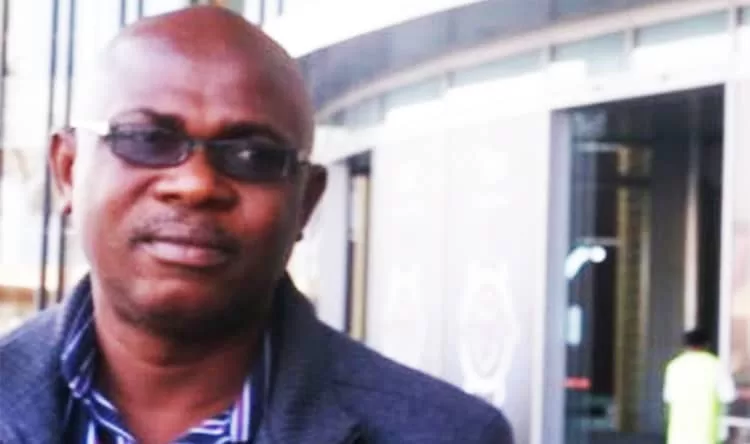
Columnist Ikeddy Isiguzo has raised fresh questions about the Lagos-Calabar Coastal Highway project and President Bola Tinubu’s second-term campaign strategy.
In his latest piece, Isiguzo criticised what he described as inconsistencies in explanations offered by Works Minister David Umahi regarding changes to the multi-billion-dollar highway.
He argued that the project, originally presented as a flagship infrastructure plan, has faced technical and financial challenges that were not adequately addressed at the outset.
Isiguzo recalled earlier concerns he raised in 2024 about the absence of detailed technical designs, environmental assessments and competitive bidding processes.
He also commented on the political dimensions of the project, noting recent statements by the minister linking adjustments to the route with presidential directives.
Turning to the 2027 elections, the columnist suggested that President Tinubu appears reluctant to campaign extensively across the country, preferring to rely on party structures and selected regional appearances.
Isiguzo listed proposed campaign locations and questioned the exclusion of certain states, interpreting the itinerary as a sign of limited political confidence.
He further criticised the ruling party’s internal dynamics, including competition among senior figures for future positions.
The column concluded with a brief reference to recent comments by the Edo State APC chairman on Peter Obi, describing them as extreme.
Isiguzo’s article continues his pattern of sharp commentary on governance and infrastructure under the current administration.
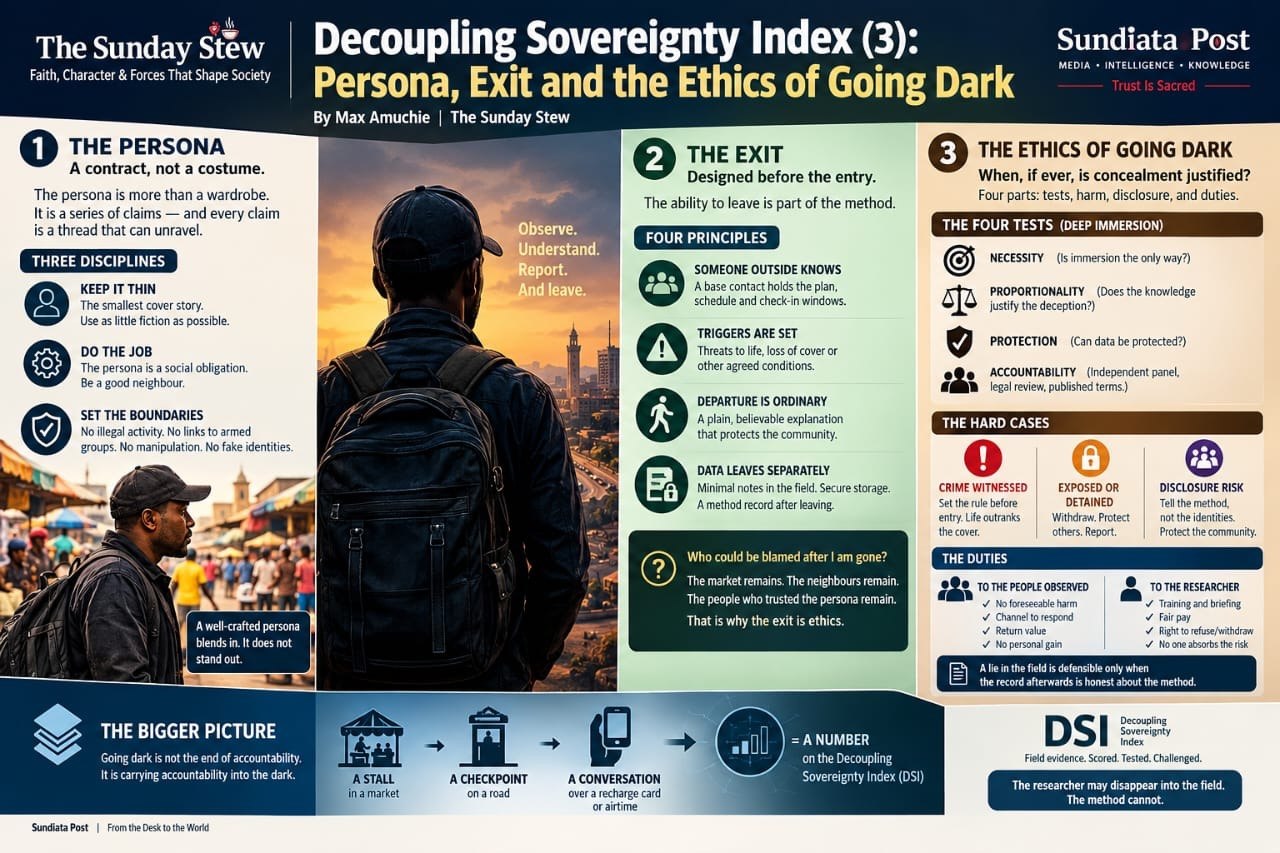
In the latest instalment of his Decoupling Sovereignty Index series, Max Amuchie examines the ethical obligations that arise when researchers adopt temporary identities to study decoupled zones.
Writing in The Sunday Stew, the Sundiata Post CEO and theorist argues that any methodology requiring a researcher to live under a borrowed role creates three unavoidable duties: the role must be disciplined, the researcher must be able to leave, and the deception must be ethically justified.
Amuchie treats the persona as a contract rather than a costume. He advises keeping the cover story thin, performing the assumed job properly, and setting clear boundaries before entering the field. These boundaries include never participating in illegal activity, never passing information to armed groups, never manipulating relationships solely to extract information, and never assuming the identity of a real person.
He stresses that the exit must be designed before entry. At the Sundiata Post Knowledge Lab, no researcher enters a zone until the exit plan is written down. This includes external check-ins, pre-agreed triggers for withdrawal, an ordinary departure story, and separating data from the person so that the community is not exposed after the researcher leaves.
On the ethics of “going dark,” Amuchie applies four tests: necessity, proportionality, protection and accountability. Immersion is justified only when remote or rapid methods cannot answer the research question.
The knowledge gained must outweigh the deception, and no observed person should face foreseeable harm. An independent panel must review and can veto any covert plan.
He addresses three hard cases: what to do if the researcher witnesses a crime, what happens if the persona is exposed, and how to disclose the method without endangering people. Life outranks the cover. Where imminent danger exists, the researcher must warn or withdraw even if it ends the assignment.
Amuchie insists that the duty runs both ways. The people observed must not pay a price for the findings, and the researcher must be trained, fairly paid and free to refuse or withdraw without penalty.
The column concludes that a lie in the field is defensible only when the later account is fully honest about the method. The people may be protected; the method may not.
Part 4 of the series will examine how field evidence is translated into scores on the Decoupling Sovereignty Index.
-
Politics3 years ago
13 Ondo Assembly Members Disown Endorsement of Aiyedatiwa
-
Politics3 years ago
APC Group, Ondo Govt, Quarrel Over Money for Endorsement
-

 Trending News5 years ago
Stop unsavoury, inciting statements – DSS warns
-

 Others5 years ago
Adron Homes Celebrates 10 Years Of Housing Excellence
-

 Humanity5 years ago
President Buhari Commiserates With Ambassador Maureen Tamuno Over The Loss Of Her Father
-

 Others7 years ago
EX- CUSTOMS BOSS, IBRAHIM MERA’S DWINDLING FAME
-

 Business2 years ago
Bigi Carbonated Soft Drinks Treats 40 Consumers to an Epic Easter Movie Hangout
-

 Business2 years ago
Wema Bank Shines at Global SME Finance Forum Conference Awards 2024 …Awarded: • SME Financier of the Year (Africa) • Platinum Award for Best Financier for Women Entrepreneurs (Africa)