
Opinion
Shaping Intercontinental Business Between Africa and Europe


Ambassador Eniola Ajayi urges a new approach to the Dutch Africa Strategy, calling for equal partnership and African inclusion in future policy design

Keynote Address by Ambassador Dr. Eniola Ajayi at a Business Dialogue on Africa organised by the Voice News Magazine based in the Kingdom of Netherlands which took place at Eko Hotel, Victoria Island, Lagos on Friday, November 28, 2025
Also read: Baba-Ahmed confirms Peter Obi remains in Labour Party
Title: Shaping Intercontinental Business Between Africa and Europe
Theme: Debunking Notions, Reshaping Mindsets in Doing Business in Africa
Opening & Acknowledgements
Your Excellencies,
Esteemed colleagues,
Leaders of industry, government, and diplomacy, Distinguished ladies and gentlemen, Good morning.
It is an honour and privilege to stand before you today to discuss a subject that sits at the very heart of our shared future – Shaping Intercontinental Business Between Africa and Europe.
Allow me to appreciate the organisers of this dialogue, The Voice Africa News Magazine, from the Netherlands for framing such a profound theme – “Debunking Notions, Reshaping Mindsets in Doing Business in Africa.”
It is indeed time to move beyond the old narratives – those outdated perceptions of Africa as a continent defined by aid, rather than by opportunity; by potential, rather than by performance.
Africa is not waiting to be discovered. Africa is open for business – on equal terms.
Setting the Context: A Moment of Transformation
We are gathered at an auspicious moment in history. The tipping point if you like.
The tectonic plates of global trade, energy, and geopolitics are shifting.
The COVID-19 pandemic and its aftermath have redrawn global value chains and revealed the vulnerabilities in our different nations – big or small.
The war in Ukraine has reshaped energy and food security priorities.
And across Africa, a young, dynamic, and connected generation is rewriting the script of our economic destiny.
Africa today is not merely a supplier of raw materials – it is a continent of creators, innovators, intellectuals and entrepreneurs who are building the industries of tomorrow.
From Lagos to Kigali, Nairobi to Accra, African startups are redefining fintech, healthtech, agritech, and clean energy solutions that speak not only to local realities but to global challenges.
The Dutch Africa Strategy – A Case Study of Intention and Opportunity
When the Dutch Africa Strategy (2023–2032) was launched in The Hague in May 2023, I had the privilege of being among the Ambassadors representing African nations.
It was a moment of recognition – that Africa’s growth and Europe’s prosperity are deeply intertwined. Our proximity to each other makes our collaboration inevitable.
The Dutch strategy articulates noble intentions. It speaks of mutual trust, equality in partnership, and shared prosperity.
It acknowledges that Africa’s development is no longer a matter of charity, but of mutual interest – in trade, security, climate resilience, and sustainable growth.
It represents an important shift: a recognition that doing business with Africa is not about aid, but about partnership; not about dependency, but about interdependence. We need each other to thrive and survive.
A Missing Element – The African Voice
However, while the Dutch Africa Strategy was commendable in vision, it also revealed a familiar pattern.
It was a strategy for Africa, but not with Africa.
African nations were not consulted in its drafting; we were presented with the finished document – a plan about our continent, developed without our direct input.
And therein lies a paradox that we must address, if we are to reshape intercontinental business:
How can we speak of equality and mutual trust when the voices of one side are absent from the design table?
True partnership cannot be built on monologue – it must be dialogue.
Africa does not seek to be a passive recipient of strategies. We seek to be co-authors of them.
We want to sit at the table not as guests, but as equals – bringing our own priorities, insights, and aspirations to the discussion.
Debunking Notions – A New Mindset for Both Sides
Ladies and gentlemen,
If this decade is to be one of genuine transformation, we must begin by *debunking old notions* – on both sides of the partnership.
For too long, Africa has been seen primarily as a source of raw materials – a continent that extracts but does not refine; that exports value but imports finished products; that fuels global industry while its own citizens remain on the margins of prosperity.
That narrative must end. Our survival depends on this.
Africa is finally waking up to the reality that our vast natural resources – from minerals to agriculture, from oil and gas to our boundless human capital – must no longer be shipped out in raw form.
We have realized that value addition must happen on African soil, by African hands, through African innovation – in partnership, yes, but with equity and ownership.
When Africa processes its cocoa, it creates jobs. We can make chocolate bars too! It is not rocket science.
When Africa refines its lithium, it powers its own industries.
When Africa manufactures its pharmaceuticals, it safeguards its own health.
This is not protectionism – it is self-empowerment. It is self preservation. It is economic justice.
Reshaping the European Mindset
At the same time, our European partners must also evolve their perspective.
Partnership with Africa should not be viewed through the lens of risk, but of reward.
The narrative of instability and fragility must give way to one of resilience and opportunity. It should call a spade – a spade. Yes, there are issues of insecurity, what we need is help, not escalation.
The Africa of today is governed by regional economic communities that are harmonising trade rules.
The African Continental Free Trade Area (AfCFTA) is creating the largest single market in the world by number of countries – a market of 1.4 billion people with a combined GDP of over three trillion dollars.
This is not a continent to be pitied. It is a continent to be partnered with – on equal footing.
The mean age of the African population is 19.2 years (due to factors that we hope will improve over time) but the benefit is that we have a virile, versatile, educated and youthful workforce.
The business mindset must therefore shift from extractive transactions to transformative investments;
from short-term profit to long-term partnership;
from seeing Africa as a *testing ground to seeing Africa as a growth engine.
Europe and Africa – Partners in Transition
Both continents are undergoing profound transitions.
Europe is reindustrialising and greening its economy – moving towards clean energy, circular production, and digital transformation.
Africa is urbanising rapidly, digitising its economies, and investing in renewable energy and youth innovation.
Our transitions can and must be aligned.
Africa holds 60% of the world’s renewable energy potential.
Europe holds decades of industrial and technological expertise.
Together, we can build a new paradigm of co-created growth – that is green, inclusive, and mutually beneficial.
Migration – A Bridge, Not a Barrier
But there is another crucial aspect of our intercontinental relationship that requires a new mindset: migration.
Too often, migration has been portrayed as a crisis to be managed rather than a force to be harnessed. Yet, when well-governed, migration is not a problem – it is an opportunity.
We must tackle the issue of migration between Africa and Europe in a way that is mutually beneficial to both continents.
Africa’s youthful population is an asset; Europe’s aging workforce presents a challenge.
A fair, regulated, and humane framework for mobility that can serve both needs.
There should be regular pathways for legal migration – pathways that attract the people and skills needed in European countries seeking to shore up their workforce, while ensuring that migration remains dignified, orderly, and mutually enriching and not exploitative.
When talent circulates, innovation follows. When movement is managed, both continents prosper.
We must therefore move from a defensive approach to migration to a developmental approach – one that sees people as bridges, not as burdens.
A New Business Compact – Built on Trust and Equality
To shape truly intercontinental business between Africa and Europe, we must anchor our cooperation on five key principles:
1. Co-creation, not prescription
Policies affecting Africa should be designed with African stakeholders at the table.
When strategies such as the Dutch Africa Plan are revisited or implemented, they should incorporate the perspectives of African governments, private sectors, and youth voices.
Ownership begins with participation.
2. Value addition within Africa
European investors must continue to partner in setting up industries in Africa – not just to extract raw materials but to manufacture, process, and innovate locally.
The success story of Friesland Campina is a case in point. This is a great company with the right mindset.
This will create jobs, reduce poverty, and deepen regional value chains.
3. Fair trade and access to markets
Trade frameworks must reflect fairness. Non-tariff barriers and complex standards often disadvantage African producers.
The future must prioritise access, technology transfer, and mutually beneficial trade agreements under AfCFTA and EU frameworks. The CBI – Ginger initiative is a welcome collaboration between Nigeria and the EU.
(Nigerian ginger is considered among the best in the world. Its aroma, sharp taste and high oil content are unique features.
Nigeria was the world’s third-largest producer of ginger in 2018. Still, economic growth in Nigeria is spread unevenly and many people live in poverty.
The Nigerian ginger sector has the potential to add more value and diversify its markets.
In 2021, the Centre for the Promotion of Imports from developing countries (CBI) started a project to strengthen the sector’s quality services.
In the project, Nigerian small and medium-sized enterprises (SMEs) are supported to create value-added ginger products.
This is done by improving quality, helping with sustainability certification and organic or refined processing.
4. Technology and knowledge partnership
The 21st-century partnership must be based on technology transfer, research collaboration, and capacity building.
Let us replace the model of finished goods for raw materials with one of shared innovation. We cannot keep collecting peanuts for our coffee beans while paying premium dollars at Starbucks.
5. Inclusive growth and sustainability
Intercontinental business must be anchored in sustainability – environmentally, socially, and economically.
Women, youth, and small enterprises must not be left behind in this journey.
The market is large enough for everyone to get a share. The sky is big enough for all birds to fly without impeding one another.
Examples of Opportunity
The opportunities for partnership are vast:
• In energy, Africa’s abundant sunlight and Europe’s technology can together lead the world in renewable innovation.
• In agriculture, Africa’s fertile lands and Europe’s processing expertise can ensure food security on both continents. With the golden triangle approach of the Netherlands ( Government-Research Institutions-Private Sector partnership), prosperity is possible.
It is no wonder Netherlands is the second largest producer of food in the world. Netherlands has mastered how to improve the yield of their produce.
• In healthcare, Africa’s growing pharmaceutical sector and Europe’s regulatory experience can build resilient health systems.
• In digitalisation, Africa’s mobile-driven innovation and Europe’s cybersecurity frameworks can together define the next frontier of global commerce.
Reclaiming the Narrative
We must remember – narratives shape behaviour.
For too long, Africa’s story has been told by others.
It is time for Africa to tell its own story – confidently, creatively, and collaboratively.
As an African diplomat who has served in Europe, I have seen firsthand that when Africa speaks with a clear voice, the world listens.
When we negotiate with clarity and unity, the terms of engagement change.
And when we demand fairness – not as charity, but as a right – we gain respect.
We must therefore approach intercontinental business not with a sense of inferiority, but with the dignity of equal partnership. We must come to the table with a true understanding of our selfworth.
A Call to European Partners
To our European friends – including the Netherlands – I say this:
The future of global prosperity is not in rivalry, but in renewed partnership.
When the Dutch Africa Strategy speaks of mutual trust and equality, let us make it real by ensuring African inclusion in every phase of implementation.
Let us transform the strategy from a policy paper into a living framework of collaboration – where Dutch and African entrepreneurs, scientists, and innovators co-create the industries of tomorrow.
Let us build joint centres of excellence, green industrial zones, and value-chain partnerships that demonstrate the power of equality in action.
A Call to African Entrepreneurs and Governments
And to my fellow Africans – government leaders, business owners, innovators – let us rise up to this moment.
The world will not value what we do not value ourselves. If you call yourself a doormat, nobody will call you a queen.
We must create enabling environments – stable policies, secure safe spaces, transparent governance, reliable infrastructure – that attract and sustain investment.
We must develop our human capital – in science, technology, engineering, entertainment, and management – to power our own industries.
We must trade more with each other – because an integrated Africa is a stronger Africa.
The artificial division of Africa in 1884 – 1885 at the Berlin conference must give way to deliberate and intentional solidarity.
Let us remember: no one will add value to our resources unless we decide to do so ourselves. Africa must first be developed by Africans. People respect what is developed.
The Spirit of Ubuntu – Our Shared Humanity
At the heart of all these conversations lies a deeper truth:
Our destinies are intertwined.
As the African proverb says, “If you want to go fast, go alone. If you want to go far, go together.”
Africa and Europe are natural neighbours.
Africa and Europe must go far – together.
Not as donor and recipient, not as exporter and importer, but as partners in progress, equals in vision, and co-architects of a sustainable future.
Conclusion – A Future Defined by Partnership
In closing, let me return to where I began:
We are not just shaping intercontinental business – we are shaping intercontinental destiny. We are being pragmatic about our inevitable future.
The Dutch Africa Strategy 2023–2032 gives us an opportunity – not a finished product, but a framework to build upon. Maybe for a Europe – Africa strategy.
It is an invitation to redefine partnership.
To move from strategy on paper to collaboration in practice.
To replace extraction with equity, and charity with shared prosperity.
Let us move forward, therefore, with mutual respect and renewed trust –
Recognising that Africa is not a problem to be solved, but a partner to be embraced.
That Europe’s success and Africa’s progress are inseparable.
And that together, we can build a world where every resource, every innovation, and every partnership adds value – not just to economies, but to human lives.
Also read: Baba-Ahmed confirms Peter Obi remains in Labour Party
As we engage in this dialogue today, let us ensure that the next time an Africa Strategy is written – it is written not about Africa, but with Africa!
Thank you.


By Ehi Braimah
Africa has emerged as one of the most strategic frontiers for global investment, trade, innovation, and economic transformation.
Also read: Customs Reform Will Unlock AfCFTA’s Full Potential, Experts Say
With a population projected to exceed 2.5 billion by 2050, abundant natural resources, a rapidly expanding middle class, and the world’s youngest workforce, the continent is increasingly attracting the attention of governments, multinational corporations, investors, development institutions, and entrepreneurs.
Against this backdrop, global business summits hosted in Africa and across the world on Africa, have become vital platforms for dialogue, partnership-building, and economic cooperation.
From investment forums and trade expos to leadership conferences and innovation summits, these gatherings bring together policymakers, business executives, financiers, academics, and development experts to discuss opportunities and challenges shaping Africa’s future.
Beyond networking events, they have become powerful instruments for driving economic growth, fostering regional integration, and positioning Africa as a key player in the global economy.
The summits on Africa and where they hold
The France-Africa Summit, otherwise known as Africa Future Forward Summit, held in Nairobi, Kenya from May 11 – 12 for the first time in an Anglophone country.
It was followed by Biashara Afrika in Lome, Togo, which held from May 18 – 22, while the London-Africa Business Summit convened by Sadiq Khan, the Mayor of London, held on June 4.
The London Summit attracted diaspora professionals, international investors, and policymakers to discuss the harmonisation of capital markets, tech investments and economic growth on Africa.
On July 30, the Global Africa Summit will hold at the Toronto Metropolitan University, Toronto, Canada. The summit will focus on translating Canada’s Africa Strategy into tangible trade, fintech, infrastructure, and green energy by connecting institutional investors with emerging African markets.
Other major and annual recurring events include the US-Africa Business Summit holding in Mauritius from July 26 – 29, co-hosted by the Corporate Council on Africa and the Government of Mauritius; the Opportunities in Africa Summit in New York City where investors and entrepreneurs explore Foreign Direct Investment (FDI) opportunities in high-growth markets like Rwanda, Senegal and Cote d’Ivoire.
There’s also the US-Africa Leaders’ Summit in Washington DC, USA; the Africa CEO Forum, the Climate Change Global Business Summit on Africa which holds in Nairobi, Kenya; the Financial Times (FT) Africa Summit that will hold from October 21 – 22, at The Landmark, London; the Transform Africa Summit, the continent’s premier annual forum on technology, innovation and digital transformation organised by Smart Africa Alliance, and others.
Growing relevance of the summits
Global business summits serve as meeting points where ideas, capital, and opportunities converge. Their relevance has increased significantly as African economies seek to diversify beyond traditional sectors such as oil, gas, and mining into manufacturing, technology, agriculture, renewable energy, healthcare, and digital services.
These summits provide a unique platform for governments to showcase investment opportunities and policy reforms aimed at attracting FDI.
Investors, in turn, gain valuable insights into emerging markets, regulatory environments, and sector-specific opportunities.
For local businesses, the events offer exposure to international markets, potential partners, and financing sources.
The role of AfCFTA
The African Continental Free Trade Area (AfCFTA) should be the economic anchor of every Africa-focused global business summit.
Whether in Abuja, Lagos, Nairobi, Kigali, Mauritius, Paris, London, New York, Washington DC, Dubai, Moscow, or Beijing, AfCFTA must be presented not merely as a trade agreement but as Africa’s blueprint for industrialisation, regional value chains and a single market of over 1.4 billion people.
Rather than promoting 54 fragmented economies, African leaders should speak with one voice, using AfCFTA to attract investment in manufacturing, infrastructure, digital technology, agriculture and clean energy.
Global summits on Africa should therefore move beyond aid and commodity exports to partnerships that expand intra-African trade, technology transfer, skills development and value addition.
A united AfCFTA agenda will strengthen Africa’s bargaining power, reduce trade barriers, create jobs and position the continent as a competitive global investment destination.
Africa’s economic transformation depends on making AfCFTA the centrepiece of every international business engagement.
Benefits
One of the most significant benefits of global business summits is their ability to attract investment. Many investment deals, public-private partnerships, and development projects originate from conversations initiated during these events.
By bringing together key decision-makers in one location, summits reduce barriers to engagement and facilitate quicker decision-making.
Another major benefit is knowledge exchange. Participants gain access to expert insights on market trends, emerging technologies, sustainable development practices, climate finance, and global economic shifts.
Such knowledge helps businesses and governments make informed decisions that enhance competitiveness and resilience.
Business summits also stimulate tourism and local economic activity. Hotels, transportation services, restaurants, event management firms, and other service providers benefit from the influx of delegates.
Host cities often gain international visibility, improving their reputation as business and investment destinations.
Furthermore, these events contribute to capacity building. Young entrepreneurs, startups, and small and medium-sized enterprises (SMEs) gain opportunities to learn from industry leaders, access mentorship, and connect with investors. This helps nurture the next generation of African business leaders and innovators.
On a broader scale, global business summits support economic diplomacy. Governments use these platforms to strengthen bilateral and multilateral relationships, negotiate trade agreements, and promote regional cooperation. Such engagements can lead to long-term economic partnerships that benefit multiple countries.
Africa’s strategic importance in the global economy
The increasing number of global business summits on Africa reflects the continent’s growing strategic importance.
Africa possesses approximately 30 percent of the world’s mineral reserves, including critical minerals such as cobalt, lithium, manganese, and rare earth elements that are essential for electric vehicles, renewable energy technologies, and advanced manufacturing.
In addition, Africa’s agricultural potential remains largely untapped. The continent holds vast areas of arable land capable of contributing significantly to global food security.
Its expanding urban population and rising consumer demand also make it one of the most promising growth markets in the world.
The continent’s digital revolution further enhances its attractiveness. Mobile technology, fintech innovation, e-commerce, and digital payment systems have transformed business operations across many African countries such as Nigeria and Kenya.
Investors increasingly view Africa not only as a source of raw materials but also as a market for innovation and technological advancement.
The new scramble for Africa
The growing international interest in Africa has led many analysts to describe current geopolitical and economic competition as a “New Scramble for Africa.” Unlike the colonial-era scramble of the late nineteenth century, today’s competition is driven primarily by economic, technological, and strategic interests rather than direct territorial control.
Major global powers, including the United States, China, the European Union, India, Turkey, Russia, and Gulf states, are actively expanding their engagement across Africa.
They compete for access to natural resources, infrastructure projects, trade opportunities, energy partnerships, digital markets, and geopolitical influence.
China has become one of Africa’s largest trading partners and infrastructure financiers, investing heavily in roads, railways, ports, and industrial parks.
Western nations have responded by increasing investment initiatives focused on sustainable development, clean energy, digital infrastructure, and private sector growth.
Meanwhile, emerging powers are seeking to deepen commercial and diplomatic ties through trade agreements, investment missions, and development partnerships.
Global business summits often serve as arenas where these competing interests intersect. International corporations and governments use such forums to announce investment commitments, launch strategic partnerships, and strengthen economic relationships with African nations.
While increased global attention creates opportunities for growth and development, it also presents challenges. African countries must ensure that investments contribute to sustainable development, local job creation, technology transfer, and industrialization.
Effective governance, transparency, and strategic negotiation are essential to ensuring that Africa derives maximum benefit from foreign engagement.
Africa’s future
As Africa’s economic influence continues to grow, global business summits will play an increasingly important role in shaping the continent’s future.
These events provide platforms for investment mobilisation, innovation exchange, policy dialogue, and international cooperation.
They also help position African countries as active participants in global economic decision-making rather than passive recipients of external interests.
The challenge and opportunity for Africa lie in leveraging these platforms to advance its own development priorities.
By fostering strategic partnerships, promoting intra-African trade, supporting entrepreneurship, and ensuring inclusive growth, business summits can become powerful catalysts for transformation.
In the context of the new scramble for Africa, the continent is no longer merely a destination for external interests.
Increasingly, it is becoming a dynamic actor with the capacity to shape global markets, influence international investment flows, and define its own development trajectory.
Also read: Customs Reform Will Unlock AfCFTA’s Full Potential, Experts Say
Global business summits on Africa provide one of the most visible and effective mechanisms through which this transformation can be realised.
By Max Amuchie | The Sunday Stew
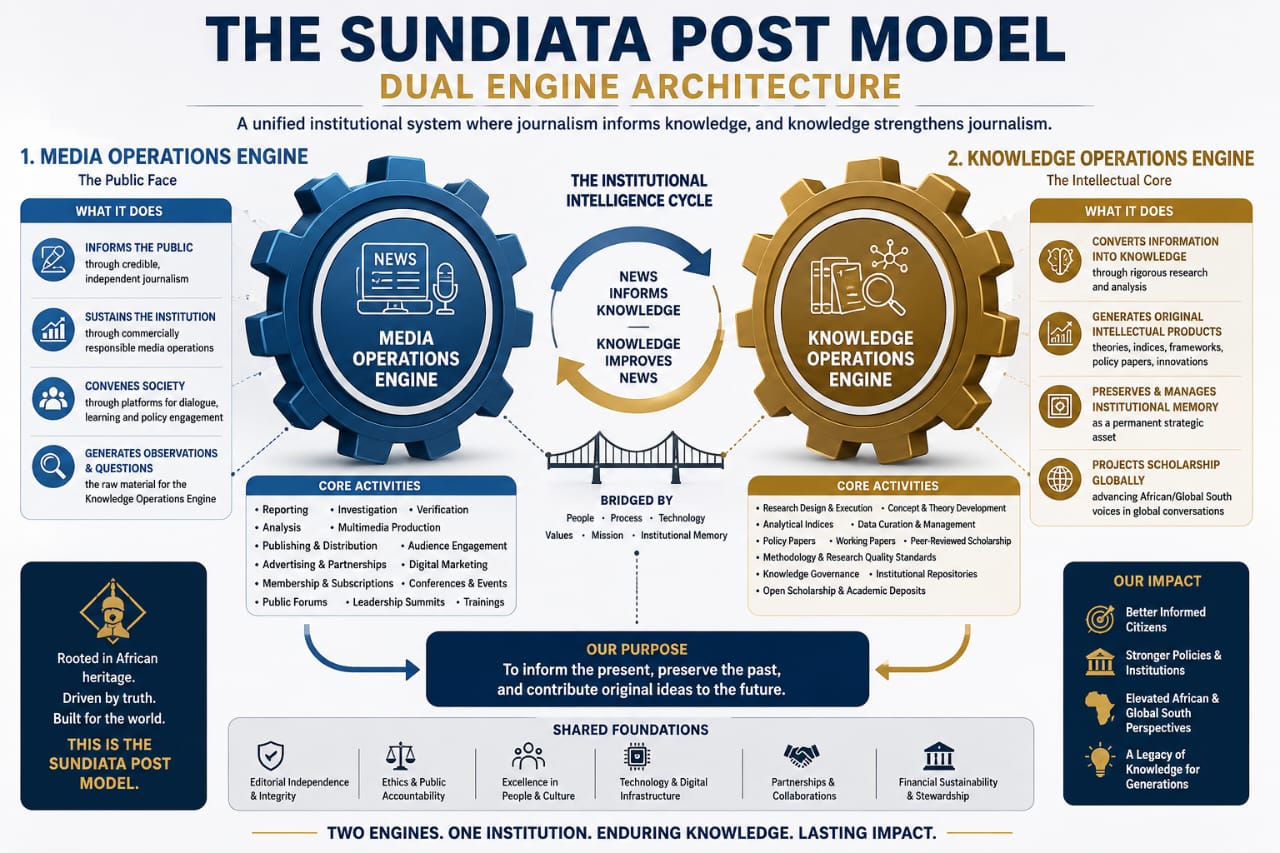
This fourth instalment of the Sundiata Post Model asks the inevitable question: What must a knowledge-producing newsroom do to survive, adapt and remain relevant across generations?
Also read: Sundiata Post Boss Max Amuchie Earns ScienceOpen Academic Appointment
That question is the gateway to what we call the Realm of the Long Term.
Every institution eventually enters the Realm of the Long Term. It is the stage at which immediate success gives way to enduring relevance, and where the central question is no longer whether an organisation can perform today, but whether it can continue creating public value across generations. Entering this realm requires more than ambition.
It demands governance, institutional memory, financial resilience, leadership succession, continuous learning and an unwavering commitment to trust. This is the realm in which institutions either become enduring or gradually disappear.
The Realm of the Long Term is the point at which management ceases to focus primarily on performance and begins to focus on long-term stewardship.
Decisions are evaluated not only by their immediate outcomes but by their contribution to the institution’s capacity to create enduring public value across generations.
Within the Sundiata Post Model the Realm of the Long Term rests on seven interdependent pillars: Financial Sustainability, Human Capital and Leadership, Knowledge Stewardship, Governance, Innovation and Adaptation, Trust and Reputation, and Mission Continuity.
Together, these pillars determine whether an institution merely survives the present or continues creating public value across generations.
Financial Sustainability
Financial Sustainability is the institution’s capacity to generate, diversify, steward and invest financial resources in ways that preserve its independence, strengthen its capabilities and enable it to pursue its mission across generations.
Financial Sustainability is the institution’s capacity to generate diverse, mission-aligned sources of income that preserve its independence while strengthening both its Media Operations Engine and its Knowledge Operations Engine over the long term.
No institution, however compelling its vision or noble its mission, can endure without the economic capacity to sustain its work. Institutions do not survive on ideas alone.
They survive because they deliberately create the financial resources that allow those ideas to mature into enduring public value.
Within the Sundiata Post Model, Financial Sustainability is understood differently from its conventional treatment in management literature. It is not simply about generating revenue, balancing budgets or maintaining profitability.
Rather, it is the strategic financing of a knowledge-producing institution. Its purpose is to preserve institutional independence while providing the resources required to sustain both the Media Operations Engine and the Knowledge Operations Engine over the long term.
The Media Operations Engine generates value through journalism and public engagement. Its financial ecosystem includes advertising, brand partnerships, digital marketing, content syndication, commercial publishing, multimedia production, conferences, annual lectures, policy dialogues, executive forums and other public-facing institutional activities.
These are not merely commercial ventures; they are mission-aligned enterprises that strengthen the institution’s capacity to produce independent journalism.
The Knowledge Operations Engine expands the institution’s financial horizon beyond the traditional economics of media.
As the institution generates original knowledge, it creates opportunities for research grants, commissioned studies, partnerships with universities, think tanks and research institutions, collaborative projects with international organisations, consultancy, executive education, policy research, book publishing, biographies, proprietary datasets and the licensing of analytical frameworks, indices and methodologies.
Knowledge itself becomes an institutional asset capable of creating both public value and sustainable income.
This represents a fundamental shift in how media organisations think about finance.
The Sundiata Post Model recognises that journalism and knowledge production are complementary economic activities.
The first generates public attention, civic engagement and commercial opportunities; the second generates intellectual capital, scholarly influence and knowledge-based revenue.
Together, they produce a diversified and resilient institutional economy capable of supporting long-term growth without compromising editorial independence or research integrity.
Financial Sustainability therefore extends beyond accounting. It encompasses the institution’s capacity to build strategic partnerships, secure collaborative projects, attract research funding, develop intellectual property and transform original ideas into enduring institutional assets.
In the Realm of the Long Term, Financial Sustainability is ultimately the stewardship of institutional resources in service of institutional purpose.
It is the first pillar because every other pillar depends upon it. Without sustainable financing, governance becomes fragile, knowledge production becomes intermittent, innovation slows, leadership development suffers and institutional memory gradually erodes.
2. Human Capital and Leadership
If Financial Sustainability provides the economic foundation of an enduring institution, Human Capital and Leadership provide its human foundation.
Buildings, technology, financial resources and even brilliant institutional designs do not create enduring organisations by themselves. Institutions ultimately rise or decline because of the quality of the people who lead them and the culture they cultivate.
Within the Sundiata Post Model, Human Capital extends beyond recruitment.
It encompasses the deliberate attraction, development, retention and continuous renewal of talented professionals who possess not only technical competence but also a commitment to the institution’s mission, values and standards.
An institution enters the Realm of the Long Term only when it begins to think beyond filling positions to building generations of capable people.
Leadership occupies a special place within this pillar. The true measure of leadership is not merely what is accomplished during a leader’s tenure, but what remains after that tenure has ended. Institutions become enduring when leadership is viewed as stewardship rather than ownership.
Every generation of leaders inherits an institution from those who came before and bears the responsibility of strengthening it for those who will come after.
This requires intentional investment in professional development, mentorship, succession planning and organisational culture.
Expertise must be cultivated. Institutional values must be transmitted. Leadership pipelines must be continuously renewed.
The departure of talented individuals should never threaten the continuity of the institution because knowledge, experience and responsibility lhave been systematically transferred to the next generation.
For a knowledge-producing institution, this responsibility becomes even greater. Journalists must continuously improve their craft.
Researchers must deepen their methodological competence. Editors must strengthen both editorial judgment and institutional leadership.
The objective is not merely to employ professionals but to cultivate an intellectual community capable of sustaining journalism, research and public service over the long term.
3. Knowledge Stewardship
Knowledge Stewardship is the deliberate creation, preservation, governance and transmission of institutional knowledge so that learning accumulates rather than disappears.
Every institution produces knowledge through its daily operations. Yet much of that knowledge is often lost through staff turnover, poor documentation or organisational neglect. The Sundiata Post Model rejects this waste.
It regards datasets, editorial experience, research outputs, methodologies, institutional records and accumulated expertise as strategic assets that must be governed, preserved and continuously enriched. Knowledge stewardship transforms experience into institutional capital.
4. Governance
Governance is the system of structures, principles and accountability through which an institution safeguards its mission, exercises authority responsibly and makes sound strategic decisions.
Strong institutions are not sustained by personalities alone but by systems that outlive individuals.
Effective governance establishes clear responsibilities, ethical standards, transparency, accountability and strategic oversight.
It protects institutional integrity during periods of growth, crisis and leadership transition. Within the Realm of the Long Term, governance provides stability without preventing innovation.
5. Innovation and Adaptation
Innovation and Adaptation are the institution’s capacity to respond intelligently to changing technological, economic and social environments while remaining faithful to its core mission.
Long-term institutions do not survive by resisting change.
They survive by adapting continuously without abandoning the principles that define them. Innovation therefore extends beyond technology.
It includes new products, new organisational practices, new revenue models, new research methods and new ways of engaging society. Adaptation ensures relevance; mission provides continuity.
6. Trust and Reputation
Trust and Reputation constitute an institution’s accumulated credibility, earned through consistent competence, integrity and public service over time.
Trust is not created by slogans or marketing campaigns. It is built gradually through countless decisions that demonstrate reliability, fairness and professionalism.
Reputation becomes one of an institution’s most valuable strategic assets because it influences public confidence, partnerships, talent recruitment and long-term legitimacy.
In the Sundiata Post Model, trust is not simply an ethical aspiration; it is an institutional resource that must be deliberately protected.
7. Mission Continuity
Mission Continuity is the institution’s ability to preserve its fundamental purpose while continually renewing its strategies, structures and methods.
Institutions that endure distinguish between mission and method. Their purpose remains constant even as the means of fulfilling that purpose evolve.
Mission continuity prevents organisations from losing their identity in response to short-term pressures while enabling them to adapt confidently to changing circumstances.
It provides the enduring direction that unites successive generations of leaders, professionals and stakeholders.
The seven pillars are mutually reinforcing. They are not independent compartments that can be strengthened or weakened in isolation.
The erosion of one inevitably affects the others, because institutions endure as integrated systems rather than as collections of separate functions.
Without Financial Sustainability, you cannot recruit and retain the best people (Human Capital and Leadership).
Without capable people, Knowledge Stewardship deteriorates.
Without Knowledge Stewardship, Innovation and Adaptation becomes weak because there is little accumulated knowledge to build upon.
Weak Governance eventually damages Trust and Reputation.
Once trust declines, revenue suffers, weakening Financial Sustainability again.
Eventually, Mission Continuity is threatened.
The Global South
While the region has produced many outstanding newspapers and broadcasters, relatively few have demonstrated the kind of uninterrupted institutional continuity that characterises some of the world’s oldest media organisations.
Political instability, economic volatility, succession challenges, fragile governance structures and rapidly changing media economics have made institutional longevity the exception rather than the rule.
The Realm of the Long Term is therefore not merely about preserving an existing institution; it is about addressing one of the enduring structural weaknesses of media development in Africa and much of the Global South.
The ambition is to build media organisations that do not merely survive their founders, but continue to generate public value across generations.
However, there are few media institutions that have proved capable of surviving across generations.
In Nigeria, the Nigerian Tribune, founded in 1949 by Obafemi Awolowo, has endured for more than seven decades, surviving colonial rule, independence, military governments, democratic transitions and the digital revolution.
In South Asia, The Hindu in India, established in 1878, and Dawn in Pakistan, founded in 1941, have likewise sustained their institutional identities through profound political, economic and technological change.
In the developed world, organisations such as Reuters (founded in 1851), The Economist (established in 1843), The New York Times (founded in 1851) have demonstrated similar resilience over even longer periods.
The longevity of these institutions suggests that enduring media organisations share certain characteristics.
They invest in governance, preserve institutional memory, renew leadership, adapt to technological change, cultivate public trust and develop sustainable business models.
Their endurance is rarely accidental; it is the product of deliberate institutional choices sustained over decades.
The Sundiata Post Model seeks to identify, organise and systematise institutional principles that appear repeatedly among such media organisations. In that sense, it is both descriptive and prescriptive.
It draws lessons from enduring institutions while proposing a coherent framework for building the knowledge-producing newsroom of the twenty-first century.
Finally, history shows that ideas sometimes outgrow the domains in which they were first conceived. Sun Tzu’s The Art of War was written as a treatise on military strategy, yet its principles have since informed thinking on business, leadership and organisational management.
Likewise, while the Sundiata Post Model is proposed as a framework for twenty-first-century journalism, its underlying principles of knowledge production, institutional memory, governance and long-term stewardship may ultimately prove relevant to other knowledge-intensive organisations.
Also read: Sundiata Post Marks Milestone as Amuchie’s Theory Goes Global
Whether that broader applicability emerges is not for me, as its author, to determine, but for others—scholars, intellectuals, media executives, publishers, and management experts—to test, adapt, critique and refine through practice.
Trust is sacred. Stay seasoned

By Ikeddy ISIGUZO,
HIS Excellency Distinguished Senator Obong Dr. Godswill Obot Akpabio, Senate President, two-tenure Governor of Akwa Ibom State, former Minister of Niger Delta, supervising the Niger Delta Development Commission, NDCC, former PDP Senate Minority Leader, who is no longer of interest to EFCC since he joined APC, should explain to Nigerians how the national budget became a bizarre bazaar in a blizzard of hustlers, under his keen watch.
Also read: Oyo Assembly Clears Makinde’s Leave Request, Deputy Takes Over
This is not an allegation. It is a call for Akpabio, to in a clear voice, stripped of fake accents, devoid of derisive side remarks, to tell us how we thought we had a budget for the needs of Nigeria.
In the last few weeks, it is clearer that the scandals in the 2026 budget are competing for brazen awards.
Honourable Abdulmumin Jibrin, Chairman of the House of Representatives Committee on Appropriations, exposed a major budget scandal in 2016 by accusing Speaker Yakubu Dogara, Deputy Speaker Yusuf Lasun, Chief Whip Alhassan Doguwa, and Minority Leader Leo Ogor of padding the 2016 budget. He claimed about 2,000 unauthorised and fictitious projects worth over ₦284 billion were smuggled into the budget.
The budget runs into thousands of page. The 2026 budget is in 2,790 pages, enough spaces for fake agencies and those endless solar street lights farmed out to government officials and agencies that have no relationship with street lights of any kind, to be inserted.
In 2016 Honourable Jibrin shouted until he was suspended with a lengthy absence beyond the law. Not one member of the House of Representatives spoke up in his defence though the accused prefaced the allegations with the admission that he was a beneficiary of the loot. He was suspended while the fat cats who he openly named stayed on their plum seats.
The award-winning anti-corruption Buhari administration said nothing. Its agencies followed the prompt.
Looting in this manner was called budget padding. If you have powers and adequate greed, you added whatever you wanted, often running into billions, and pulled it out as trappings of office. No questions.
The most we would hear are whimpers from those who were dealt with unfairly in the sharing of the loot.
Part of oversight functions became agencies being forced to execute “constituency projects” for legislature in parts far cast from their locations.
Have we forgotten that Federal College of Education, Umunze, Anambra State, was constructing roads in Surulere, Lagos State, 522 kilometres away? This was at a time the school considered its budget inadequate and its internal road were in a state – with no budget to fix them.
For fuller disclosure and perspective, Surulere was the constituency of the Honourable Speaker of the House of Representatives, Femi Gbajabiamila, now the Chief of Staff to President Bola Ahmed Tinubu. The construction board shamelessly announced, the project, with College of Education, Umunze, as the “client”.
Gbaja, as he is still fondly called, is not alone in this practice which persists and preceded his arrival at the headship of the House of Representatives.
The explanation from the Speaker’s Office deepened the mystery about the relationship between Umunze and Surulere.
“It is, therefore, crucial to inform the public that the Speaker did not divert or swap projects from the South East to South West, but that the legislature has a technical template for budgeting in which executing agencies of Federal Government, most time, are allotted jobs outside of their locations,” the statement clarified.
How does the College of Education, Umunze move from the “client” of the road project that was awarded to JRB Construction Limited, an Abuja-based company, to being the “executing agency” of its own project? Gbaja muddled up the explanation, if ever there was one.
The public only learnt “that the legislature has a technical template for budgeting in which executing agencies of Federal Government” were allocated projects outside their locations.
College of Education, Umunze did not bid for the project. It had no known competence in road construction. While the construction board stated that it was paying for the contract, it was also downgraded to an executing agency of a contract it supposedly awarded.
By the time the Auditor-General of the Federation audits the accounts of ministries and agencies fingers frequently point at the National Assembly as a promoter of opaque accounting practices.
The Auditor-General’s report forwarded to the National Assembly in 2025 exposed that in 2022, the Corporate Affairs Commission had N118.75 million undocumented spending, which CAC said it spent on Nigerian lawmakers on their frequent visits for oversight functions.
Will the Public Accounts Committees of the National Assembly look into these matters?Let us note that 2022 was also the year of College of Education, Umunze constructing roads in Surulere from the school’s annual budget.
It is in the midst of the abuse of budgets and budgeting processes – the building and renovating of palaces for traditional rulers, churches and mosques getting funding – that Akpabio made a most tepid statement that hinted at his timid determination to punish a contractor who he alleged embarrassed the National Assembly and Nigeria. Both can be merged to read Akpabio.
According to Akpabio, he was embarrassed while addressing the House of Representatives when he discovered that the microphones were not working well. He warned the contractor and said he had issued earlier warnings about shoddy maintenance jobs.
Why was Akpabio bringing his troubles with microphones to the attention of the public? What did he say that we needed microphones to hear?
Of all the issues buffeting Nigerians from all sides, he chose to intervene over malfunctioning microphones. It would be recorded for him among his many achievements.
The national budget is being frittered away. Funds, mostly borrowed, are being shared to individual interests that are in conflict with national interests. Akpabio is silent in a great example of absent leadership.
Akpabio will not do anything. Akpabio cannot do anything. His grovelling even in public before the President leaves little to wonder about what happens in private.
Turning up at the National Assembly proudly donnng the Tinubu cap, marked the beginning of his submission of the National Assembly to Tinubu.
When at the launching of the Lagos-Calabar Coastal Highway, renamed Tinubu Coastal Highway only last week, Akpabio broke into the “On your mandate we shall stand” song, stopping mid stanza on discovering that his croaky voice was the only one nauseating the public.
With or without microphone, Akpabio should address Nigerians on his silent role in the dispersal of our national resources through the imprimatur of the National Assembly which he controls. Could this be what standing on Tinubu’s mandate means?
Finally…
.FOR over three years Governor Hope Uzodinma has overseen the South-East like a viceroy accountable to Tinubu. He spoke for South-East or decided not to speak at all.
The summary of his speeches – the South-East is lucky to have Tinubu as President and in gratitude should vote him for another tortuous tenure.
The wider belief is that Tinubu has the South-East’s five Governors in his pocket. Alex Otti says Uzodinma cannot speak for other Governors and that they did not endorse Tinubu.
But when you listen to Otti speak about Tinubu, it is more than an endorsement. Otti possibly wants to endorse Tinubu directly not through a proxy.
NIGERIA’S football is of low capacity, riddled with administrative incapacity, technical incompetence, and corruption is a given.
It cannot survive without a major surgery to kick life into it. Any investment in our football today is a waste unless the shackles on our football are broken. First move would be dismantling the NFF which a Federal High Court declared illegal in 2012: the judgement subsists 14 years on.
The planned election should be on hold until the obstacles to inclusiveness, accountability, governance are rested. Let us organise our football, that should be a priority over who attends the next FIFA Congress or who lugs the next meaningless titles. More next week.
MRS Oluremi Tinubu has just donated N2 billion to be invested in reviving the production of Akwete fabrics in Abia State. Nice one, though I keep wondering about the source of the money she donates.
WE should be grateful to whoever or whatever got Senator David Nweze Umahi quiet in the past week.
Could it be this? The Incorporated Trustees of the Southern Kaduna Peoples’ United Association, SOKAPU, has instituted a suit against Umahi before the Federal High Court in Kaduna against the Minister of Works, David Umahi, over the death of Mary Habila on June 27 at the minister’s residence.
SOKAPU is seeking an order compelling the conduct of an autopsy on the deceased to establish the cause of death and is also claiming N20 billion in damages against Umahi over the alleged loss of life arising from what it described as a breach of duty of care while the deceased was under his custody.
Also read: Oyo Assembly Clears Makinde’s Leave Request, Deputy Takes Over
Umahi was 63 yesterday and the President hailed him as “one of my outstanding, hardworking ministers, with passion, dedication to duty, and deep sense of patriotism”.
-
Politics2 years ago
13 Ondo Assembly Members Disown Endorsement of Aiyedatiwa
-
Politics2 years ago
APC Group, Ondo Govt, Quarrel Over Money for Endorsement
-

 Trending News5 years ago
Stop unsavoury, inciting statements – DSS warns
-

 Others4 years ago
Adron Homes Celebrates 10 Years Of Housing Excellence
-

 Humanity4 years ago
President Buhari Commiserates With Ambassador Maureen Tamuno Over The Loss Of Her Father
-

 Others7 years ago
EX- CUSTOMS BOSS, IBRAHIM MERA’S DWINDLING FAME
-

 Business2 years ago
Bigi Carbonated Soft Drinks Treats 40 Consumers to an Epic Easter Movie Hangout
-

 Business2 years ago
Wema Bank Shines at Global SME Finance Forum Conference Awards 2024 …Awarded: • SME Financier of the Year (Africa) • Platinum Award for Best Financier for Women Entrepreneurs (Africa)