
Opinion
Beyond oil: Niger Delta attracts new investments for economic growth and development


Niger Delta Summit in Port Harcourt targets $5bn investment and 500,000 jobs through diversification and innovation
By Ehi Braimah

In the mangrove-fringed creeks and bustling markets of the Niger Delta, the scent of crude oil has long defined daily life.
Also read: Nigeria inflation rises to 15.38% as food prices surge
For decades, the region’s nine states – Akwa Ibom, Bayelsa, Cross River, Delta, Edo, Imo, Ondo, Rivers, and Abia – have powered Nigeria’s economy through vast hydrocarbon reserves.
Yet for many residents, that black gold has delivered more curses than blessings: environmental degradation from oil spills, youth unemployment fueling unrest, and a sense of abandonment amid federal wealth that rarely trickled down.
Families in fishing villages watched their waters turn toxic; young graduates in Port Harcourt scanned job boards dominated by oil multinationals, only to face cycles of militancy and amnesty programmes that offered temporary relief but little lasting dignity.
Now, a quiet but determined shift is underway.
Local business leaders are rewriting the script, betting that the Niger Delta region’s true wealth lies not just in its subsoil but in its people, rivers, farmland, and untapped entrepreneurial spirit.
At the heart of this pivot is the maiden Niger Delta Economic and Investment Summit (NDEIS), scheduled for May 19 – 21, 2026, in Port Harcourt, Rivers State, with the theme: Driving investment, innovation, and industrial growth in the Niger Delta.
Organised by the Niger Delta Chamber of Commerce, Industry, Trade, Mines and Agriculture (NDCCITMA), the event carries an audacious goal: catalysing up to five billion dollars in structured investments over the next five years and creating more than 500,000 direct and indirect jobs.
Ambassador Idaere Gogo-Ogan, NDCCITMA chairman, framed the ambition plainly during a pre-summit media briefing in March 2026. “The region is ready to deliver 500,000 new jobs, inclusive of investment drive and wealth creation,” he said, describing the summit as a platform to deliberate on “investment mobilisation, enterprise growth, industrial expansion, and regional coordination.”
President Bola Tinubu is expected as special guest of honour, with Barbados Prime Minister Mia Amor Mottley delivering the keynote, an intriguing nod to lessons from small-island economies that have thrived through diversification and resilience.
Dr. Solomon Edebiri, NDCCITMA secretary and local organising committee chairman, struck a note of pragmatic optimism. The summit, he explained, is “a strategic initiative designed to reposition the Niger Delta as a competitive hub for investment, enterprise development, and sustainable industrialisation.” While the world knows the Delta for oil and gas, its real legacy, he argued, rests on “a wealth of diverse and largely untapped opportunities” that the gathering aims to unlock.
Those opportunities are starting to crystalise.
Discussions at the summit and related roundtables point to concrete sectors beyond crude: agriculture and agro-processing to leverage the region’s fertile soils and waterways; manufacturing and logistics to turn Port Harcourt and Warri into industrial nerve centers; blue economy initiatives harnessing fisheries, shipping, and coastal tourism; energy transition projects that optimise the existing oil-and-gas value chain (a shift toward renewable energy), and small-and-medium-enterprises (SME) scaling that could empower local entrepreneurs.
Recent analyses echo this vision, highlighting how five billion dollars in inflows could reshape the economy by reducing oil dependency and channeling capital into youth-driven ventures in farming, light manufacturing, and services.
The Niger Delta Development Commission (NDDC) has thrown its weight behind the effort, signaling institutional buy-in for broader regional plans.
Chairman Chiedu Ebie and Managing Director/CEO Samuel Ogbuku have championed infrastructure upgrades, skills programmes, and sustainable projects that align with the summit’s goals – efforts that extend beyond flashy announcements to the gritty work of roads, power, and training centres that make investment viable on the ground.
This local momentum dovetails with a national story of cautious investor re-engagement.
Despite persistent security challenges, rankings on global terrorism indices, sporadic attacks in the northeast, and lingering instability in parts of the north-central zone, foreign and domestic capital is showing renewed interest in Nigeria, and the Niger Delta Chamber of Commerce, Industry, Trade, Mines and Agriculture is poised to announce the region to the world as a land full of opportunities for investors.
While speaking on a recent Sunrise Daily broadcast on Channels TV, I pointed to President Tinubu’s UK visit last month and a high-level investment forum hosted by the Central Bank of Nigeria alongside the UK’s Foreign, Commonwealth and Development Office.
Reforms such as exchange-rate unification, fuel-subsidy removal, and strengthened banking capital requirements have begun to stabilise macroeconomic indicators and rebuild confidence.
I noted that 28 percent of recent capital inflows came from foreign investors, with 34 banks meeting the new CBN recapitalisation thresholds.
For the Niger Delta, the development agenda feels personal. During the interview, I specifically praised the region’s push to mobilise local capital and foster self-reliant growth, urging the six regional development commissions to adopt their template.
The message is clear: reducing dependence on federal allocations and oil rents is no longer optional, it is the path to dignity and sustainable development.
Yet nuance demands caution. Skeptics will recall past summits, master plans, and billions pledged that evaporated into reports and photo-ops.
Youth unemployment remains painfully high; environmental remediation lags; and trust between communities, government, and investors is still fragile.
Roadshows across the Delta states, Abuja, and Lagos at some point will definitely amplify the mission, thereby turning ideas into bankable projects, but execution will test whether discipline and speed can match the ambition. As Edebiri emphasised, the shift from “ambition to implementation” is everything.
Still, the human stakes are unmistakable.
Picture a young woman in Yenagoa who once saw her family’s fishing nets come up empty because of pollution; today she eyes training in aquaculture under blue-economy initiatives.
Or the engineering graduate in Uyo who once joined restive groups out of frustration but now dreams of a manufacturing startup backed by summit-linked investors.
These are not abstract statistics – they are the 500,000 jobs, lives that could move from survival to aspiration if the pieces align.
As Port Harcourt prepares to host investors, business leaders, CEOs, development finance executives, members of the diplomatic community, heads of MDAs, young innovators, exhibitors, media practitioners, policy analysts, changemakers, and members of business membership organisations, the Niger Delta stands at a crossroad.
The oil rigs will not disappear overnight, but value-chain optimisation remains part of the transition. Indeed, the narrative is broadening.
What was once dismissed as a region of perpetual crisis is quietly positioning itself as a diversified engine of national economic growth, rooted in agriculture, innovation, and human capital rather than a single extractive resource.
The world is watching. The Niger Delta is home to over 30 million people and the economic engine of Nigeria.
It contributes more than 90 percent of Nigeria’s oil revenue, and holds the vast majority of the nation’s gas reserves. Even with the immense natural wealth, the region remains economically underserved.
NDCCITMA was established with a mandate to facilitate rapid, even and sustainable development of the Niger Delta into a region that is economically prosperous, socially stable, ecologically regenerative, and politically peaceful.
The chamber serves as the private sector implementation arm of the region’s development strategy to attract investment, marking a critical pivot from aid-based development to enterprise-driven growth.
If the summit delivers even a fraction of its promise, the creeks that were once a major security flashpoint, may yet sparkle with a new possibility of attracting investors from around the world for the Niger Delta people and Nigeria.
Also read: BoI signs strategic partnership framework deal with German Int’l Agency to accelerate MSME growth
Clearly, the journey beyond oil has begun which marks a new dawn of development for the region.


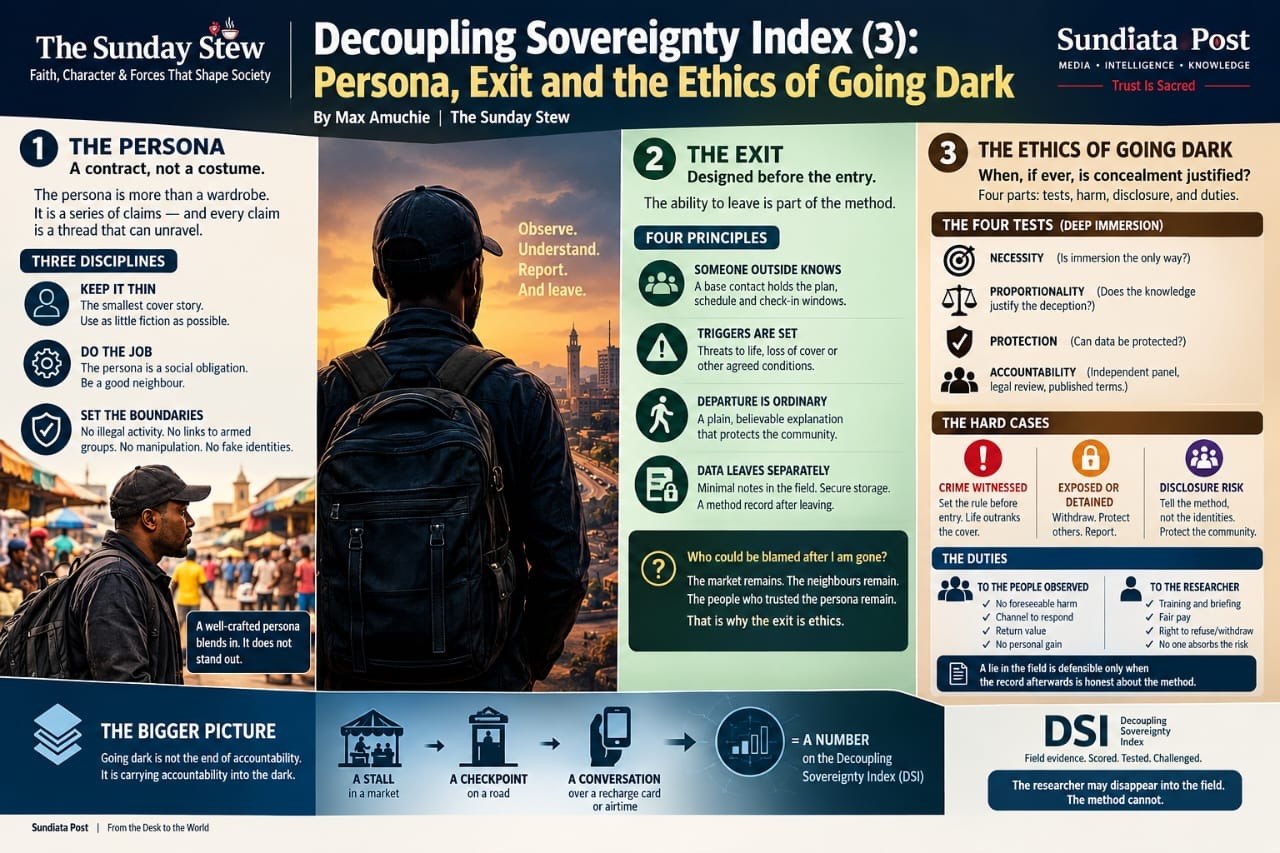
In the latest instalment of his Decoupling Sovereignty Index series, Max Amuchie examines the ethical obligations that arise when researchers adopt temporary identities to study decoupled zones.
Writing in The Sunday Stew, the Sundiata Post CEO and theorist argues that any methodology requiring a researcher to live under a borrowed role creates three unavoidable duties: the role must be disciplined, the researcher must be able to leave, and the deception must be ethically justified.
Amuchie treats the persona as a contract rather than a costume. He advises keeping the cover story thin, performing the assumed job properly, and setting clear boundaries before entering the field. These boundaries include never participating in illegal activity, never passing information to armed groups, never manipulating relationships solely to extract information, and never assuming the identity of a real person.
He stresses that the exit must be designed before entry. At the Sundiata Post Knowledge Lab, no researcher enters a zone until the exit plan is written down. This includes external check-ins, pre-agreed triggers for withdrawal, an ordinary departure story, and separating data from the person so that the community is not exposed after the researcher leaves.
On the ethics of “going dark,” Amuchie applies four tests: necessity, proportionality, protection and accountability. Immersion is justified only when remote or rapid methods cannot answer the research question.
The knowledge gained must outweigh the deception, and no observed person should face foreseeable harm. An independent panel must review and can veto any covert plan.
He addresses three hard cases: what to do if the researcher witnesses a crime, what happens if the persona is exposed, and how to disclose the method without endangering people. Life outranks the cover. Where imminent danger exists, the researcher must warn or withdraw even if it ends the assignment.
Amuchie insists that the duty runs both ways. The people observed must not pay a price for the findings, and the researcher must be trained, fairly paid and free to refuse or withdraw without penalty.
The column concludes that a lie in the field is defensible only when the later account is fully honest about the method. The people may be protected; the method may not.
Part 4 of the series will examine how field evidence is translated into scores on the Decoupling Sovereignty Index.


By Seun Oloketuyi
The omission of Ladi Adebutu and his running mate, Yemi Sowunmi-Kolapo, from the Independent National Electoral Commission’s (INEC) list for the 2027 Ogun State governorship election may have raised concerns within the Peoples Democratic Party (PDP), but there are reasons the party remains confident that its candidate can still make the list.
At the centre of the dispute is Adebutu’s membership registration. His camp maintains that he completed the PDP’s digital registration, had his membership card printed and verified, and fulfilled the necessary requirements within the stipulated period. The Ogun PDP has also insisted that his name was included in the membership register submitted to INEC.
If the party can back these claims with verifiable records, it will have a strong basis to challenge the omission and ask the commission to reconsider its decision.
Another point in Adebutu’s favour is that INEC officials monitored the PDP governorship primary held on September 27, 2026, where he emerged as the party’s candidate. While monitoring the primary does not automatically settle the separate membership register issue, it forms part of the process that produced the PDP ticket.
INEC has explained that the omission of affected candidates is linked to compliance with membership register requirements under the Electoral Act 2026. The Supreme Court upheld the relevant provisions in its September 24 judgment. The law must be respected, but the facts surrounding each disputed case must also be properly examined.
The PDP has an opportunity to notify INEC of the omission and present supporting documents before the October 24, 2026 deadline. This gives the party a chance to demonstrate that it complied with the requirements and that Adebutu’s exclusion should be reviewed.
For Adebutu, the key is proving that his registration and the party’s submission of its membership register met the law. If the documents support the PDP’s position, INEC would have grounds to reconsider the omission in accordance with the law.
The issue also matters to Ogun voters, who deserve a fair opportunity to choose among candidates who meet the electoral requirements. Adebutu’s supporters believe he should have the opportunity to contest if he has fulfilled the conditions set by law.
Ultimately, political reactions will not decide this matter; the evidence will. The PDP must present its records, and INEC must assess them fairly.
Adebutu’s return to the list is not yet confirmed, but the case is far from over. If the PDP can prove that the requirements were met and his omission was unjustified, there is a strong basis for his name to be restored to INEC’s list.
Seun oloketuyi Author of How to Win Elections in Nigeria writes from Lagos.


On the 2nd of October, 2026, an XEJet aircraft lifted off from Abuja and touched down at Gusau International Airport. For the people of Zamfara, that moment had been thirty years in the making.
Also read: Governor Dauda Lawal Announces Nationwide Nutrition Emergency, National Intervention Fund at Addis Ababa Summit
This was no ordinary commercial flight launch; for a northwestern state that had never had an airport since its creation in 1996, it was long overdue.
While many still lazily define Zamfara as a den of kidnappers, Governor Dauda Lawal has spent most of three years pouring concrete into a runway that tells a different story.
Before Gusau International Airport existed, anyone in Zamfara needing to fly had to endure hours on the road to Sokoto or Kano.
For Muslims embarking on the Hajj pilgrimage to Saudi Arabia, that overland journey was itself an ordeal.
For a state blessed with agricultural riches and mineral potential, the absence of an air corridor meant investors looked elsewhere, farm produce could not efficiently reach external markets and the movement of talent was shackled by sheer distance.
This isolation was not natural. It was the product of decades of governance failure.
A previous administration had announced the airport’s construction in 2019, claiming a $1 billion public-private partnership would deliver it.
By the time Lawal took office in May 2023, what remained was a graveyard of unfinished concrete and a financial record clouded in opacity.
Governor Lawal inherited not just an abandoned project but a treasury hollowed out by years of mismanagement and lack of foresight.
In June 2024, construction restarted and by March 2026, a Federal Government Bombardier Challenger 605 completed a historic test flight at Gusau International Airport, confirming that the runway, navigation aids and ground handling systems met airworthiness standards which was met with commendation from the aviation industry players.
It was a timeline compressed to its limits. In Nigeria, a state-level airport project typically takes years, sometimes over a decade, from conception to operation.
Lawal’s team did it in under two years of hard work. More significant is the technical validation.
Official records show Gusau International Airport became the only airport in Nigeria to pass all 17 International Civil Aviation Organisation quality assurance steps.
That detail may escape the average traveller but it means this is not a vanity project dressed up for ribbon-cutting photographs. It is infrastructure built to international specifications.
On the 15th of May, 2026, the first Hajj flight departed from Gusau, carrying 415 pilgrims on a Max Air aircraft directly to Saudi Arabia.
At the inaugural ceremony, Lawal said many people doubted whether this could become a reality.
That sentence captured the story of a state that had been underestimated for far too long, finally proving its doubters wrong.
Critics asked, does a state with stubbornly high poverty rates really need an international airport?
That question ignores the most basic causal relationship between infrastructure and economic development. Zamfara’s agricultural potential has been strangled by transport bottlenecks for decades.
The state produces hibiscus, sesame seeds, groundnut seeds, cotton seeds, Sorghum (Guinea Corn) & Millet precisely the commodities in high demand in international markets.
But without air cargo links and efficient logistics, farmers sell raw materials cheaply to middlemen while the bulk of the profit flows elsewhere.
Lawal with an investment banker background understands that what he is building is not just an airport but an ecosystem.
On the 21st of September, 2026, the Zamfara State Government signed an air route development agreement with XEJet, establishing regular commercial flights between Gusau and Abuja, operating Bi-weekly.
On the 2nd of October, 2026, two days after commercial flights began, he flagged off a 95-kilometre road project in Tsafe Local Government Area.
The road, connecting farming communities like Yandoton Daji, Cediya and Doka, includes five bridges. Its purpose is unambiguous; let farm produce out, let security forces in.
“When roads connecting farmlands are motorable, the heavy machinery we procured can reach the fields,” Lawal said at the groundbreaking. “After harvest, agricultural produce can move smoothly to markets.” Governor Lawal Said.
This is not an isolated project; it’s a coherent chain, the airport opens external gateways, the roads open internal circulation and together they transform the deadlock of “farmers can grow but cannot sell” into a living economy where produce moves, markets expand and money stays in local pockets.
On the surface, this is a simple route. Symbolically, it is a rupture. It means Gusau is no longer a dot on the map that requires a gruelling journey to reach. It is a destination accessible from the capital in about an hour.
For investors, the decision cost of travelling to Gusau drops from a full day on the road to a short 40-minute flight from Abuja.
For civil servants, traders, students and patients, this route redraws the boundaries of what is possible in daily life.
The airport terminal offers free internet access. Lawal’s team clearly intends for Gusau to be connected not only physically to the national grid of transportation but digitally to the networks of the knowledge economy.
In a state seeking to nurture IT talent and attract tech-enabled businesses, connectivity is not a luxury; it is the foundation.
What the airport represents is a shift in trajectory a proof that Zamfara can conceive, execute and complete a project of national significance within a single political term.
In years to come, when Zamfara farmers are exporting hibiscus, sesame and other agricultural produce directly to buyers in Europe and the Middle East, when investors are flying in for meetings rather than avoiding the state altogether, when a young person from Gusau can board a flight to Abuja for a job interview and return the same day, the true value of this airport will become apparent.
Starting and finishing a project of that magnitude in under three years is the mark of a government serious about development at every level.
Governor Lawal deserves the accolades. More importantly, the people of Zamfara deserve the future this runway has opened for them.
Also read: Governor Dauda Lawal Announces Nationwide Nutrition Emergency, National Intervention Fund at Addis Ababa Summit
The rescue mission is not complete; the planes are flying, for a state that spent three decades grounded, this development is nothing short of a revolution.
-
Politics3 years ago
13 Ondo Assembly Members Disown Endorsement of Aiyedatiwa
-
Politics3 years ago
APC Group, Ondo Govt, Quarrel Over Money for Endorsement
-

 Trending News5 years ago
Stop unsavoury, inciting statements – DSS warns
-

 Others5 years ago
Adron Homes Celebrates 10 Years Of Housing Excellence
-

 Humanity5 years ago
President Buhari Commiserates With Ambassador Maureen Tamuno Over The Loss Of Her Father
-

 Others7 years ago
EX- CUSTOMS BOSS, IBRAHIM MERA’S DWINDLING FAME
-

 Business2 years ago
Bigi Carbonated Soft Drinks Treats 40 Consumers to an Epic Easter Movie Hangout
-

 Business2 years ago
Wema Bank Shines at Global SME Finance Forum Conference Awards 2024 …Awarded: • SME Financier of the Year (Africa) • Platinum Award for Best Financier for Women Entrepreneurs (Africa)