
Business
Nigeria Signs Strategic CEPA with UAE to Boost Trade


Nigeria signs a historic CEPA with UAE to deepen trade, investment, and renewable energy cooperation, opening new opportunities for businesses

Nigeria on Tuesday, January 13, 2026, signed a Comprehensive Economic Partnership Agreement (CEPA) with the United Arab Emirates on the sidelines of the Abu Dhabi Sustainability Week.
Also read: Nigerian Caregiver Arrested in Toronto for Assaulting Vulnerable Adults
President Bola Ahmed Tinubu, who announced the agreement, said it was designed to deepen bilateral cooperation in renewable energy, infrastructure, logistics, aviation, and digital trade.
The signing ceremony was attended by President Tinubu; UAE President Mohamed bin Zayed Al Nahyan; Nigeria’s Minister of Industry, Trade and Investment, Dr. Jumoke Oduwole; and UAE Minister of Foreign Trade, Dr. Thani bin Ahmed Al Zeyoudi.
Describing the CEPA as “historic and strategic,” Tinubu said it would create enduring opportunities for people and businesses in both countries while supporting climate-smart infrastructure and sustainable industrial growth.
He also disclosed that Nigeria would co-host Investopia with the UAE in Lagos in February 2026, a global investment forum aimed at accelerating sustainable financing inflows.
President Tinubu outlined Nigeria’s plan to mobilise up to $30 billion annually in climate and green industrial finance, backed by the National Carbon Market Activation Policy and the National Carbon Registry.
He highlighted ongoing energy reforms, including the Electricity Act 2023, and initiatives such as a $500 million distributed renewable energy fund and a $750 million World Bank programme to expand clean electricity access to 17.5 million Nigerians.
Dr. Jumoke Oduwole explained that CEPA would eliminate tariffs on more than 7,000 Nigerian products entering the UAE, including fish, oil seeds, cotton, pharmaceuticals, and chemicals, with further industrial goods phased over three to five years.
The agreement also facilitates Nigerian business operations in the UAE, allowing corporate entities, managers, and executives to relocate for renewable three-year periods.
Oduwole emphasised that CEPA would attract foreign investment, support industrialisation, strengthen transport and logistics, and create quality jobs for Nigeria’s youthful population.
She stressed that swift implementation would be facilitated by key federal agencies including the Nigerian Export Promotion Council, Nigerian Investment Promotion Commission, Nigeria Customs Service, and Standards Organisation of Nigeria.
Also read: Nigeria’s Passport Improves to 89th Globally, Visa-Free Access to 44 Countries
Tinubu reaffirmed Nigeria’s target of net-zero emissions by 2060 while pursuing industrial growth and universal energy access, describing the agreement as a “fundamental step in securing shared prosperity for Nigeria, Africa, and the world.”




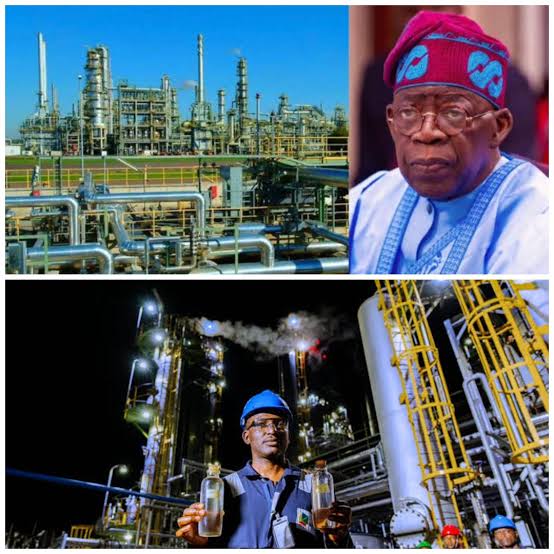
President Bola Tinubu has reaffirmed the Federal Government’s commitment to rehabilitating and repositioning Nigeria’s dormant national refineries, declaring that the facilities will not be allowed to become stranded assets.
Tinubu was represented by the Permanent Secretary of the Ministry of Petroleum Resources, Mrs Patience Oyekunle, at the 20th OTL Africa Downstream Energy Week in Lagos on Monday.
The President said the government is adopting a more rigorous and commercially sustainable approach to the rehabilitation of the Port Harcourt, Warri and Kaduna refineries.
“At the same time, the government remains committed to ensuring that existing national refining assets are not allowed to become stranded investments,” the statement said.
“We are pursuing a more rigorous, commercially sustainable approach to the rehabilitation and repositioning of our refineries, supported by technical assessment, stronger partnerships, and improved operational discipline.”
The objective, according to the administration, is for Nigeria to refine more of its crude oil, create greater domestic value and become a reliable supplier of energy to Africa.
The national refineries, managed by the Nigerian National Petroleum Company Limited (NNPC), have remained largely inactive for years despite significant spending on turnaround maintenance. The NNPC has signed a memorandum of understanding with Chinese firms as part of ongoing efforts to revive the facilities.
Tinubu also noted the contribution of private refining capacity, particularly the Dangote Refinery, which has reached its 650,000 barrels-per-day nameplate capacity, in strengthening Nigeria’s prospects of becoming a net exporter of refined petroleum products.
-
Politics3 years ago
13 Ondo Assembly Members Disown Endorsement of Aiyedatiwa
-
Politics3 years ago
APC Group, Ondo Govt, Quarrel Over Money for Endorsement
-

 Trending News5 years ago
Stop unsavoury, inciting statements – DSS warns
-

 Others5 years ago
Adron Homes Celebrates 10 Years Of Housing Excellence
-

 Humanity5 years ago
President Buhari Commiserates With Ambassador Maureen Tamuno Over The Loss Of Her Father
-

 Others7 years ago
EX- CUSTOMS BOSS, IBRAHIM MERA’S DWINDLING FAME
-

 Business3 years ago
Bigi Carbonated Soft Drinks Treats 40 Consumers to an Epic Easter Movie Hangout
-

 Business2 years ago
Wema Bank Shines at Global SME Finance Forum Conference Awards 2024 …Awarded: • SME Financier of the Year (Africa) • Platinum Award for Best Financier for Women Entrepreneurs (Africa)