
Business
Nigeria’s Debt, Salaries Exceed Revenue Amid Capital Cuts


Nigeria’s 2025 budget shows debt and personnel costs surpass revenue, forcing major cuts to capital projects and highlighting fiscal vulnerability

Debt service and personnel costs have exceeded the Federal Government’s total revenue for the first seven months of 2025, the Budget Office of the Federation revealed on Wednesday, underscoring the strain on the nation’s finances.
Also read: Four Lawmakers Defect to APC Amid Party Crisis
The 2026–2028 Medium-Term Expenditure Framework and Fiscal Strategy Paper showed that between January and July, the government earned N13.67tn against a pro rata target of N23.85tn, leaving a shortfall of N10.19tn, or roughly 43 per cent.
The shortfall was largely due to a sharp drop in oil receipts, which fell 62.2 per cent below target, while dividends from state-linked entities also underperformed.
Despite modest gains from company income tax and Value Added Tax, the fiscal gap forced the government to overspend on debt service, which rose to N9.81tn, consuming 71.8 per cent of total revenue.
Combined with personnel costs of N4.51tn, recurrent spending alone accounted for roughly 105 per cent of revenue, leaving little room for capital investments.
Capital expenditure bore the brunt of the squeeze. Aggregate spending on projects from January to July was N3.60tn, only 26.3 per cent of the prorated N13.67tn budget.
Ministries, departments, and agencies received less than 10 per cent of their planned allocations, while donor-funded and project-tied loans fared relatively better.
The Budget Office linked the weak capital performance partly to the extended implementation of the 2024 budget, which is still financing ongoing projects.
The government has now directed that 70 per cent of the 2025 capital budget be carried over into 2026 to prioritise the completion of existing projects and manage spending pressures amid weak revenue inflows.
Economists expressed mixed views. Professor Sheriffdeen Tella of Olabisi Onabanjo University criticised the preparation of the 2026 budget when the 2025 budget had barely begun implementation, calling it premature.
Conversely, Dr Muda Yusuf of the Centre for the Promotion of Private Enterprise supported the rollover, saying it restores credibility and prevents continuous overlapping of budgets.
The MTEF document also revealed that non-debt recurrent expenditure fell 26 per cent below target, pensions were underfunded by half, and overheads for ministries were sharply reduced, while debt service overshot projections by 17.5 per cent.
The analysis highlights Nigeria’s fiscal vulnerability, particularly the economy’s reliance on oil revenue, even as non-oil revenues gradually increase their contribution to the Federation Account.
Also read: Four Lawmakers Defect to APC Amid Party Crisis
The report warns that without structural fiscal reforms, capital projects critical to health, education, infrastructure, and social safety nets will continue to face deep constraints.


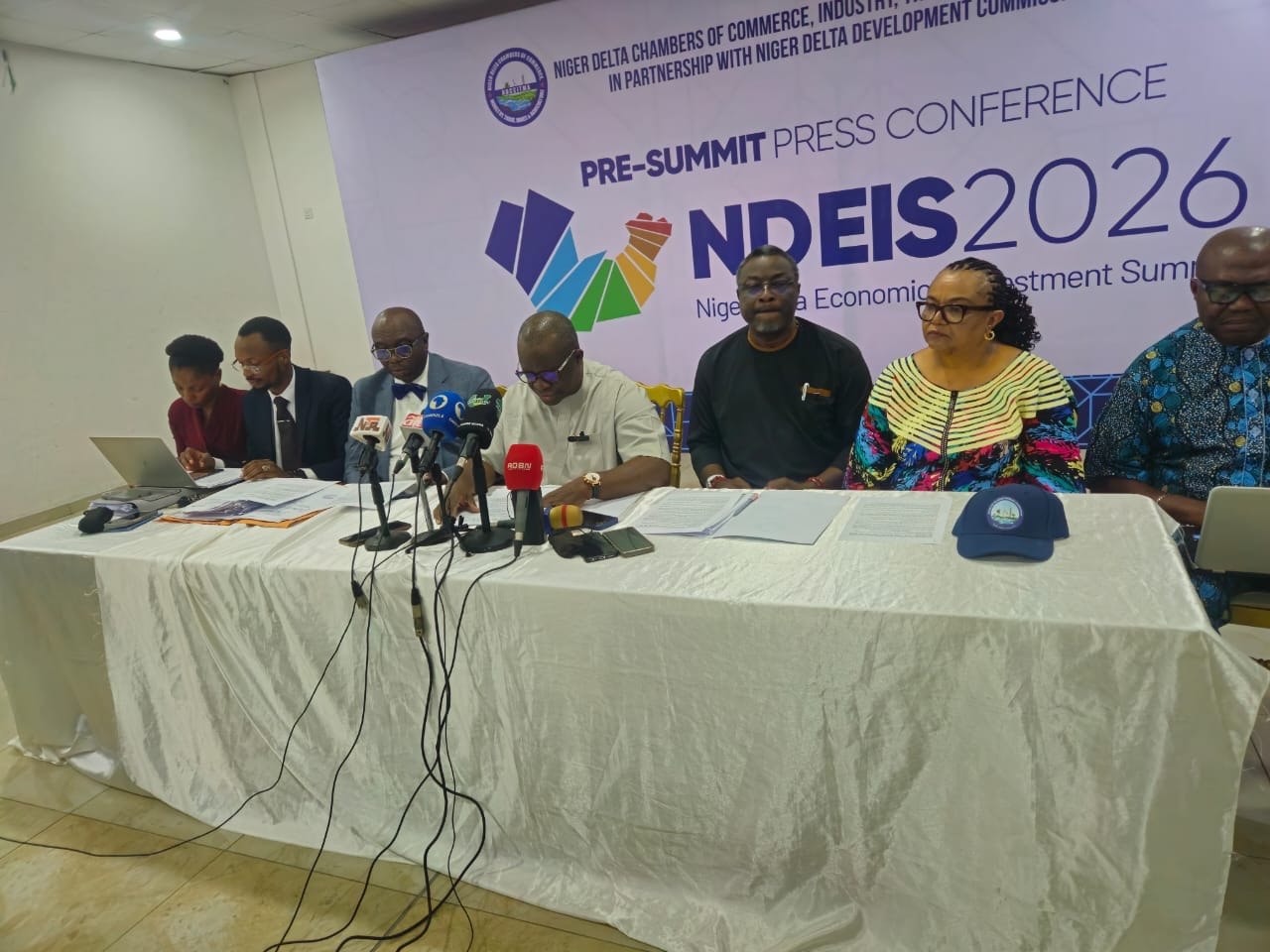
The Niger Delta Chamber of Commerce, Industry, Trade, Mines and Agriculture (NDCCITMA) has dismissed allegations that it appropriated the Niger Delta Economic & Investment Summit (NDEIS) brand, insisting it lawfully obtained trademark acceptance for the name and will proceed with its 2026 summit as scheduled.
In a statement issued on September 12, 2026, the chamber described claims by Kunle Nwiwa Junior as “cheap blackmail, misleading, mischievous and a misrepresentation of the facts,” maintaining that it independently developed the summit and followed all required regulatory procedures.
According to NDCCITMA, it applied for and received a Trademark Acceptance Letter for the name Niger Delta Economic & Investment Summit (NDEIS) in August 2025 under File No. NG/TM/O/2025/387284.
The chamber said the chronology of events contradicts allegations that it copied another party’s application, arguing that its trademark acceptance predated the period during which Nwiwa’s own application was reportedly still pending before the relevant authorities.
“Economic Summit” is a generic expression
NDCCITMA further argued that the phrase “Economic Summit” is a generic description widely used for conferences that bring together governments, investors, businesses, development institutions and other stakeholders to discuss investment and economic development.
The chamber maintained that while concepts may be widely used, legal protection only arises from recognised intellectual property rights, including duly registered trademarks and other enforceable proprietary interests.
It therefore rejected suggestions that any individual or organisation has exclusive ownership of the broader concept of an economic summit.
Court grants interim injunction
Addressing reports that the summit had been halted, NDCCITMA said the dispute is already before the Federal High Court in Port Harcourt and that there is no court order restraining the event.
The chamber disclosed that in Suit No. FHC/PHC/CS/57/2026, Justice Stephen Dalyop Pam granted an interim injunction restraining the defendants—Kunle Nwiwa Junior and Keneva Consult Ltd.—from interfering with the planned summit.
According to NDCCITMA, the court also directed the defendants to remove publications, notices, petitions, social media posts and other statements allegedly considered damaging to the chamber’s name, integrity and reputation pending the hearing of its motion for interlocutory injunction.
The matter has been adjourned until September 22, 2026 for further hearing.
Chamber rejects ₦500 million demand claim
NDCCITMA also alleged that it had received a demand from Nwiwa Junior requesting ₦500 million as a condition for abandoning his claims over the summit.
The chamber said the demand was rejected, adding that it subsequently petitioned the Inspector-General of Police over what it described as repeated harassment and threats directed at its officials.
It said the petition sought police intervention, including inviting the complainant for questioning and caution where necessary.
Summit opens September 15
Despite the legal dispute, NDCCITMA reaffirmed that the 2026 Niger Delta Economic & Investment Summit will hold from September 15 to 17, 2026, at the Obi Wali Conference Centre in Port Harcourt, Rivers State.
The summit will be held under the theme “Driving Investment, Innovation & Industrial Growth in the Niger Delta” and is expected to bring together policymakers, investors, business leaders, development partners and industry stakeholders to discuss economic transformation across the region.
The chamber said it remains committed to promoting commerce, industry, trade, mining, agriculture and sustainable economic development throughout the Niger Delta while allowing the courts to determine all outstanding legal issues.


Tinubu Niger Delta summit opens in Port Harcourt as investors and policymakers gather to drive investment, innovation and industrial growth
-
Politics3 years ago
13 Ondo Assembly Members Disown Endorsement of Aiyedatiwa
-
Politics3 years ago
APC Group, Ondo Govt, Quarrel Over Money for Endorsement
-

 Trending News5 years ago
Stop unsavoury, inciting statements – DSS warns
-

 Others5 years ago
Adron Homes Celebrates 10 Years Of Housing Excellence
-

 Humanity5 years ago
President Buhari Commiserates With Ambassador Maureen Tamuno Over The Loss Of Her Father
-

 Others7 years ago
EX- CUSTOMS BOSS, IBRAHIM MERA’S DWINDLING FAME
-

 Business2 years ago
Bigi Carbonated Soft Drinks Treats 40 Consumers to an Epic Easter Movie Hangout
-

 Business2 years ago
Wema Bank Shines at Global SME Finance Forum Conference Awards 2024 …Awarded: • SME Financier of the Year (Africa) • Platinum Award for Best Financier for Women Entrepreneurs (Africa)