
Uncategorized
Human Rights Group Petition Police Over Harassment, Abduction Of Journalist

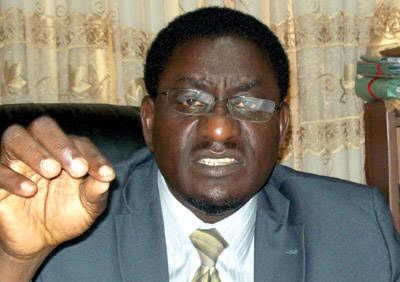
Committee for the Defence of Human Rights (CDHR) has furiously condemned and berated the reckless, unlawful, and provocative intimidation, harassment and threat of invasion and arrest of Mr. Adumonza Isiahomhen, an Online Journalist, Publisher, and Editor-in-Chief of OpenLife, by Police Officers from the Criminal Investigation Department of Ekiti State Police Command, led by one Ade.

The attempt of forceful invasion into Mr. Idumonza’s Office at Plot 7, Ilapo Estate, opposite AIT Alagbado, Lagos, on Friday 3rd September 2021 by Police Officers from the Ekiti State Command, Ado-Ekiti, following a story originated from an anonymous parent of a student of Afe Babalola University, Ado-Ekiti, titled Afe Babalola University in Rumbles as Parents Complain of Fraud, published on Thursday, August 19, 2021, was a clear manifestation of the violation of the Journalist’s constitutionally guaranteed rights to privacy and freedom of expression and the Press, by the Officers of the Nigeria Police.
It was gathered on Friday, 3rd September 2021 that errant Police Officers, claim to be in possession of a purported petition but refused to inform the Journalist who the Petitioner is and they refused to avail the Journalist with a copy of the petition despite the request by the Journalist.
Apparently, the Officers are determined to get the Journalist arrested this weekend. Thus, without provocation and without justification, they had apparently attempted to invade the Lagos Office of the Online Journalist in search of him for his arrest.
In a statement by its National Publicity Secretary, Comrade (Barr) Henry Ekine, made available to the Press, CDHR described the attempted invasion and unjustified threat of arrest of Comrade Idumonza as not only reckless but insensitive and callous.
Comrade Ekine, on behalf of the President, Comrade (Dr.) Osagie Obayuwana, the National Executive Committee, and members of CDHR expressed the commitment of the Organization to the protection and defense of Human Rights of all persons. Injury to one is an injury to all!
CDHR, therefore, called on the Inspector-General of Police, Mr. Usman Baba Alkali, the Commissioner of Police, Ekiti State Command and the Commissioner of Police, Lagos State Command, to swiftly intervene in this matter and ensure that the Journalist is not unjustly intimidated, harassed or arrested.
The Human Rights Group demanded that the Inspector General of Police must caution Police Officers and Personnel to uphold Citizens’ Rights. This case, just clearly reveals the disturbing level of insensitivity to the rights of citizens; it shows gross intolerance against matters of Human Rights and Civil Rights Activists by some Policemen and other security agents.
Comrade Ekine decried how Human Rights activists have become targets for harassment by some security agents. CDHR expressed worry over the level to which the respect for Human Rights in the country has degenerated and how some Policemen have become the enemies of the citizens; they have become the perpetrators of the violation of the Rights of innocent citizens.
The Police need to be more professional with the objective to promote and protect the rights of all citizens at all times; the right to freedom of expression and the Press remains a fundamental right and must be protected, especially by state agents in all circumstances. The Police must not be willing tools in the hands of people.
The foremost human rights group emphasized that the right to freedom of expression is guaranteed under Chapter IV of the Constitution of the Federal Republic of Nigeria, 1999, as an amendment, as well as under the African Charter on Human and Peoples Rights; the International Covenant on Civil and Political Rights, as well as the Universal Declaration of Human Rights.
If any individual or institution feels offended by a privileged or fair publication such individual is advised to approach the Court in a civil defamation action not to employ state actors to harass and intimidate citizens with threat of arrest. The state has the positive responsibility to ensure the protection of Citizens’ Rights.


Uncategorized
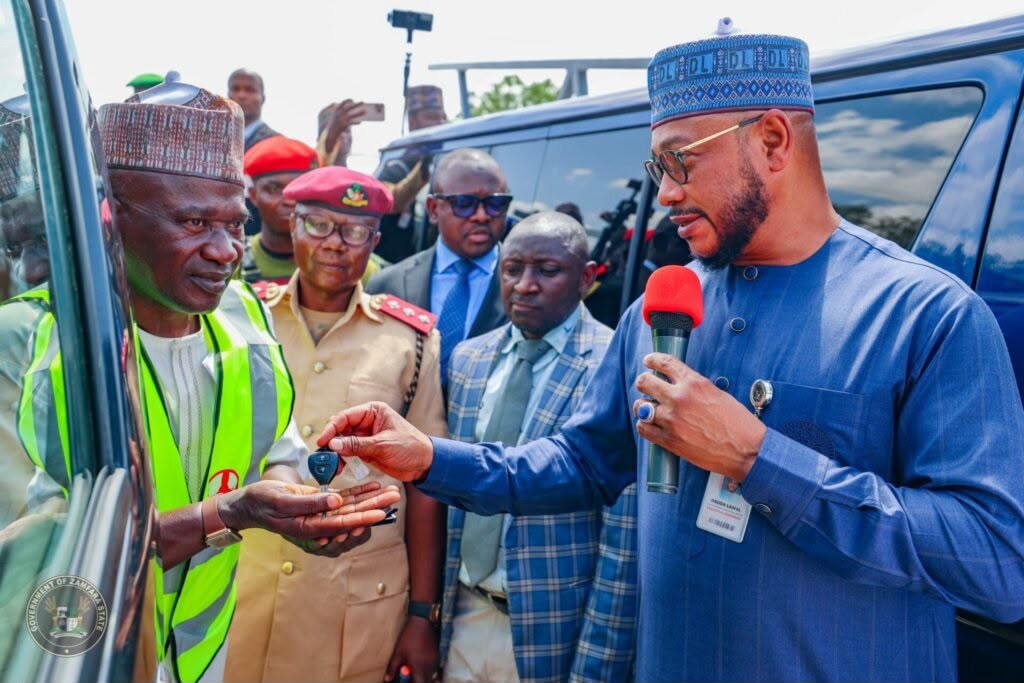
Governor Dauda Lawal Distributes 50 Subsidised Buses, Commissions Fire Trucks for Swift Emergency Response

By Adebayo Adeoye
All is clearly not well within the ranks of the All Progressives Congress in Bauchi State. What should have been a defining moment for party unity and strategic positioning ahead of the 2027 elections has instead deepened mistrust, widened internal divisions and exposed dangerous cracks within the party. For an opposition party still struggling to regain political momentum in one of Nigeria’s most competitive states, the timing could hardly be worse. Rather than serving as a launchpad for renewed ambition, the governorship primary has become a stark reflection of the APC’s internal dysfunction — one that could shape its political fortunes long before voters head to the polls.
The so called Last Friday’s governorship primary, which produced former Governor Mohammed Abubakar as candidate, was expected to rally party faithful around a credible challenger for 2027. Instead, it has triggered widespread controversy and bitter reactions across the party. What ought to have strengthened internal cohesion has, in many quarters, been condemned as deeply flawed, opaque and lacking the transparency required to inspire confidence among party members. Allegations of backroom deals, imposed outcomes and the sidelining of longstanding stakeholders have rapidly evolved from whispers into open accusations the party leadership can no longer ignore. The resulting credibility crisis is not merely reputational; it strikes at the institutional foundations necessary for any serious electoral campaign.
For many observers and loyal party members, the exercise represented more than a routine internal contest. It was a test of the APC’s democratic credentials and its readiness to reposition itself after years of electoral setbacks in Bauchi. The party had a rare opportunity to demonstrate discipline, inclusiveness and a genuine commitment to internal democracy. It had the chance to show voters that it had learned from past mistakes and was prepared to offer a coherent alternative to the ruling Peoples Democratic Party. Instead, the primary has left many supporters frustrated, alienated and uncertain about the party’s direction. What should have united the APC has instead pushed it closer to fragmentation.
Concerns continue to grow over what critics describe as the complete absence of participatory democracy in favour of a forced consensus process. These concerns were reinforced by comments attributed to the endorsed candidate, Mohammed Abubakar, and by the controversial declaration of results announced by retired AIG John Abang, which many party stakeholders insist reflected a predetermined outcome rather than a credible electoral exercise.
The grievances extend far beyond the immediate contestants and their campaign teams. Ward officials, delegates and grassroots mobilisers — the very backbone of electoral politics in Nigeria — feel sidelined and betrayed after investing time, loyalty and resources into a process they believe disregarded their voices. These are the individuals who organise communities, mobilise voters and translate party messaging into electoral support. When such actors lose faith in the process, the consequences are rarely passive. In closely contested political environments like Bauchi, disillusionment at the grassroots can prove decisive.
The broader political context makes the crisis even more consequential. Bauchi has long been a battleground state where power has alternated between the APC and the PDP. Governor Bala Mohammed has significantly consolidated the PDP’s political networks and influence across the state. Against that backdrop, the APC’s most realistic path to electoral competitiveness in 2027 depended on presenting a united front, a credible candidate and a compelling alternative vision. The governorship primary was therefore not just an internal exercise; it was a strategic moment capable of defining the party’s electoral future. Instead, it has handed the ruling party an early political advantage.
More troubling still is the growing fear that unresolved grievances could trigger defections, weaken party cohesion and embolden rival political forces ahead of 2027. Nigerian political history repeatedly shows that opposition parties rarely succeed when consumed by internal divisions and leadership disputes. In many cases, electoral defeats stem less from the popularity of opponents than from unresolved internal crises allowed to fester unchecked. Bauchi itself has witnessed this pattern before, and the APC now risks repeating it.
Indeed, the party faces one of its most consequential internal tests in recent years. Influential figures across the state are reportedly disenchanted with both the outcome of the primary and the manner in which it was conducted. Quiet consultations outside official party structures have already begun — often an early sign of possible realignments. In several local governments, ward executives are said to be demoralised and uncertain about committing themselves to a process they no longer trust. If left unresolved, the fallout could cripple grassroots mobilisation, weaken fundraising efforts and push influential stakeholders toward strategic defections, political abstention or alternative alliances.
For a party serious about reclaiming political relevance in Bauchi, unity cannot remain a slogan recited at press conferences while the conditions necessary for unity are undermined in practice. Reconciliation, dialogue and genuine inclusion must now become urgent priorities. That requires more than symbolic appeals for calm. It demands credible engagement with aggrieved aspirants, delegates and grassroots structures. It requires transparent mechanisms for addressing grievances and accountability for actions that have left the party more divided than before the primary.
The 2027 election is approaching quickly, and time is not on the APC’s side. The window for reconciliation and political recovery remains open, but not indefinitely. The party must now make a clear choice: unity with all its difficult compromises, or division with all its predictable consequences.

His Excellency, the Executive Governor of Zamfara State, Dr. Dauda Lawal, has officially approved the sum of N3.2 billion for the complete renovation, accreditation, and commencementof academic activities at the Zamfara State School of Nursing and Health Sciences, located in Zurmi Local Government Area. This was confirmed in an official statement released marking a major intervention in the state’s ailing healthcare education sector, which has suffered years of neglect and infrastructural decay.
According to government sources, the funds will be channeled into three critical areas: the overhauling of lecture halls, administrative blocks, student hostels, and practical demonstration labs to meet modern standards; the settlement of regulatory fees and implementation of curriculum upgrades required by the Nursing and Midwifery Council of Nigeria (NMCN); and enabling the school to admit its first batch of students in over five years, with a focus on midwifery, community health and general nursing. Speaking on the development, the state Commissioner for Health described the approval as a new chapter in healthcare manpower development, noting that the Zurmi school has remained non-functional for nearly a decade due to poor infrastructure and loss of accreditation.
Governor Dauda Lawal is not just renovating a school but rebuilding the backbone of primary healthcare delivery in Zamfara, adding that without trained nurses and community health workers, the state’s hospitals cannot function and that this N3.2 billion investment will change the narrative.
Residents of Zurmi and prospective students have greeted the news with excitement, with many having lost hope of ever seeing the institution reopen. Governor Dauda Lawal, who has made health sector revitalization a cornerstone of his administration, was quoted as saying that his government remains committed to accessible, quality education and healthcare across all 14 local government areas of the state, adding that no Zurmi child should travel hundreds of kilometers just to become a nurse. The state government has issued a directive to the Ministry of Health and the Ministry of Education to ensure the project is completed within nine months, with accreditation visits scheduled to begin before the end of the current fiscal year.
-
Politics2 years ago
13 Ondo Assembly Members Disown Endorsement of Aiyedatiwa
-
Politics2 years ago
APC Group, Ondo Govt, Quarrel Over Money for Endorsement
-

 Trending News5 years ago
Stop unsavoury, inciting statements – DSS warns
-

 Others5 years ago
Adron Homes Celebrates 10 Years Of Housing Excellence
-

 Humanity5 years ago
President Buhari Commiserates With Ambassador Maureen Tamuno Over The Loss Of Her Father
-

 Others7 years ago
EX- CUSTOMS BOSS, IBRAHIM MERA’S DWINDLING FAME
-

 Business2 years ago
Bigi Carbonated Soft Drinks Treats 40 Consumers to an Epic Easter Movie Hangout
-

 Business2 years ago
Wema Bank Shines at Global SME Finance Forum Conference Awards 2024 …Awarded: • SME Financier of the Year (Africa) • Platinum Award for Best Financier for Women Entrepreneurs (Africa)